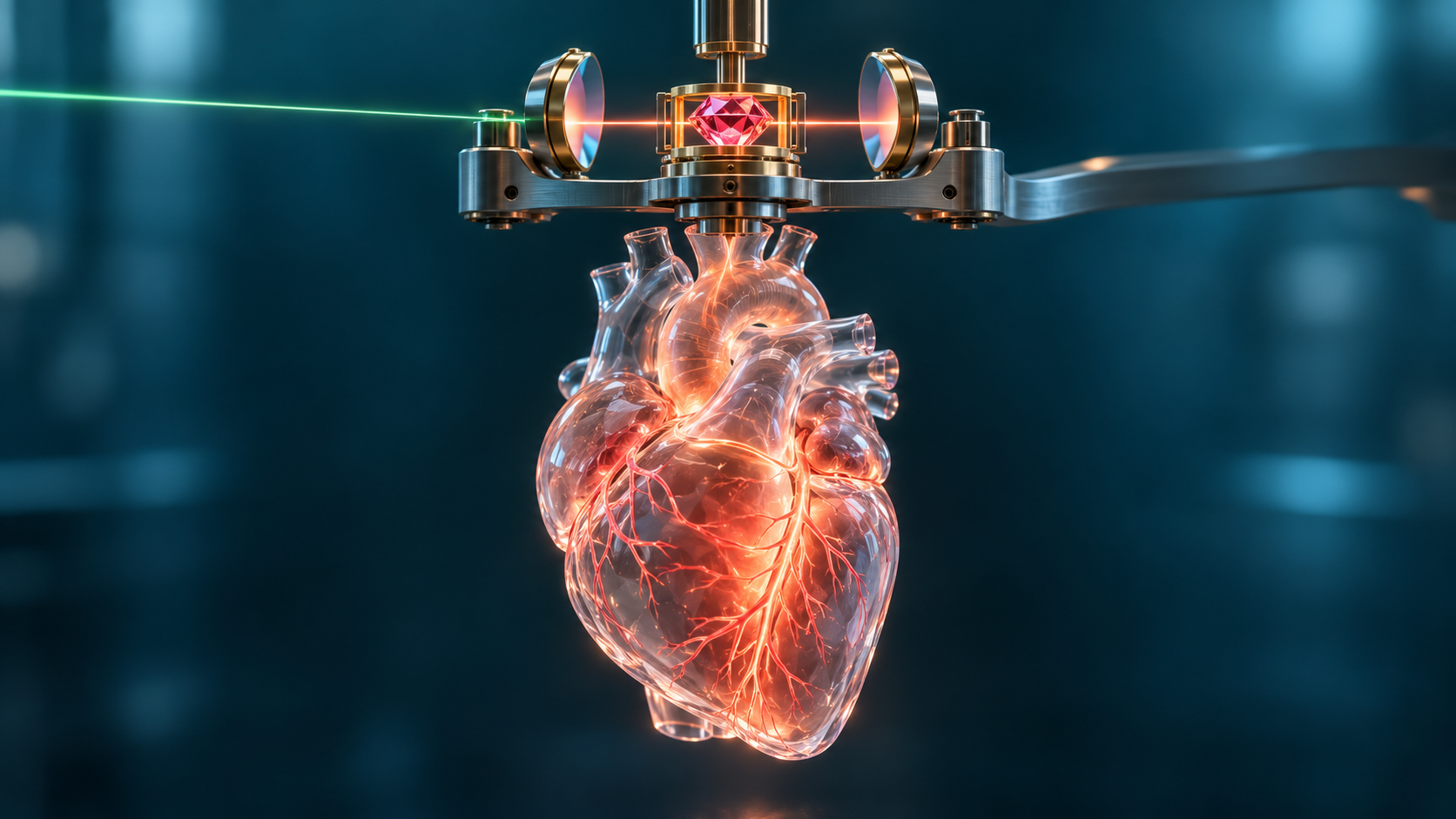
Fraunhofer IAF Puts a Diamond Quantum Sensor Inside a Laser Cavity: 100% Optical Contrast and a Calculated Limit Below 400 fT/√Hz, Nature Communications, 22 October 2026
What a Fraunhofer IAF team in Freiburg reported in Nature Communications on 22 October 2026
Quentir Medicine Monitor
Evidence-based insights for quantum medicine.
The magnetic field of a thinking brain is hundreds of millions of times weaker than the field of the Earth. Measuring it today usually means a liquid-helium machine or a helmet of vapor-cell sensors, and in both cases a room lined with metal shielding to keep the city's magnetic noise out.
A paper published in Nature Communications on 22 October 2026 describes a different route toward that measurement. A team at the Fraunhofer Institute for Applied Solid State Physics IAF in Freiburg, led on the paper by first author Florian Schall and senior author Jan Jeske, placed a small diamond containing nitrogen-vacancy centers inside the cavity of a semiconductor laser. The atomic defects in the diamond respond to magnetic fields, and in this arrangement they decide whether the laser runs at all. The authors report that the magnetic resonance of the diamond can switch the laser completely off, which gives the sensor a full on-off signal where conventional diamond sensors see a change of a few percent in their glow.
The technique is called laser threshold magnetometry. It was first proposed in theory, and the Freiburg group now shows it working on a laboratory bench with real diamonds. The paper, Laser-enhanced quantum sensing boosts sensitivity and dynamic range, was received on 18 August 2026 and accepted on 22 September 2026.
The authors connect the result directly to medicine. They write that the improved performance could enable a new generation of quantum sensors for medical applications and could help measure physiological and neurological signals, and they name magnetoencephalography outside magnetically shielded rooms as one application in view. Magnetoencephalography, or MEG, maps brain activity from the magnetic fields that neurons produce, and hospitals use it today to locate the source of seizures before epilepsy surgery.
The paper is careful about what it has and has not shown. Its headline sensitivity is a calculated limit for the setup, and the authors state plainly that it has not yet been reached in an actual measurement. That distinction shapes everything a clinician or a hospital buyer should take from it.