Fraunhofer IAF Puts a Diamond Quantum Sensor Inside a Laser Cavity: 100% Optical Contrast and a Calculated Limit Below 400 fT/√Hz, Nature Communications, 22 October 2026
Quentir Medicine Monitor
Evidence-based insights for quantum medicine. Published by Quentir Systems LLC · October 23, 2026.
The magnetic field of a thinking brain is hundreds of millions of times weaker than the field of the Earth. Measuring it today usually means a liquid-helium machine or a helmet of vapor-cell sensors, and in both cases a room lined with metal shielding to keep the city's magnetic noise out.
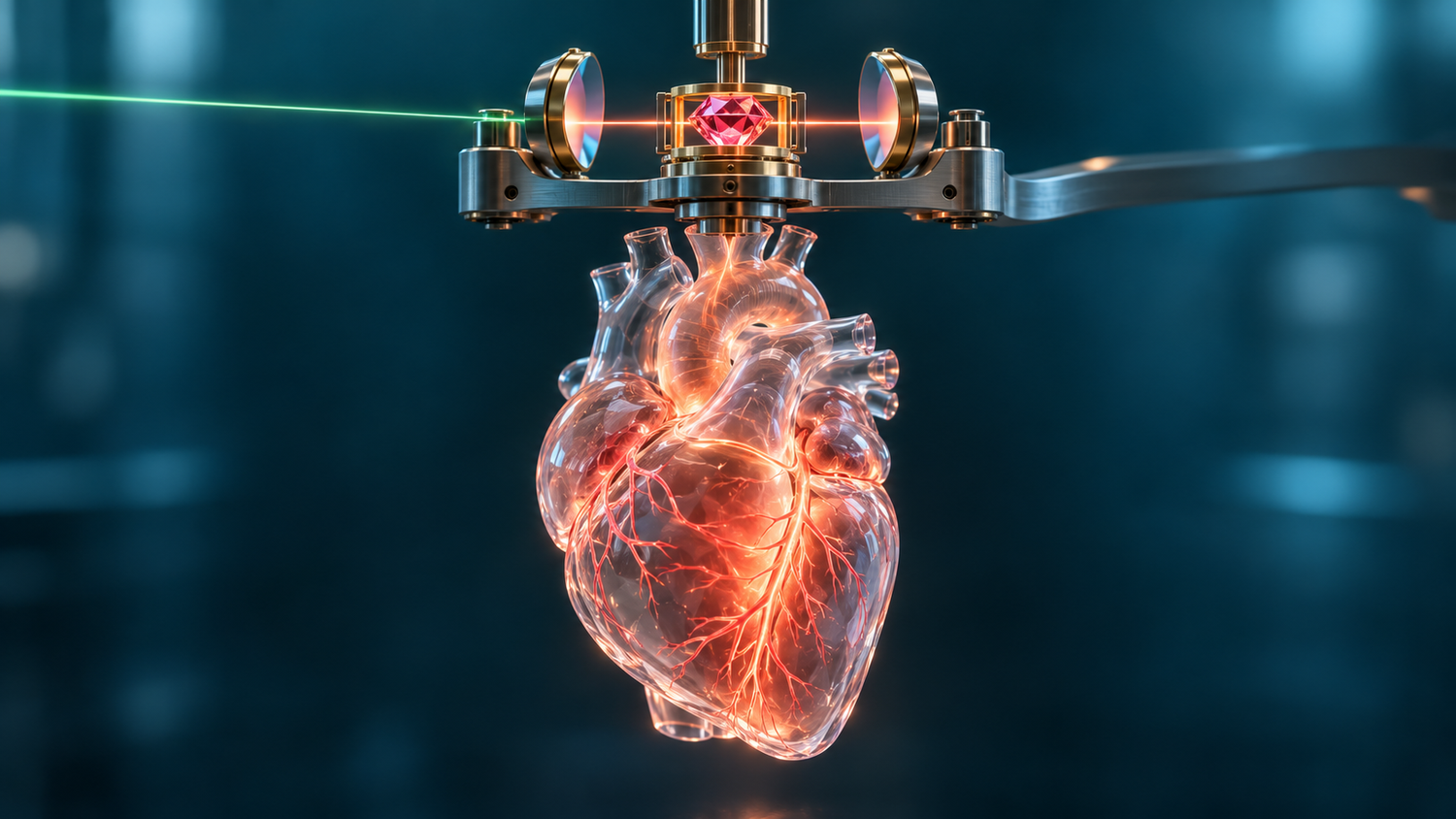
A paper published in Nature Communications on 22 October 2026 describes a different route toward that measurement. A team at the Fraunhofer Institute for Applied Solid State Physics IAF in Freiburg, led on the paper by first author Florian Schall and senior author Jan Jeske, placed a small diamond containing nitrogen-vacancy centers inside the cavity of a semiconductor laser. The atomic defects in the diamond respond to magnetic fields, and in this arrangement they decide whether the laser runs at all. The authors report that the magnetic resonance of the diamond can switch the laser completely off, which gives the sensor a full on-off signal where conventional diamond sensors see a change of a few percent in their glow.
The technique is called laser threshold magnetometry. It was first proposed in theory, and the Freiburg group now shows it working on a laboratory bench with real diamonds. The paper, Laser-enhanced quantum sensing boosts sensitivity and dynamic range, was received on 18 August 2026 and accepted on 22 September 2026.
The authors connect the result directly to medicine. They write that the improved performance could enable a new generation of quantum sensors for medical applications and could help measure physiological and neurological signals, and they name magnetoencephalography outside magnetically shielded rooms as one application in view. Magnetoencephalography, or MEG, maps brain activity from the magnetic fields that neurons produce, and hospitals use it today to locate the source of seizures before epilepsy surgery.
The paper is careful about what it has and has not shown. Its headline sensitivity is a calculated limit for the setup, and the authors state plainly that it has not yet been reached in an actual measurement. That distinction shapes everything a clinician or a hospital buyer should take from it.
What Schall, Jeske and colleagues built in Freiburg: an NV diamond inside a 1042 nm laser cavity
A nitrogen-vacancy center is a defect in the diamond lattice where a nitrogen atom sits next to a missing carbon atom. Its electron spin responds to magnetic fields, works at room temperature and can be read with light. Most diamond magnetometers shine green light on a dense ensemble of these defects and watch how brightly the diamond fluoresces red as a microwave signal is swept across the spin resonance. The difficulty is that the brightness changes only a little. The paper puts the theoretical ceiling for this fluorescence contrast at about 22 percent, and in practice ensembles reach a few percent.
The Freiburg design adds a second medium. A membrane external-cavity surface-emitting laser, a semiconductor gain chip, produces infrared light at 1042 nanometers. The NV-doped diamond sits in the same cavity and absorbs some of that light through one of its internal energy levels. How much it absorbs depends on its spin state, and therefore on the magnetic field. Tuned close to the laser's threshold, a small change in that absorption is enough to stop the laser altogether.
The work was funded by the German Federal Ministry of Research, Technology and Space under grants 13N16485 and 13N16492, with additional support from the Fraunhofer project MagArray. The eleven authors include co-authors from Leipzig University, the German laser-chip company Twenty-One Semiconductors, the College of Staten Island in New York, Japan's National Institutes for Quantum Science and Technology and Tohoku University, and RMIT University in Melbourne.
Which numbers the paper reports: 100 percent contrast, 2 to 50 milliwatts of signal, and a calculated limit below 400 femtotesla
The measured results are the optical ones. The team reports 100 percent optical contrast between the spin states, meaning the laser output drops to zero on resonance, together with collimated output beams between 2 and 50 milliwatts. They also show that this full contrast holds for all four orientations of the NV centers in the crystal, which is what allows the sensor to measure the direction of a field as well as its strength.
From those measurements the authors calculate the photon-shot-noise sensitivity limit, the sensitivity the setup could reach once every source of technical noise is removed. With one diamond the limit is 1160 femtotesla per root hertz, combined with an intrinsic dynamic range of plus or minus 280 microtesla. That range is derived from the width of the magnetic resonance, and the paper notes that the optimal calculated sensitivity applies over a smaller part of it. With a second diamond and adjusted settings, in vector operation, the limit falls below 400 femtotesla per root hertz with a range of plus or minus 40 microtesla. The authors plot published diamond and vapor-cell magnetometers on a chart of sensitivity limit against range and fit a trend line through them. Their combined sensitivity and range improve on the fitted trend by a factor of up to 590, and by 520 on average. The comparison is with the fitted trend, using calculated limits, and it is no measured head-to-head test against each existing sensor.
Quantum pillar: sensing. Technology readiness: TRL 3 of 9. The laser-and-diamond sensor has worked on a laboratory bench as a proof of concept, but its key sensitivity is still a calculation, and it has not yet measured any signal from a human body.
Why a range of plus or minus 280 microtesla matters for brain and heart scans outside a shielded room
Clinical MEG today relies on superconducting sensors cooled with liquid helium or on optically pumped vapor-cell magnetometers. The Nature Communications paper notes that both reach femtotesla sensitivities but usually need cryogenics, heating or magnetically shielded environments. The wearable vapor-cell system that a University of Nottingham team reported in Nature in 2018 let participants move their heads during a scan, and it still ran inside a shielded room with field-cancelling coils. Quentir has followed how that helmet approach is reaching children with epilepsy.
Shielding does two jobs. It keeps the much larger and changing fields of a hospital, from the Earth's field to elevators, imaging equipment and a passing bed, from pushing a sensitive sensor out of its working range. It also strips away the environmental magnetic noise that would otherwise bury a brain signal even in a sensor that is not saturated. A wide dynamic range helps with the first job only. The Freiburg sensor keeps a wide linear range of plus or minus 280 microtesla, which the authors describe as five times the Earth's field, while its calculated sensitivity improves. Most diamond magnetometers trade one for the other. The most sensitive designs narrow the resonance and shrink their linear range to below plus or minus 5 microtesla, according to the paper.
A review in Nature Reviews Physics in 2023 on quantum sensors for biomedical applications describes the same tension across the field. The interest in diamond for medicine comes from its room-temperature operation and its small sensing volume, which the Freiburg authors put at about 100 micrometers on each side. A sensor that keeps both sensitivity and range would remove one obstacle to measuring the head or chest in an ordinary room. Rejecting environmental noise would still require other means, such as reference sensors and gradiometer arrangements, which the authors say a wide range makes easier to build. Quentir's Defense Monitor covered a comparable trade-off in a field-tested rubidium magnetometer from USTC, where tolerance for fast-changing fields was the point of the design.
What still separates the Freiburg bench setup from a clinical magnetometer
The authors are explicit that technical noise in their laser system is typically orders of magnitude above the calculated limit, so the reported sensitivities have not been achieved as actual sensitivities in measurements. They call the setup a proof of concept. To approach the limit they list a highly stable laser, lock-in detection, balanced detection to cancel common noise, thermal stabilization and possibly active cavity stabilization or monolithic integration. The system uses two pump lasers, a green one for the diamond and one for the gain chip, and noise from both has to be removed.
The paper also notes that none of the fifteen techniques used by the most sensitive existing diamond magnetometers, such as pulse sequences, has been applied yet. Adding magnetic flux concentrators could raise sensitivity further, at the cost of range and vector capability. The authors see a clear path to laser threshold vector magnetometers that reach their shot-noise limit, and they ground that view in semiconductor lasers that already operate near this noise level. That path is a research program. The paper reports no measurement of a brain, a heart or a tissue phantom.
What hospital neurology and cardiology buyers can take from the paper in 2026
For a neurology department weighing an MEG investment, nothing in this paper changes the options on the market in 2026. Superconducting MEG systems and wearable vapor-cell systems remain the clinical choices, and both still assume a shielded room. What the paper adds is a credible engineering argument that diamond sensors may one day combine femtotesla-level sensitivity with a range wide enough to stay linear in the fields of an ordinary building. Range alone does not remove the need for shielding. Any claim that a diamond system can drop the shielded room would also have to show that it rejects environmental noise well enough to record a brain signal, and no such demonstration exists in this paper.
The useful signals to watch are concrete. The first is a measured sensitivity, from this group or another, that approaches the calculated limit. The second is a demonstration on a biomagnetic signal, such as a heartbeat recorded by magnetocardiography, whose fields are far stronger than those of the brain and which is a common early test for a new magnetometer. The third is a compact, integrated version of the laser and diamond that could be packaged as a wearable sensor. Until those appear, the Freiburg result is best read as a strong physics advance for quantum sensing in medicine, several steps from a patient.
Sources
Primary source: Florian Schall, Lukas Lindner, Yves Rottstaedt, Marcel Rattunde, Florentin Reiter, Rüdiger Quay, Roman Bek, Alexander M. Zaitsev, Takeshi Ohshima, Andrew D. Greentree and Jan Jeske, Laser-enhanced quantum sensing boosts sensitivity and dynamic range, Nature Communications 17, 10825, 22 October 2026. Also drawn on: Boto and colleagues on wearable MEG in Nature (2018), Aslam and colleagues on biomedical quantum sensors in Nature Reviews Physics (2023), and earlier Quentir coverage.