IIT Bombay Review, 8 October 2026: Where Diamond Quantum Sensors and Fluorescent-Protein Qubits Stand for Medicine, From Living Cells to a Rat's Heartbeat
Quantum sensors for medicine, from diamond to fluorescent proteins
Quentir Medicine Monitor
Evidence-based insights for quantum medicine.
A cardiologist reads the heart through electrodes on the skin, and a neurologist reads the brain through sensors on the scalp. A small research field is trying to place quantum sensors next to the molecules themselves, inside cells and tissue, where they can report temperature, magnetic fields or chemical stress from within.
On 8 October 2026 three engineers at the Indian Institute of Technology Bombay posted a review of where that effort stands. Jyotiprakash Parhi, Ayan Majumder and Kasturi Saha follow quantum sensors for biomedicine from their established form, tiny defects in diamond, to a newer one: the fluorescent-protein qubit, a sensor a living cell can make for itself from its own genetic instructions. Between those two ends sit the nanodiamond probes that have already been placed inside cells to measure heat and the stiffness of the material around them.
The paper, "From Solid-State Spin Defects to Fluorescent Proteins: A Perspective on Quantum Optical Sensing Platforms for Biomedical Applications," is a preprint on arXiv (2610.11644) and has not been peer reviewed. It reports no new experiment. Its value for a hospital research director, a pathologist or a medical-device buyer is the map it draws: which measurements have been shown in cells, which in a living animal, and which problems the authors say still stand between these sensors and clinical use. A summary table sets out, sensor by sensor, the furthest biomedical stage reached, the representative study and the main barrier to translation.
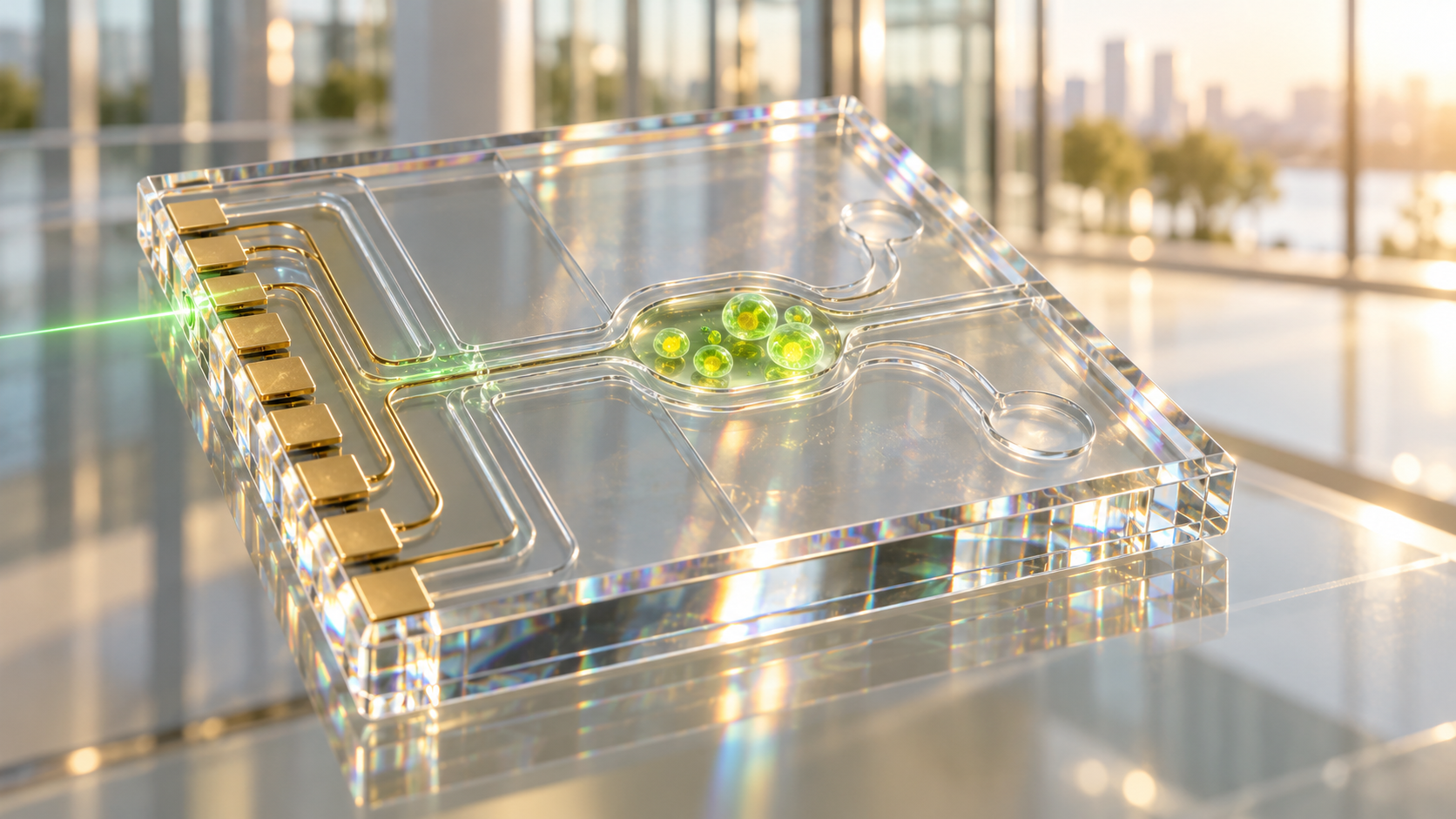
The common thread is a defect or molecule whose electron spin changes how brightly it glows. Shine green or blue light on it, often together with a weak microwave signal, and the glow dims or brightens depending on the magnetic field, the temperature or the chemistry nearby. Because the readout is light, a microscope can collect it from inside a cell without wires.