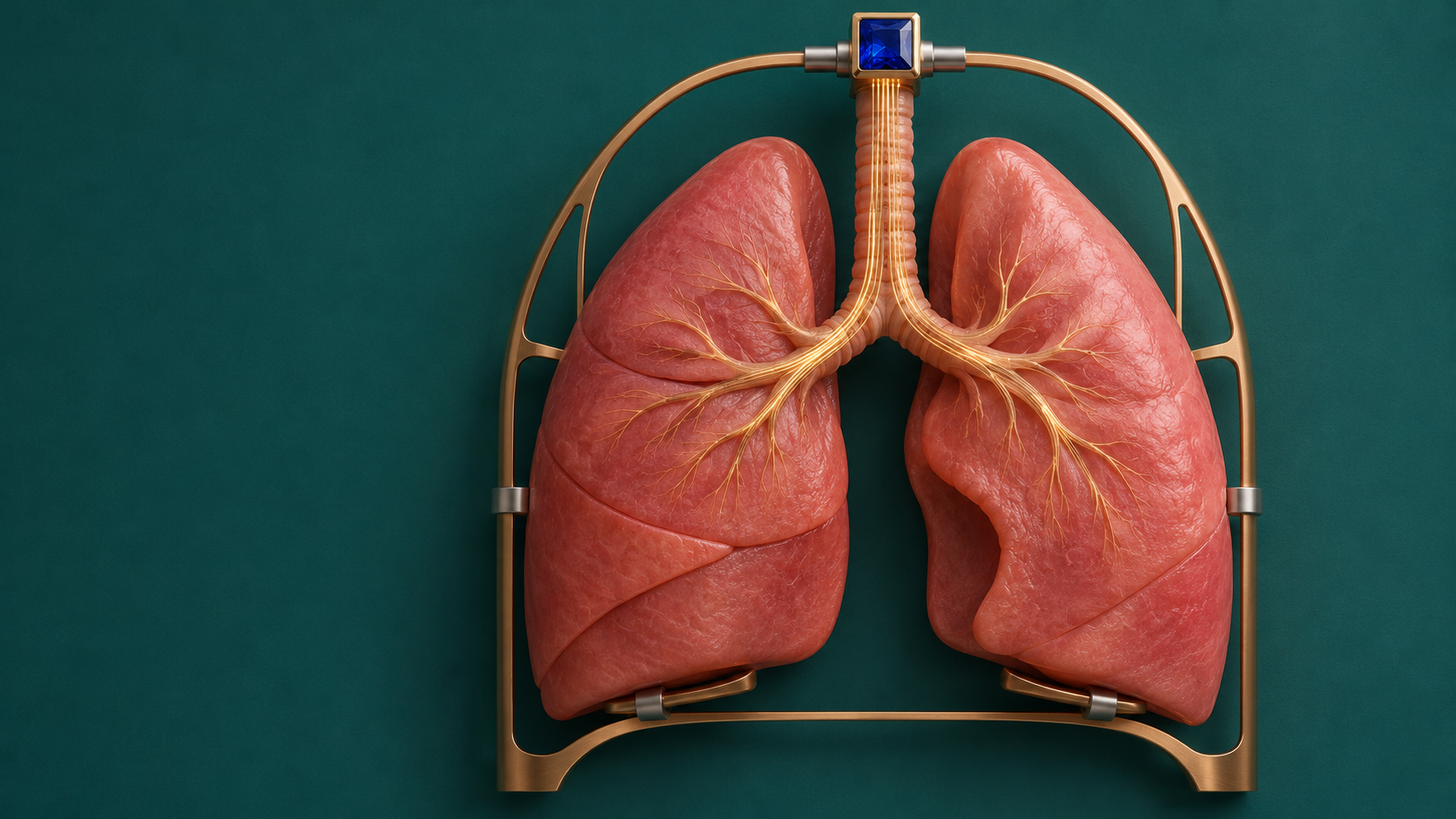
Florida Atlantic Tests a Lung Cancer Quantum Classifier on D-Wave Hardware: 91.90% on an Advantage Processor and 94.31% in Simulation, Discover Quantum Science, 9 September 2026
How Florida Atlantic ran a lung cancer quantum support vector machine on D-Wave hardware
Quentir Medicine Monitor
Evidence-based insights for quantum medicine.
Engineers at Florida Atlantic University have taken their quantum classifiers off the simulator and onto a working quantum computer. In a study that predicts lung cancer from symptoms and risk factors, a quantum support vector machine running on a D-Wave Advantage processor classified 91.90 percent of test cases correctly, against 94.31 percent for the same method in simulation.
The paper, by Muhammad Minoar Hossain, Md. Hasibul Hassan Himal and Arslan Munir, appeared in Discover Quantum Science on 9 September 2026 as article 34 of volume 2. The university announced it on 2 November 2026 in a Florida Atlantic release that calls the findings preliminary. The study asks a narrow question about lung cancer prediction: how quantum learning methods behave when the training set is kept deliberately small.
For a hospital reader, the step worth noting is the hardware. In August Quentir reported that the same group's 90.26 percent heart-disease result came from a simulator. This time the team ran its highest-scoring model on D-Wave annealing hardware, on two D-Wave systems, and reported the hardware numbers next to the simulated ones.
The starting point is a public file, the Lung Cancer Dataset posted on Kaggle by Mysar Ahmad Bhat in 2023. It holds 309 entries with 15 input attributes, such as smoking, yellow fingers, wheezing, coughing and chest pain, and a yes-or-no lung cancer label. It contains no medical images, pathology results, laboratory values or cancer stages. The authors describe their work as "a preliminary screening-support and methodological study rather than a clinical diagnostic system."
The cancer and non-cancer groups in the file were unequal in size, so the team applied SMOTE, a technique introduced by Chawla and colleagues in the Journal of Artificial Intelligence Research in 2002 that creates synthetic examples by interpolating between real neighbors in the smaller class. That brought the file to 540 entries, 270 per class. A feature-selection step written as a QUBO, the binary optimization format that quantum annealers solve, then kept ten inputs: allergy, alcohol consumption, wheezing, swallowing difficulty, coughing, chest pain, peer pressure, yellow fingers, chronic disease and smoking.
The evaluation turns the usual split around. The 540 entries were divided into five partitions of 108. In each of five rounds the models trained on one partition and were tested on the remaining 432. Training on one fifth of the data is deliberate: it imitates the small cohorts that many hospital and rare-disease datasets offer.
The team compared three classifiers: quantum support vector machines, quantum k-nearest neighbors and quantum boosting. Gate-based versions ran through IBM's Qiskit, Google's Cirq and Xanadu's PennyLane, and annealing versions ran through OpenJij and D-Wave's Ocean software. Testing every method under one data preparation and one evaluation protocol is the paper's main methodological contribution, since many quantum machine learning papers test one method on one platform.
The D-Wave quantum support vector machine scored highest, at 94.31 percent in simulation. On hardware it reached 91.90 percent on the system D-Wave calls Advantage_system6 and 90.05 percent on Advantage_system4. The paper describes Advantage_system6 as a sixth-generation Advantage2 processor with the Zephyr topology. D-Wave's own solver documentation lists both systems as Advantage processors with the Pegasus topology and reserves the Advantage2 and Zephyr labels for solvers named Advantage2_system, so this post follows the manufacturer. D-Wave's hybrid solvers landed between 87.04 and 91.89 percent. The gate-based quantum k-nearest neighbors method reached 92.96 percent in Qiskit and 92.99 percent in PennyLane, so the top hardware result sits below two gate-based simulations in the same paper.
The gate-based side ran into a practical limit. When the team tried the Qiskit quantum support vector machine on an IBM quantum computer, the job called for 59,719,680 circuit shots, above IBM's system limit of 10,000,000. The authors cut that hardware test down to 50 samples, 30 for training and 20 for testing. Quantum kernel methods compare every pair of training examples, so their cost grows quickly with the size of the dataset, and that growth is a fair question for any vendor offering such a model.

Which Blood Signal Rewards a Quantum Kernel
A screening gap a blood draw might close
Annual low-dose CT screening lowers lung cancer mortality, and most of the people who qualify for it are not up to date with it. The American Cancer Society reported in June 2024 that 18.1 percent of screening-eligible US adults were up to date in 2022 survey data, which leaves the larger share of a proven survival benefit unclaimed. Blood-based tests are attractive because collection is easier to distribute and to repeat than a CT appointment. The study compares two molecular readouts, drawn from a wider field that also includes mutation panels, circulating proteins and cell-free RNA: cell-free DNA fragmentomics, which reads the length and position of circulating fragments, and methylation, which reads chemical marks at defined genomic targets. Both produce high-dimensional, nonlinear data, and both are degraded by the heterogeneity of lung cancer.
What the Cleveland Clinic and IBM Quantum preprint reports
A team from Cleveland Clinic Research and IBM Quantum posted a preprint on August 19, 2026 asking whether a quantum kernel classifies those signals better than a conventional support vector machine. The methylation cohort covered 813 individuals with 188 cancers across 56 methylation targets; the fragmentomics cohort covered 718 individuals with 172 cancers across 473 genomic regions. Features were encoded with angle and dense-angle feature maps across circuits of 10 to 20 qubits, using three entanglement patterns, and the resulting fidelity kernels fed a precomputed-kernel support vector machine and a kernel-PCA logistic regression.
A split verdict, measured in simulation
On fragmentomics the quantum-kernel models reached held-out AUC values around 81 to 82 percent against a classical baseline near 78 to 79 percent. On methylation the ordering reversed, with the classical model centered around 83 to 84 percent and the quantum models between 80 and 82.5 percent. Widening from 20 to 40 features did not reliably help. Every kernel was computed by exact statevector simulation on ordinary computers, so no quantum processor was involved, and the authors list hardware execution under finite sampling and device noise as future work. Quentir places the work at TRL 3 of 9 on the quantum computing pillar and reads the split, rather than either half of it, as the finding.

The CT Map Moves During Robotic Bronchoscopy
Why the CT map moves
A bronchoscopy route begins as a CT map of the lungs. By the time a clinician advances a scope, the patient is positioned, sedated and ventilated under different conditions. Airways can deform or partially collapse, leaving a small peripheral lesion in different coordinates relative to the planning image. This CT-to-body divergence is the engineering problem behind Johnson & Johnson's MONARCH QUEST 3 software update. The August 17 announcement describes changes to registration and navigation, a three-dimensional compass overlay, wider compatibility with cone-beam CT systems and one-click segmentation of lung nodules.
What the clearance establishes
The FDA public record lists K260382 for the MONARCH Platform, with a substantial-equivalence decision dated July 25, 2026. That places the finished update at TRL 8 of 9 under Quentir's shared readiness ladder: qualified for commercial release, with the final rung reserved for documented operational use of this exact version. The regulatory decision does not establish that the new features improve diagnostic yield or reduce complications. Johnson & Johnson's announcement relies on internal technical reviews for segmentation, registration and scope-tip estimation, without publishing a patient-level performance dataset for QUEST 3.
The clinical question remains open
A 2026 retrospective study of 331 MONARCH procedures provides an independent reference point. Adding mobile cone-beam CT did not significantly change diagnostic yield or complication rates in that single-center comparison, although procedure time fell and radiation exposure increased. The study predates QUEST 3 and cannot answer whether its AI nodule segmentation changes outcomes. It does show why a clear map is only one part of the pathway. Imaging, registration, navigation, tissue sampling and pathology all shape the result a patient ultimately receives. The version-specific outcome record will determine whether this update reduces uncertainty at the point where the scope, the lesion and the biopsy tool finally meet. Quentir reads the launch as a mature medical-device update with a valid market pathway and an unresolved question about incremental clinical benefit.