Quentir Medicine Monitor
Evidence-based insights for quantum medicine. Published by Quentir Systems LLC · November 3, 2026.
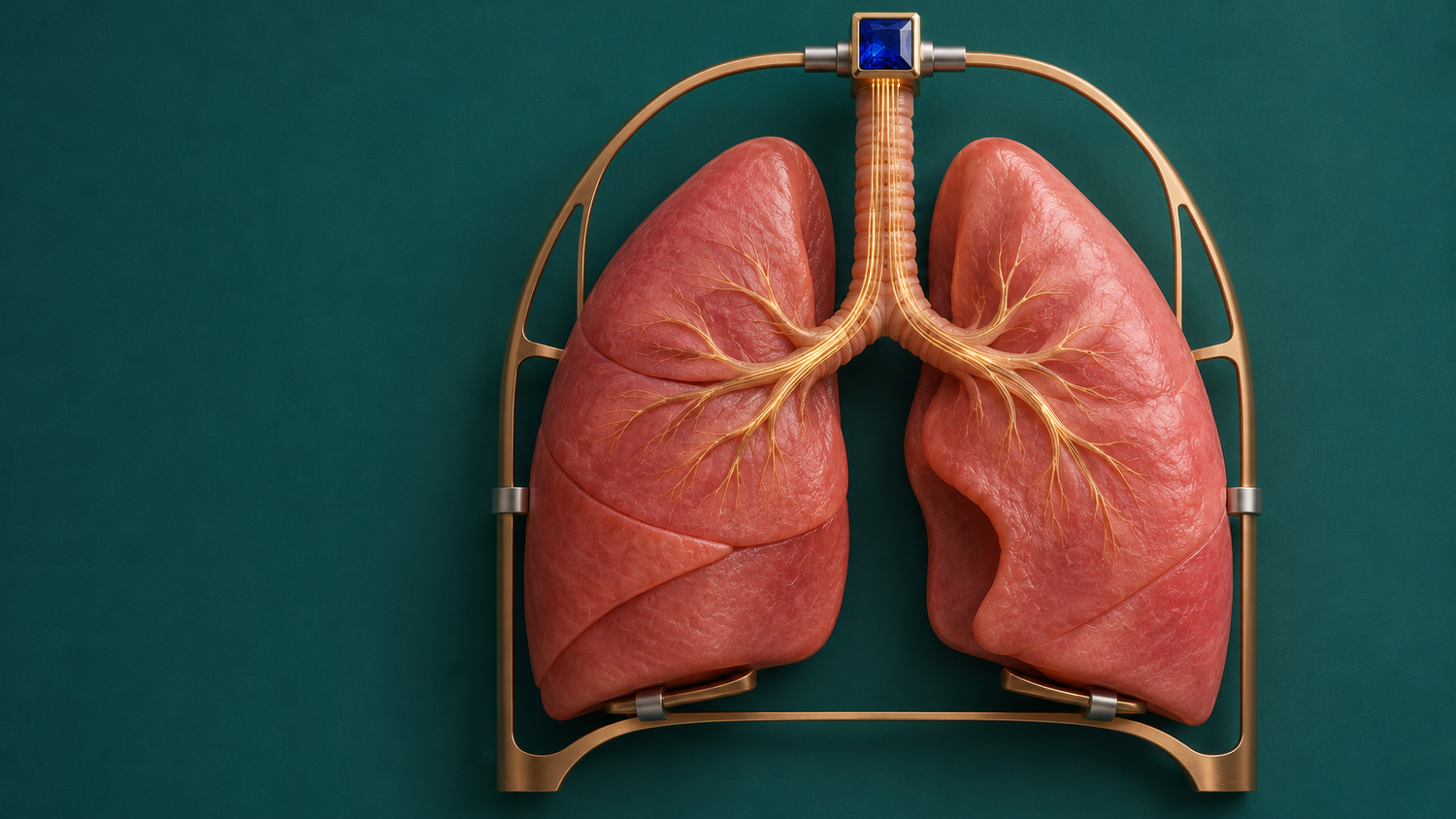
Engineers at Florida Atlantic University have taken their quantum classifiers off the simulator and onto a working quantum computer. In a study that predicts lung cancer from symptoms and risk factors, a quantum support vector machine running on a D-Wave Advantage processor classified 91.90 percent of test cases correctly, against 94.31 percent for the same method in simulation.
The paper, by Muhammad Minoar Hossain, Md. Hasibul Hassan Himal and Arslan Munir, appeared in Discover Quantum Science on 9 September 2026 as article 34 of volume 2. The university announced it on 2 November 2026 in a Florida Atlantic release that calls the findings preliminary. The study asks a narrow question about lung cancer prediction: how quantum learning methods behave when the training set is kept deliberately small.
For a hospital reader, the step worth noting is the hardware. In August Quentir reported that the same group's 90.26 percent heart-disease result came from a simulator. This time the team ran its highest-scoring model on D-Wave annealing hardware, on two D-Wave systems, and reported the hardware numbers next to the simulated ones.
What data the Florida Atlantic team used: 309 Kaggle survey entries expanded to 540 with SMOTE
The starting point is a public file, the Lung Cancer Dataset posted on Kaggle by Mysar Ahmad Bhat in 2023. It holds 309 entries with 15 input attributes, such as smoking, yellow fingers, wheezing, coughing and chest pain, and a yes-or-no lung cancer label. It contains no medical images, pathology results, laboratory values or cancer stages. The authors describe their work as "a preliminary screening-support and methodological study rather than a clinical diagnostic system."
The cancer and non-cancer groups in the file were unequal in size, so the team applied SMOTE, a technique introduced by Chawla and colleagues in the Journal of Artificial Intelligence Research in 2002 that creates synthetic examples by interpolating between real neighbors in the smaller class. That brought the file to 540 entries, 270 per class. A feature-selection step written as a QUBO, the binary optimization format that quantum annealers solve, then kept ten inputs: allergy, alcohol consumption, wheezing, swallowing difficulty, coughing, chest pain, peer pressure, yellow fingers, chronic disease and smoking.
The evaluation turns the usual split around. The 540 entries were divided into five partitions of 108. In each of five rounds the models trained on one partition and were tested on the remaining 432. Training on one fifth of the data is deliberate: it imitates the small cohorts that many hospital and rare-disease datasets offer.
How the quantum methods scored on five software platforms and on D-Wave hardware
The team compared three classifiers: quantum support vector machines, quantum k-nearest neighbors and quantum boosting. Gate-based versions ran through IBM's Qiskit, Google's Cirq and Xanadu's PennyLane, and annealing versions ran through OpenJij and D-Wave's Ocean software. Testing every method under one data preparation and one evaluation protocol is the paper's main methodological contribution, since many quantum machine learning papers test one method on one platform.
The D-Wave quantum support vector machine scored highest, at 94.31 percent in simulation. On hardware it reached 91.90 percent on the system D-Wave calls Advantage_system6 and 90.05 percent on Advantage_system4. The paper describes Advantage_system6 as a sixth-generation Advantage2 processor with the Zephyr topology. D-Wave's own solver documentation lists both systems as Advantage processors with the Pegasus topology and reserves the Advantage2 and Zephyr labels for solvers named Advantage2_system, so this post follows the manufacturer. D-Wave's hybrid solvers landed between 87.04 and 91.89 percent. The gate-based quantum k-nearest neighbors method reached 92.96 percent in Qiskit and 92.99 percent in PennyLane, so the top hardware result sits below two gate-based simulations in the same paper.
The gate-based side ran into a practical limit. When the team tried the Qiskit quantum support vector machine on an IBM quantum computer, the job called for 59,719,680 circuit shots, above IBM's system limit of 10,000,000. The authors cut that hardware test down to 50 samples, 30 for training and 20 for testing. Quantum kernel methods compare every pair of training examples, so their cost grows quickly with the size of the dataset, and that growth is a fair question for any vendor offering such a model.
Quantum pillar: computing. Technology readiness: TRL 3 of 9. This is Quentir's assessment for lung cancer risk classification: the method works as a proof of concept on a small public survey file and on real quantum hardware, but it has not been tested on hospital patients, on independent clinical data or in any prospective study.
Why applying SMOTE before the train-test split matters for the 94.31 and 91.90 percent figures
The headline numbers carry one caveat that the university release does not spell out. According to the methods section, SMOTE "is applied once to construct a balanced experimental dataset from the original patient records," before the data were divided into partitions. A synthetic example built from two real entries can therefore land in a test partition while its parents sit in the training partition. The paper states that "the training and testing partitions are strictly disjoint during model construction" and that the protocol "does not introduce information leakage." It reports no check, such as oversampling inside each training partition only, that would show the accuracy holds up. In standard machine learning practice that check matters, because oversampling before the split can inflate test accuracy.
The dataset raises a second question. A file of yes-or-no answers about yellow fingers, peer pressure and coughing, with no imaging or tissue diagnosis attached, cannot show how well a model would separate early lung cancer from the cough of a long-term smoker with bronchitis.
The paper does compare its quantum models with seven classical methods: support vector machine, k-nearest neighbors, logistic regression, random forest, XGBoost, decision tree and a multilayer perceptron. In that comparison the simulated D-Wave model scored highest and the hardware run scored lowest, at 91.90 percent, which the authors call "reasonably competitive with the classical baselines." The classical accuracies appear only in a chart, Figure 9, and the text gives no numbers for them. Every model in the comparison, quantum or classical, was scored on the same oversampled partitions.
Clinical screening already rests on firmer ground. The US Preventive Services Task Force recommends annual low-dose computed tomography for adults aged 50 to 80 with a 20 pack-year smoking history who still smoke or quit within the past 15 years. A symptom questionnaire model would have to show what it adds to that pathway before a lung clinic could use it.
The disclosures are short. The paper declares no funding and no competing interests, and the authors thank Florida Atlantic and D-Wave for access to D-Wave's hardware. The university has installed a D-Wave Advantage2 system on its Boca Raton campus; the paper's reported runs used the Advantage solvers above. The release quotes Catherine Potts, a D-Wave manager, on the result.
How Quentir Reads It
The Florida Atlantic paper offers a fair cross-platform comparison and the group's first hardware numbers, and both deserve credit. It does not yet show that a quantum classifier predicts lung cancer better than a classical one: the hardware result scored lowest in the paper's own comparison with seven classical methods, the classical figures are given only as a chart, and the order of oversampling leaves every test accuracy open to doubt. The authors' own next steps, larger datasets from several institutions with imaging or genomic inputs and predictions that are easier to interpret, point in the right direction. A rerun with oversampling restricted to the training partitions, with the classical results reported as numbers, would show whether the internal comparison holds. Whether any of these models helps a lung clinic would still depend on independent clinical data.
Sources
Primary source: the Discover Quantum Science article of 9 September 2026 by Muhammad Minoar Hossain, Md. Hasibul Hassan Himal and Arslan Munir. Also drawn on: the Florida Atlantic University release of 2 November 2026, the 2002 SMOTE paper by Chawla, Bowyer, Hall and Kegelmeyer, the US Preventive Services Task Force lung cancer screening recommendation, D-Wave's solver documentation, and earlier Quentir coverage.