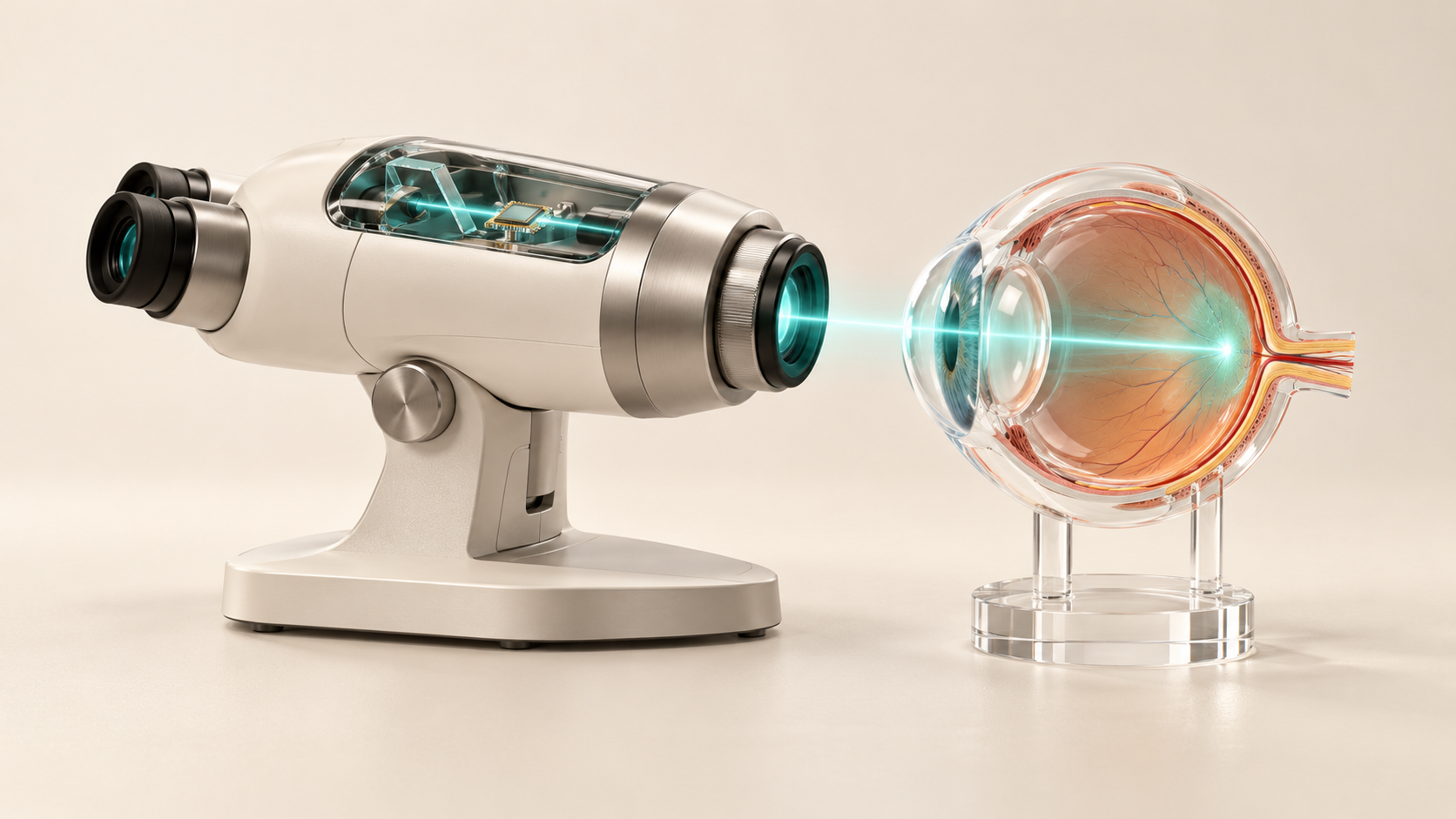
Siloton Announces £8.4 Million Innovate UK Contract on 14 October 2026 to Trial Its Chip-Based Handheld OCT Eye Scanner With Sunderland Eye Hospital
Siloton takes its chip-based retinal scanner toward NHS trials
Quentir Medicine Monitor
Evidence-based insights for quantum medicine.
The Bristol start-up Siloton has won an £8.4 million contract from Innovate UK to finish two versions of its handheld eye scanner, one for clinics and one for patients' homes, and to test both over the next two years. The company announced the award on 14 October 2026. The money comes through Contracts for Innovation: Quantum Missions Primer, a UK Research and Innovation program in which public bodies set a problem and pay companies to develop a solution.
The device performs optical coherence tomography, or OCT, the scan that eye clinics use to see the layers of the retina in cross-section. Siloton says it has compressed a tabletop's worth of fragile optics onto a photonic chip smaller than a £1 coin, set in a binocular-style headset that a patient looks into. Clinical trials of the in-clinic version will run with Sunderland Specialist Eye Hospital, and York Health Economics Consortium will use the trial data to refine estimates of what the system could save the NHS.
For a hospital eye service, the question is practical. OCT is the main tool for following age-related macular degeneration, diabetic eye disease and glaucoma, and most patients on those pathways need repeat scans for years. A scanner small and cheap enough to sit in a community clinic, or in a living room, would change where those repeat visits happen.
According to Siloton's press release of 14 October 2026, the contract pays for the design of in-clinic and at-home versions of its GiraffeOCT device and for trials on both. Patients in the North East and North Cumbria will have access to the in-clinic system during the Sunderland trials. The company expects the funding to shorten its development by up to two years, and it plans to grow its staff to 16 by August 2028, with hiring in photonics, electronics and software.
Chief executive Alasdair Price said the contract also covers a wider range of detectable diseases, integration of a second-generation chip called BlueJay, which he described as the same architecture used in the company's system for astronauts, and a cloud platform behind the service. The European Space Agency is listed as a customer; it wants a way to follow the eye problems astronauts often develop in orbit. Siloton also plans a second-generation device, CheetahOCT, designed to measure further layers of the retina, and intends to raise more investment on the back of the award.
The company frames the need with NHS figures: ophthalmology is the busiest outpatient specialty in England, with about nine million attendances in 2023/24, and at the end of July 2026 nearly 623,000 people were waiting for an eye appointment, 8.7 percent of all NHS waits. These numbers come from the press release, which does not cite the underlying NHS dataset.