Siloton Announces £8.4 Million Innovate UK Contract on 14 October 2026 to Trial Its Chip-Based Handheld OCT Eye Scanner With Sunderland Eye Hospital
Quentir Medicine Monitor
Evidence-based insights for quantum medicine. Published by Quentir Systems LLC · October 18, 2026.
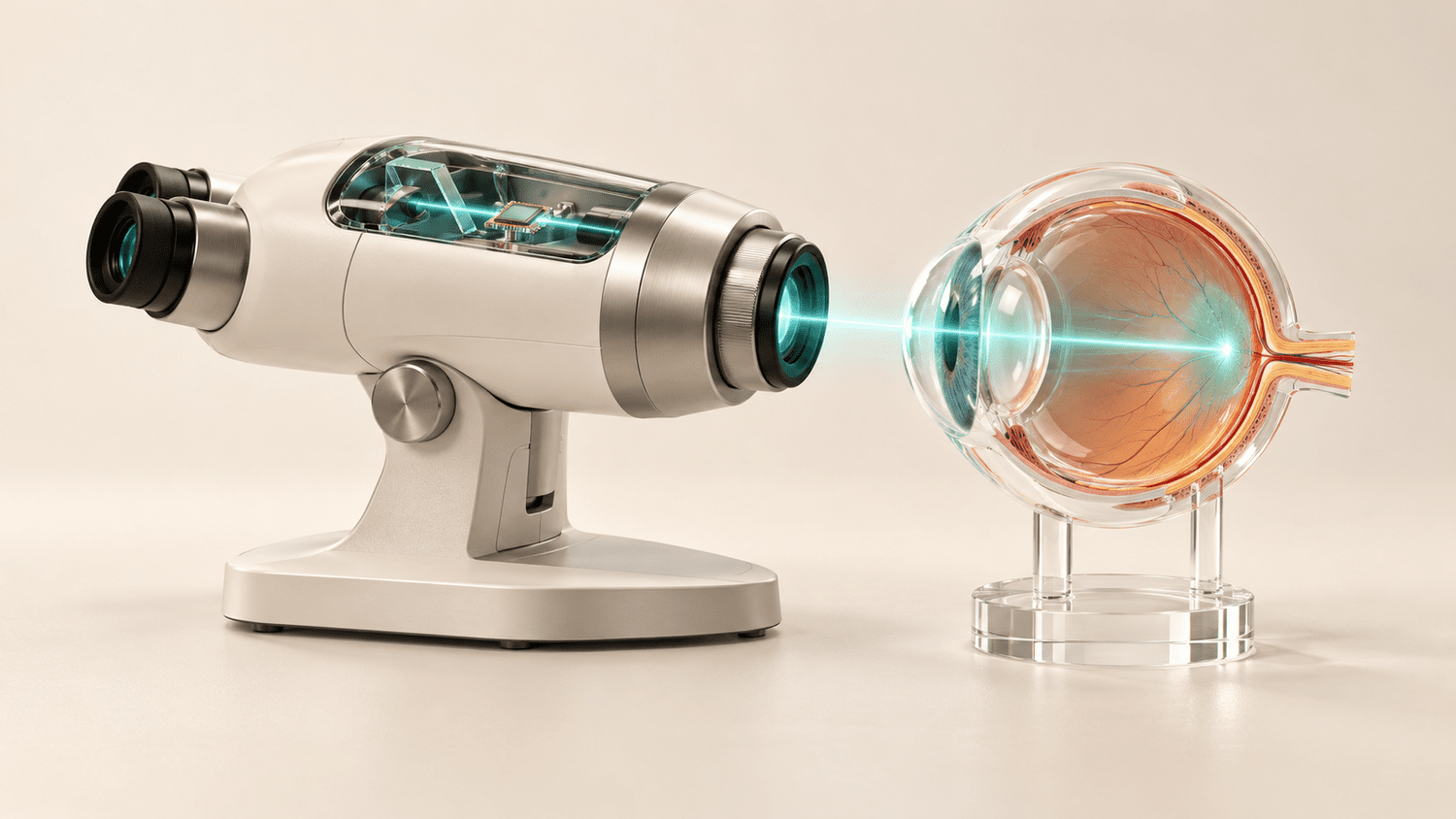
The Bristol start-up Siloton has won an £8.4 million contract from Innovate UK to finish two versions of its handheld eye scanner, one for clinics and one for patients' homes, and to test both over the next two years. The company announced the award on 14 October 2026. The money comes through Contracts for Innovation: Quantum Missions Primer, a UK Research and Innovation program in which public bodies set a problem and pay companies to develop a solution.
The device performs optical coherence tomography, or OCT, the scan that eye clinics use to see the layers of the retina in cross-section. Siloton says it has compressed a tabletop's worth of fragile optics onto a photonic chip smaller than a £1 coin, set in a binocular-style headset that a patient looks into. Clinical trials of the in-clinic version will run with Sunderland Specialist Eye Hospital, and York Health Economics Consortium will use the trial data to refine estimates of what the system could save the NHS.
For a hospital eye service, the question is practical. OCT is the main tool for following age-related macular degeneration, diabetic eye disease and glaucoma, and most patients on those pathways need repeat scans for years. A scanner small and cheap enough to sit in a community clinic, or in a living room, would change where those repeat visits happen.
What Siloton's 14 October 2026 announcement commits to: GiraffeOCT trials, Sunderland, and a team of 16 by August 2028
According to Siloton's press release of 14 October 2026, the contract pays for the design of in-clinic and at-home versions of its GiraffeOCT device and for trials on both. Patients in the North East and North Cumbria will have access to the in-clinic system during the Sunderland trials. The company expects the funding to shorten its development by up to two years, and it plans to grow its staff to 16 by August 2028, with hiring in photonics, electronics and software.
Chief executive Alasdair Price said the contract also covers a wider range of detectable diseases, integration of a second-generation chip called BlueJay, which he described as the same architecture used in the company's system for astronauts, and a cloud platform behind the service. The European Space Agency is listed as a customer; it wants a way to follow the eye problems astronauts often develop in orbit. Siloton also plans a second-generation device, CheetahOCT, designed to measure further layers of the retina, and intends to raise more investment on the back of the award.
The company frames the need with NHS figures: ophthalmology is the busiest outpatient specialty in England, with about nine million attendances in 2023/24, and at the end of July 2026 nearly 623,000 people were waiting for an eye appointment, 8.7 percent of all NHS waits. These numbers come from the press release, which does not cite the underlying NHS dataset.
Quantum pillar: sensing. Technology readiness: TRL 6 of 9, on the Monitor's provisional assessment. Siloton reports that a first group of adult patients tried an earlier version of the scanner in 2025, and the new contract pays for formal clinical trials, so the device has been shown on real patients; the cited announcements do not establish regulatory authorization for routine clinical use, and the scanner is not yet part of routine NHS eye care.
Where the quantum label comes from: Mission 3 of the UK National Quantum Strategy
OCT itself dates from 1991, when David Huang, James Fujimoto and colleagues described it in a paper in Science. It works by low-coherence interferometry: broadband light is split, one part reflects off the tissue and the other off a reference path, and their interference shows how deep each reflection came from. In a standard clinic machine this happens in bulk lenses, mirrors and fibers. Siloton's step is to route that light through waveguides etched into a chip, a field known as integrated photonics.
Neither the press release nor the company's product pages says which quantum effect, if any, the chip relies on beyond the physics that governs all light. The quantum framing follows the funding line. In its National Quantum Strategy Missions, published in 2023, the UK government set Mission 3: by 2030, every NHS Trust will benefit from quantum sensing-enabled solutions that help people with chronic illness through early diagnosis and treatment. A UCL announcement of September 2026 also calls the device "quantum-enabled" without explaining the term; the link to the Mission 3 funding line is the Monitor's reading.
Hospital buyers have met this vocabulary before. The Monitor's piece on what the word quantum means on a hospital CT scanner showed how a photon-counting detector carries the term without any quantum computing inside the gantry. Siloton's scanner should be read the same way: an optical imaging device whose value lies in size, cost and where it can be used, judged on image quality and clinical outcomes.
How UCL and Great Ormond Street plan to adapt the scanner for children, announced 21 September 2026
A month before the Innovate UK award, Siloton and the UCL Great Ormond Street Institute of Child Health announced a project funded by the National Institute for Health and Care Research. Professors Ameenat Lola Solebo and Marinko Sarunic will co-develop a version of the system for the front of the eye that children can use in the community or at home. The lenses will be tuned to children's eyes and the casing reshaped for smaller faces. That announcement names the device Akepa and states that a first cohort of adult patients trialled it in 2025; the October release uses the name GiraffeOCT for the in-clinic and home system.
The pediatric project matters for the readiness reading, and its scope is narrower than the company's wider ambitions. The announced adaptation covers imaging of the front of the eye. Price also listed other children's conditions, including inherited diseases and signs of brain tumors that first appear in the optic disc, which sit at the back of the eye; the announcement does not say the adapted device will image them. For the children it does serve, home monitoring would reduce hospital trips that can disrupt school and parents' work.
What NHS eye services and buyers should watch for during the two-year contract
The award is a development contract with trials attached. It does not show that a home OCT scan matches a clinic scan for treatment decisions, and none of the announcements reports image-quality comparisons, diagnostic accuracy or a regulatory submission. The figures to look for from Sunderland are the share of scans good enough for a clinician to act on, agreement with standard clinic OCT, and how many patients can take a usable scan without help.
The health economics work by York Health Economics Consortium will be the second test, since a cheaper scanner only saves money if it removes hospital visits without adding missed disease or repeat scans. Quentir's Defense Monitor covered a separate UK award of £50 million to six quantum sensing and navigation firms on 13 October 2026. Together the two awards show the government spending on sensing missions in the same week, and the eye scanner is the award tied directly to the Mission 3 target for NHS Trusts.
Sources
Primary source: Siloton, press release of 14 October 2026 on its £8.4 million Innovate UK contract, quoting chief executive Alasdair Price. Also drawn on: Siloton's announcement of 21 September 2026 with the UCL Great Ormond Street Institute of Child Health (Ameenat Lola Solebo and Marinko Sarunic), the UK government's National Quantum Strategy Missions of 2023, the 1991 Science paper by David Huang, James Fujimoto and colleagues, Scientist Live's coverage, and the Monitor's earlier coverage. The readiness rating is the Monitor's editorial assessment.