USTC Researchers in Hefei Place Silicon Carbide Quantum Sensors at the Center of Nanopillars: 1 to 2 Million Detected Photons per Second and Nanoscale NMR, arXiv 2611.16252, 12 November 2026
What the Laboratory of Spin Magnetic Resonance in Hefei reported on 12 November 2026
Quentir Medicine Monitor
Evidence-based insights for quantum medicine.
Physicists at the University of Science and Technology of China in Hefei have built arrays of silicon carbide quantum sensors whose detected photon count rates run ten to twenty times higher than typical values for the same sensors in a flat crystal. They used the devices to pick up nanoscale nuclear magnetic resonance signals from hydrogen nuclei a few nanometers above the chip, at room temperature.
The work appeared as a preprint on 12 November 2026. The hardware sits several steps away from any clinical instrument. Sensors made from atomic defects in crystals can feel the magnetic fields of single molecules, but they are faint, and they are hard to make by the thousand with the same performance. The Hefei group reports progress on both counts, using a material the semiconductor industry already processes on full wafers and sensors that are both excited and read out with near-infrared light, which the authors expect to cause less light damage in biological samples than the green light that pumps most diamond sensors.
The paper, "Bright and Uniform Silicon Carbide Nanophotonic Arrays for Scalable Nanoscale Quantum Sensing" on arXiv, comes from Chenyang Liao, Chihang Luo, Xin Chen, Cunliang Xin, Hongfang Zuo, Haoyu Sun, Fazhan Shi, Mengqi Wang and Ya Wang. Mengqi Wang and Ya Wang are the corresponding authors. The group works at the Laboratory of Spin Magnetic Resonance in USTC's School of Physical Sciences and at the Hefei National Laboratory. The manuscript has not yet been through peer review.
The sensors are two kinds of light-emitting defects in the 4H form of silicon carbide, known as PL5 and PL6 centers. Each defect carries an electron spin whose response to a magnetic field can be read out with a laser and a microwave signal, a technique called optically detected magnetic resonance. In earlier work these centers gave stable signals at room temperature, with a typical detected count rate of about 100,000 photons per second in bulk crystal. The weak signal is a direct limit on sensitivity, since the measurement improves with the square root of the light collected.
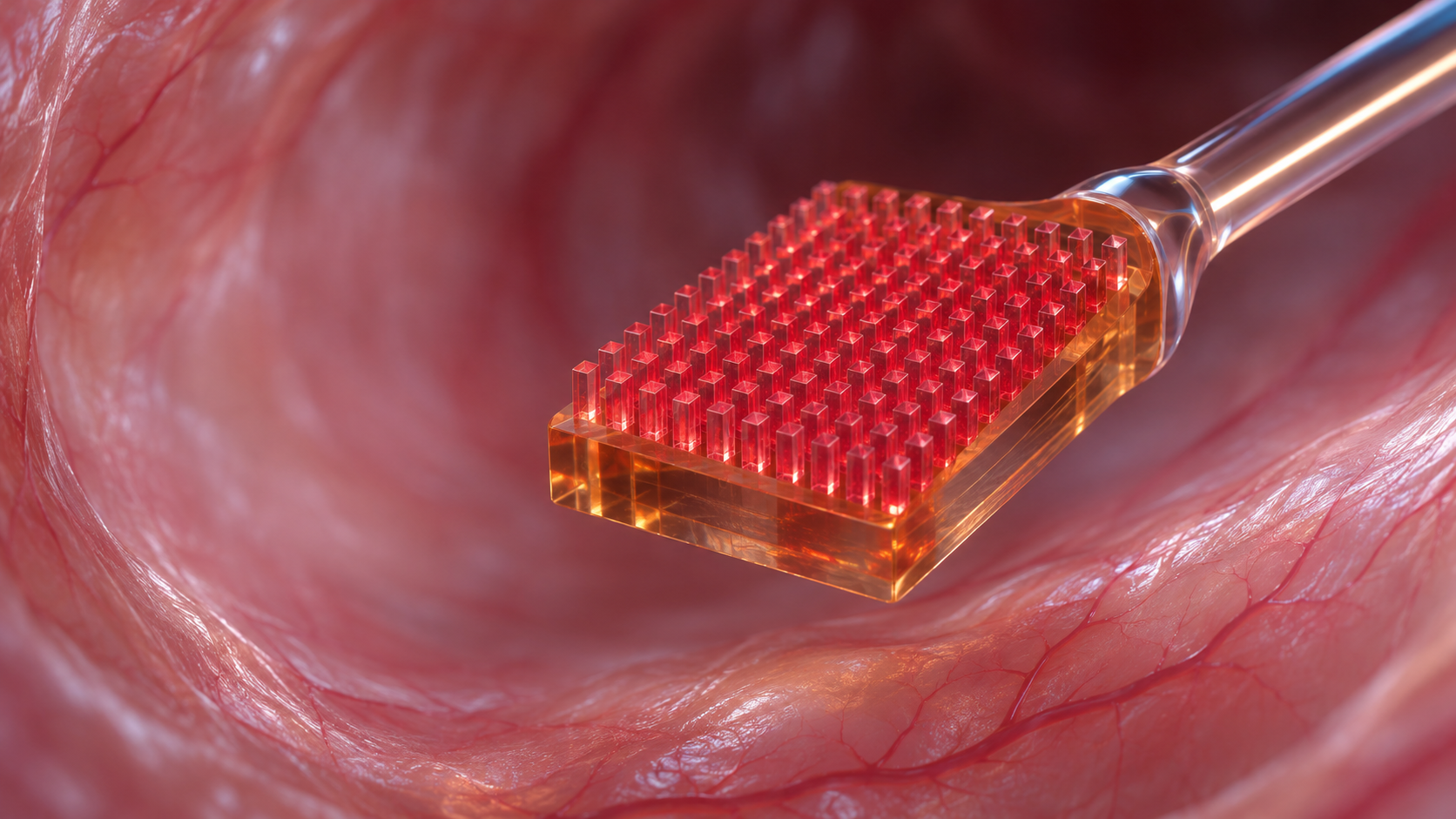
The team shaped the crystal surface into tiny pillars, each 480 nanometers tall with a top radius of 310 nanometers, so that more of the defect's light leaves the crystal and reaches the microscope. Simulations predicted that this geometry collects about 54 percent of the light from a PL6 center and 32 percent from a PL5 center with an air objective of numerical aperture 0.7. They also showed that the gain disappears quickly when the defect sits off-center in the pillar.