Forty-Six Qubits, One Small Cancer Dataset
What the 46-qubit result did
A cancer neoantigen may differ from an ordinary human peptide by one amino acid. The peptide must bind to a patient’s HLA molecule and then be recognized by a T cell. A Science Advances team used quantum convolutional neural networks to model those two filters and combined them in Q-CHIPP.
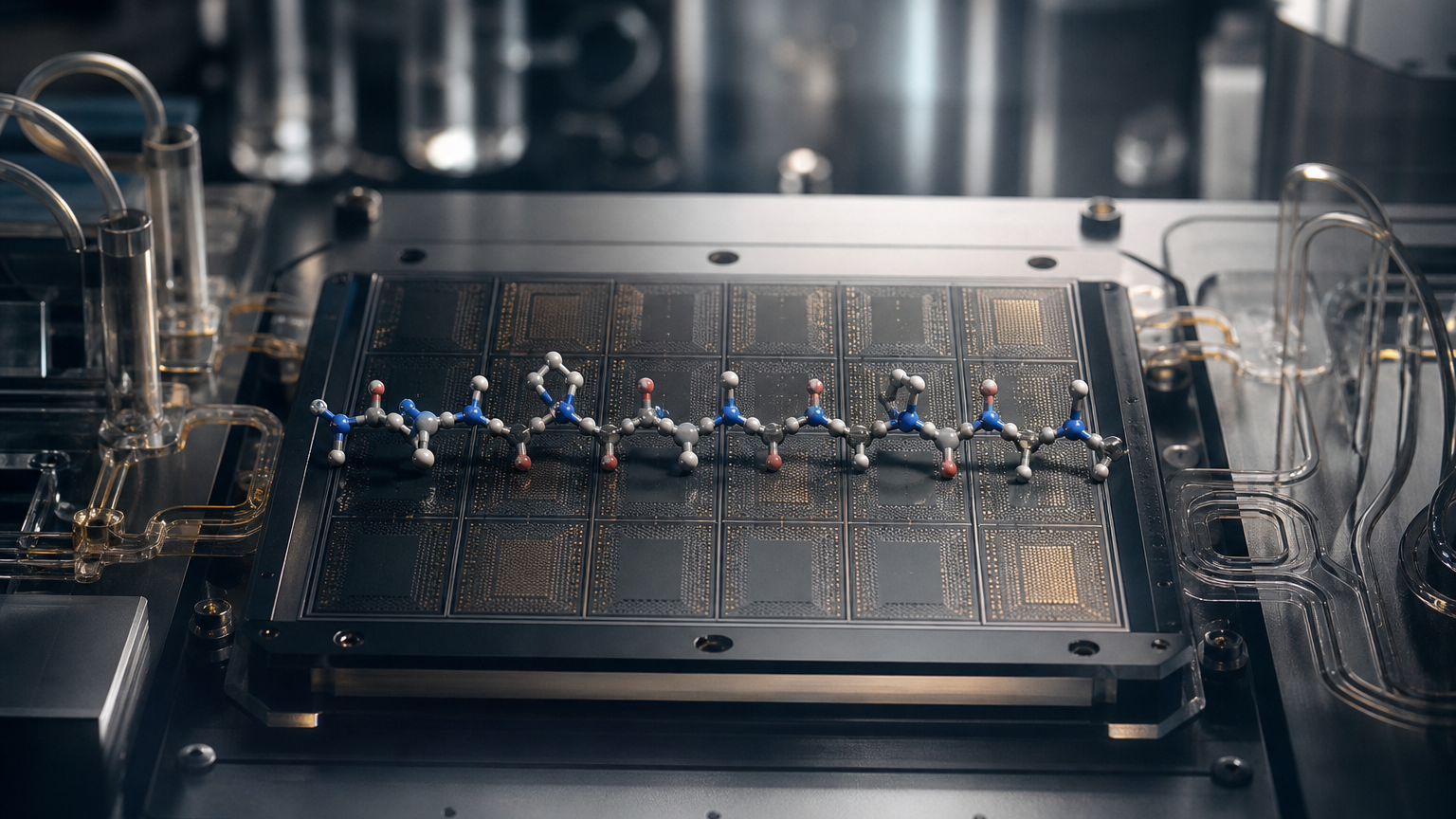
The largest hardware experiment represented a full nine-amino-acid peptide with 46 qubits. It used 150 training peptides and 50 test peptides, with 20,000 shots per circuit and two noise-mitigation methods. The model reached F1 0.70. The paper’s unrestricted classical network scored 0.65 and its random forest 0.66 on larger training and test splits.
The biological task is harder than binding
A peptide that binds to HLA may still provoke no T-cell response. Q-CHIPP therefore combines a binding model with an immunogenicity model trained only on confirmed binders. This design addresses a known confound: mixing binders and nonbinders can make binding performance look like immunogenicity prediction.
The patient result remains retrospective
The researchers applied Q-CHIPP to 209,889 candidate peptides from 111 people with HLA-A*02:01-positive lung cancer treated with immunotherapy. Predicted antigen burden was associated with overall survival, but the candidate peptides were not experimentally screened for immunogenicity. The study supports external biological testing, not prospective prediction for a new patient.