Forty-Six Qubits, One Small Cancer Dataset
Quentir Medicine Monitor
Evidence-based insights for quantum medicine. Published by Quentir Systems LLC · July 31, 2026.
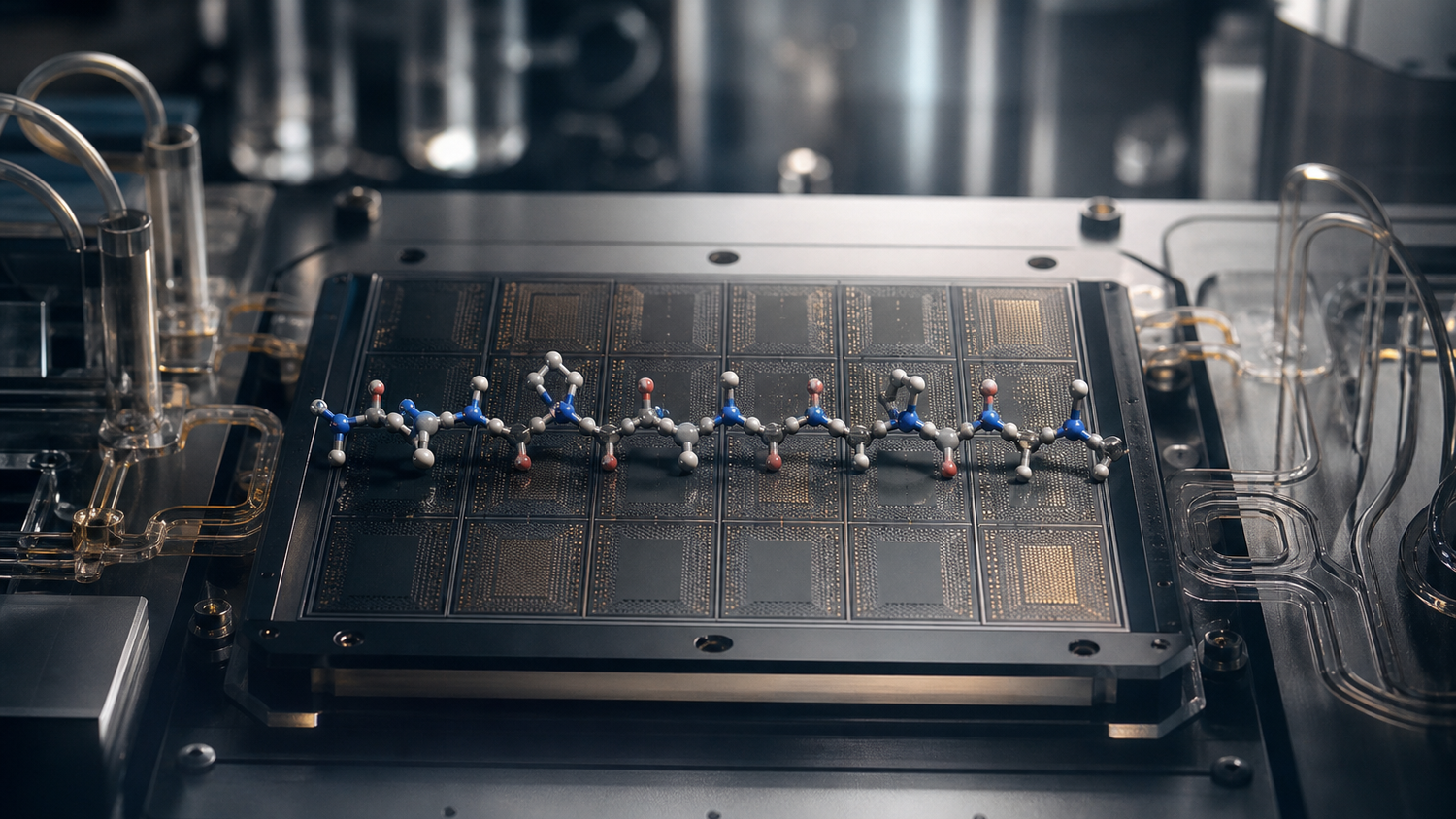
A cancer neoantigen can differ from an ordinary human peptide by a single amino acid. That minute change must survive two filters before it can matter to an immune response: the peptide must bind to a patient’s HLA molecule, and a T cell must recognize the resulting complex. Predicting both events from scarce, noisy data has resisted years of conventional machine learning.
A Science Advances paper published July 24 reports a serious attempt to use quantum machine learning at that bottleneck. Researchers from Cleveland Clinic and IBM trained quantum convolutional neural networks on peptide data, moved selected models onto the IBM Quantum System One at Cleveland Clinic and assembled two models into Q-CHIPP: Quantum Convolutional HLA Immunogenic Peptide Prediction. The largest hardware experiment encoded a full nine-amino-acid peptide across 46 qubits.
Practical takeaway. Q-CHIPP is a real-hardware, retrospective modeling result, not a clinical predictor ready for use. Its most useful contribution is a measurable small-data benchmark that future work can reproduce across hardware, HLA types and independent patient cohorts.
What the 46-qubit result did
The team began with a larger Immune Epitope Database collection, then curated balanced subsets because hardware runs were constrained by time and noise. The full-peptide experiment used 150 training peptides and 50 test peptides. Five qubits represented each of nine amino-acid positions, with one padding qubit for the circuit architecture. The model ran with 20,000 shots per circuit, Pauli twirling and dynamical decoupling.
The 46-qubit model reached an F1 score of 0.70 for immunogenicity classification. In the paper’s table, a limited classical convolutional network scored 0.60, an unrestricted classical network 0.65 and a random forest 0.66. Those classical comparators used a larger 300-training, 100-test split, while the full-peptide quantum run used the smaller hardware split. The authors summarize the experiment as a 6% classification-accuracy increase with fewer training samples.
That comparison is encouraging, but it is not a general quantum-advantage result. The unrestricted classical network and random forest were close. The quantum and classical full-peptide models were not trained on identical sample counts. The quantum circuit’s loss became unstable after roughly 400 iterations during a run lasting multiple days, which the authors attribute to device noise. The result establishes that a substantial quantum neural network can learn a biomedical classification task on present hardware; it does not establish that quantum computing is the preferred available method for neoantigen prediction.
Quantum pillar: computing. Technology readiness: TRL 4, validated in the laboratory. The models ran on real quantum hardware and were tested retrospectively on recorded peptide and patient data, without prospective clinical deployment.
The biological task is harder than binding
A peptide that fails to bind HLA cannot be presented to a T cell. A peptide that binds may still provoke no immune response. This distinction can make a model appear better than it is. The Q-CHIPP paper shows that NetMHCpan’s apparent immunogenicity performance fell from an area under the curve of 0.79 when binders and nonbinders were mixed to 0.55 when the analysis was restricted to confirmed binders.
The problem was already visible in a 2022 benchmark of computational epitope and neoantigen models. Its authors found suboptimal cancer-neoantigen prediction and highlighted confounding from differences among HLA types and training data. Q-CHIPP responds by separating the two biological questions. One quantum model predicts HLA binding from peptide positions associated with binding; another predicts T-cell recognition using only confirmed binders and positions associated with immunogenicity. A peptide is called positive only when both models agree.
This is the more consequential design choice. It asks the model to clear two gates rather than letting the easier binding signal stand in for immune recognition. In tests restricted to confirmed binders, Q-CHIPP’s component immunogenicity model reached an F1 score of 0.67 without binding rank and 0.70 with it. The unrestricted classical network reached 0.68 and 0.65 in those same rows; the random forest reached 0.65 and 0.69. The models were essentially in the same performance neighborhood.
The patient result is an association, not a prediction trial
The team then applied pretrained Q-CHIPP models to 209,889 candidate peptides derived from 111 people with HLA-A*02:01-positive lung cancer who had received immunotherapy. It counted each patient’s predicted immunogenic peptides and split patients into high- and low-burden groups. The groups had statistically different overall survival, with a log-rank P value of 0.0085. NetMHC’s binding-rank count gave P = 0.0275.
Several boundaries matter. The candidate peptides in that cohort were not experimentally screened for immunogenicity. The survival analysis was retrospective and restricted to one HLA allele, one peptide length and one cancer setting. Patients were divided at the median predicted burden, so the study did not validate an individual decision threshold. A random-forest combination produced a slightly stronger P value of 0.0052. These data therefore support a relationship worth testing, not a claim that Q-CHIPP predicts treatment response for a new patient.
The distinction is humane as well as statistical. A neoantigen score could eventually help prioritize expensive laboratory screens, identify vaccine targets or refine immunotherapy research. Used too early, the same score could discard a useful candidate or imply that a patient is more or less likely to benefit without sufficient support. The next validation must preserve that asymmetry: false negatives and false positives do not carry the same cost at every point in a therapeutic workflow.
How Quentir Reads It
Quentir reads Q-CHIPP as a credible laboratory-stage quantum-machine-learning study with unusually concrete disclosure. The public paper names the processor, circuit scale, shot count, mitigation methods, training and test sizes, F1 scores, classical baselines, cohort restriction and observed instability. That makes the claim inspectable rather than rhetorical.
The next decisive result is not simply more qubits. It is a preregistered comparison using identical frozen splits, repeated hardware runs, tuned classical baselines and confidence intervals; followed by external validation across additional HLA alleles, peptide lengths and centers. Experimental testing of predicted peptides should show whether Q-CHIPP improves the yield of true immunogenic candidates. Prospective work should then ask whether that improvement changes a research or treatment decision.
Forty-six qubits have crossed an important threshold: they processed a full peptide representation on real hardware and produced a benchmark that can be challenged. The clinical threshold remains elsewhere. It begins when the model’s additional predictions survive biological testing outside the data and institutions that produced them.
Sources
Primary source: Peters et al., Science Advances, July 24, 2026. Technical context: Buckley et al., Briefings in Bioinformatics, April 21, 2022.