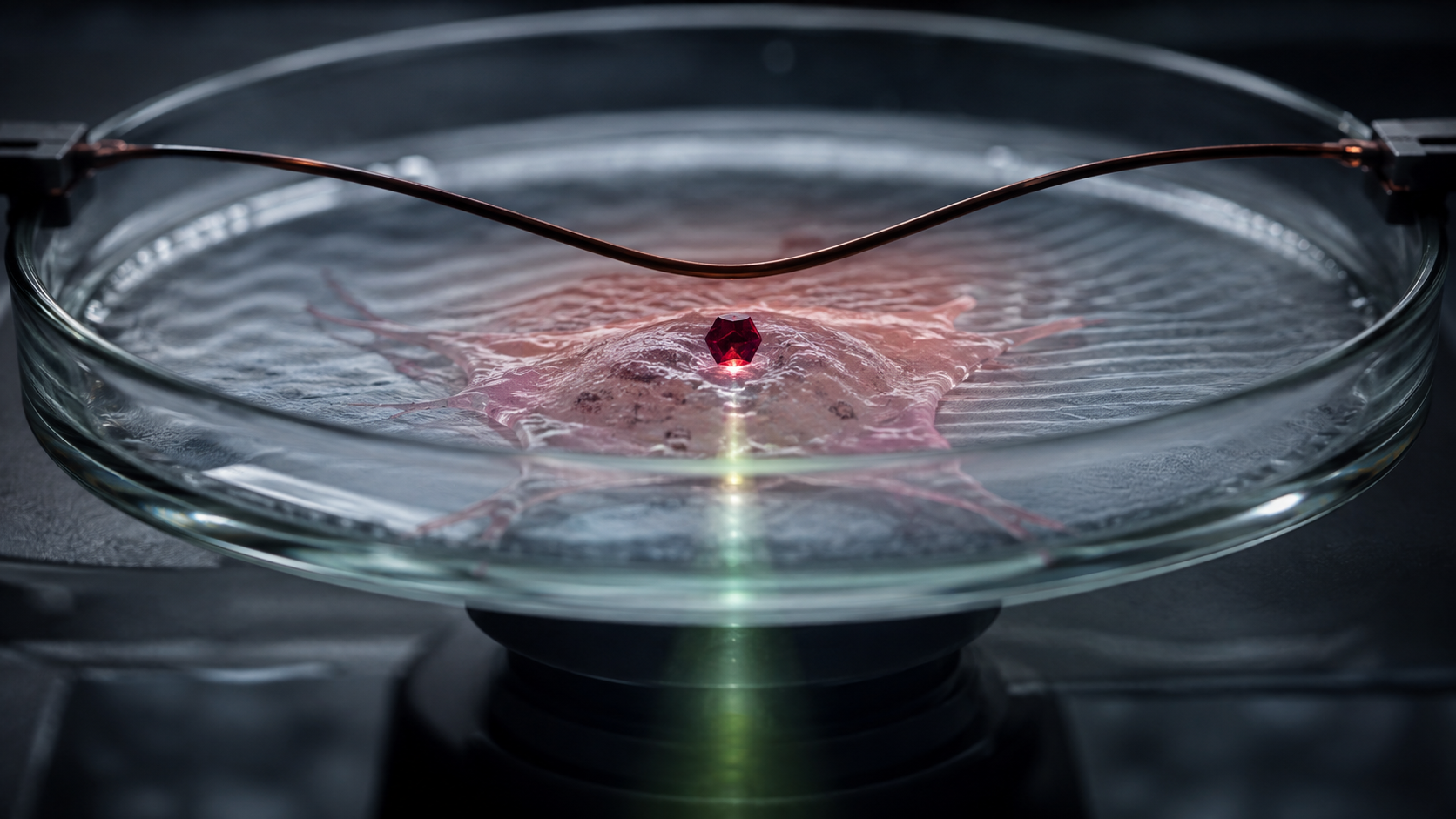
A 280-Nanometre Diamond Reached a 682 Microkelvin Resolution Floor: Cambridge, Warwick and Cardiff, 4 September 2026
Quentir Medicine Monitor
Evidence-based insights for quantum medicine.
On 4 September 2026 a group drawn from the Cavendish Laboratory at the University of Cambridge, the University of Warwick and Cardiff University posted a preprint on nanoscale thermometry with a free-standing diamond particle. Jack W. Hart, Soham Pal, Julien R. E. Roth, Katie Ninham, Abbie H. Aleksandrova, Xander Peetroons, Soumen Mandal, Oliver A. Williams, Gavin W. Morley, Mete Atature and Helena S. Knowles report that the platform as a whole reaches roughly an order of magnitude better sensitivity than previously published nanodiamond figures.
Three numbers carry the result, and each needs its qualifier. The paper reports an extrapolated resolution floor of 682 microkelvin, a figure derived from the fitting error of the functional form rather than from a single demonstrated reading; the average error on a temperature measurement that took 83 seconds to acquire was 11.9 millikelvin. The sensor is a 280-nanometre nanodiamond ball-milled from isotopically purified carbon-12, small enough in principle to sit inside a cell and holding two nitrogen-vacancy centers rather than one. And the same paper measures the heat its own readout laser pours into the sample, finding 337 millikelvin of heating for every milliwatt of incident optical power, with an observed maximum rise of 224 millikelvin at 0.63 milliwatts, which is some 330 times the extrapolated resolution floor.
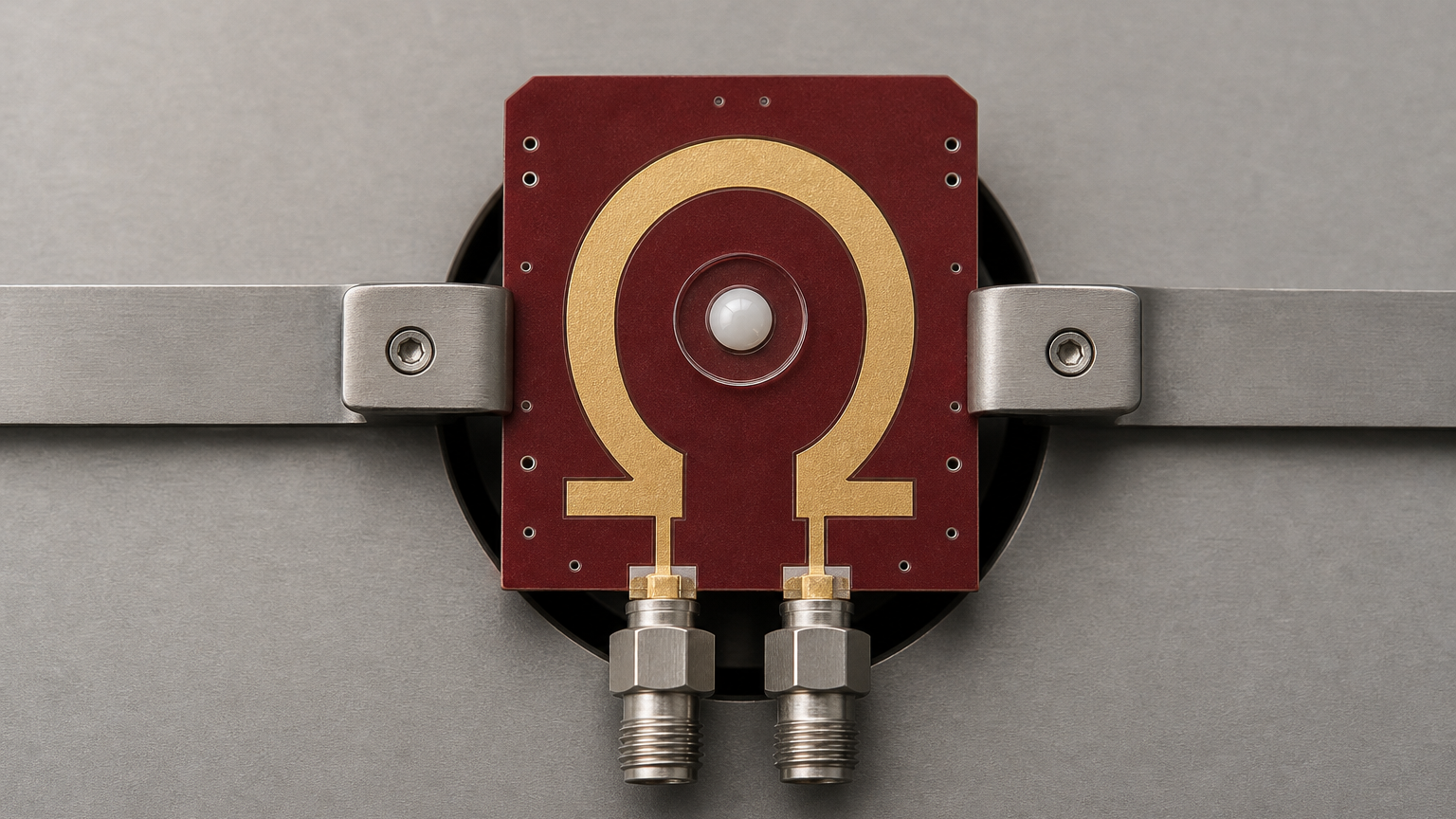
Nanodiamond Charge Drift Reads Macrophage Inflammation: Chicago and Iowa in Advanced Materials, 4 February 2026
Nanodiamond quantum sensors have been read as thermometers inside living cells for more than a decade. One of them, a 70-nanometer crystal sitting inside a mouse macrophage, drifted downward by 0.27 megahertz over 200 seconds of measurement, which on the usual arithmetic means the cell warmed by 3.62 degrees Celsius. A team at the University of Chicago and the University of Iowa has now put a different quantity behind that same number.
Their paper, Probing cellular activity via charge-sensitive quantum nanoprobes, appeared in Advanced Materials on 4 February 2026, with Uri Zvi as first author and Denis R. Candido at Iowa, Aaron Esser-Kahn and Peter C. Maurer at Chicago as corresponding authors. It was received on 15 March 2025 and accepted on 15 January 2026. The University of Iowa publicized it on 26 August 2026, six months after the article went online, which is why it reaches this Monitor now.
What the zero-field splitting actually tracks, and the dipole term that was being dropped
The sensor is a nitrogen-vacancy center, an atomic defect in diamond whose spin can be initialized with green light, driven with microwaves and read out optically. Each 70-nanometer crystal used here carries roughly 100 of them. The measured quantity is the zero-field splitting, the frequency gap between the spin's ground sublevels, which sits near 2.87 gigahertz and moves by about 74 kilohertz for every kelvin. That temperature coefficient is what turned these particles into intracellular thermometers in the first place.