A 280-Nanometre Diamond Reached a 682 Microkelvin Resolution Floor: Cambridge, Warwick and Cardiff, 4 September 2026
Quentir Medicine Monitor
Evidence-based insights for quantum medicine. Published by Quentir Systems LLC · September 7, 2026.
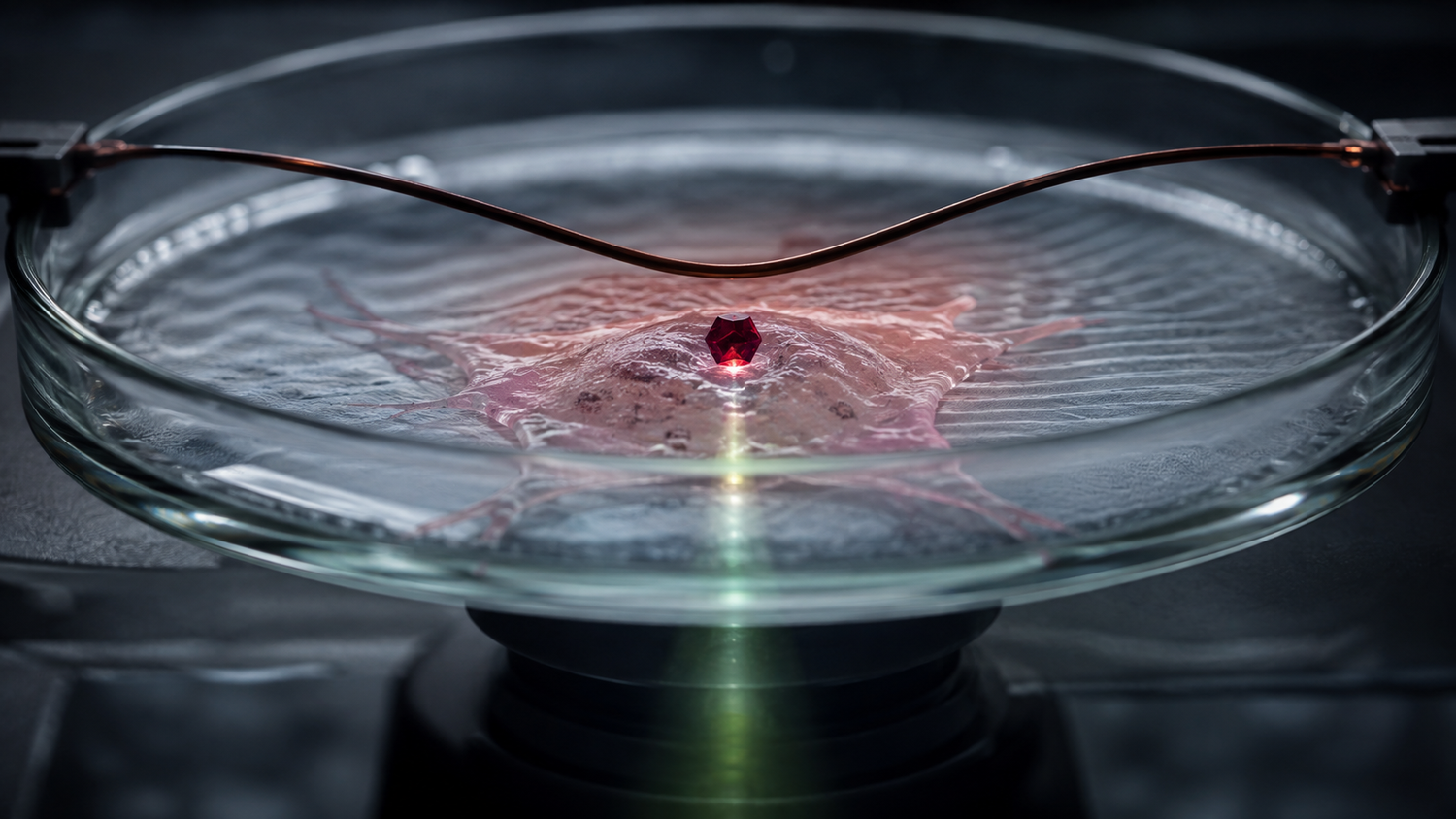
On 4 September 2026 a group drawn from the Cavendish Laboratory at the University of Cambridge, the University of Warwick and Cardiff University posted a preprint on nanoscale thermometry with a free-standing diamond particle. Jack W. Hart, Soham Pal, Julien R. E. Roth, Katie Ninham, Abbie H. Aleksandrova, Xander Peetroons, Soumen Mandal, Oliver A. Williams, Gavin W. Morley, Mete Atature and Helena S. Knowles report that the platform as a whole reaches roughly an order of magnitude better sensitivity than previously published nanodiamond figures.
Three numbers carry the result, and each needs its qualifier. The paper reports an extrapolated resolution floor of 682 microkelvin, a figure derived from the fitting error of the functional form rather than from a single demonstrated reading; the average error on a temperature measurement that took 83 seconds to acquire was 11.9 millikelvin. The sensor is a 280-nanometre nanodiamond ball-milled from isotopically purified carbon-12, small enough in principle to sit inside a cell and holding two nitrogen-vacancy centers rather than one. And the same paper measures the heat its own readout laser pours into the sample, finding 337 millikelvin of heating for every milliwatt of incident optical power, with an observed maximum rise of 224 millikelvin at 0.63 milliwatts, which is some 330 times the extrapolated resolution floor.
What the 4 September 2026 Preprint Reports: a 682 Microkelvin Resolution Floor and 9.6 Millikelvin per Root Hertz at the Shot-Noise Limit
The preprint, "Microkelvin resolution thermometry at the nanometre scale," was submitted to arXiv on 4 September 2026 as an eight-page paper with three figures, filed under quantum physics, applied physics, and instrumentation and detectors. Its method is standard in outline. A nitrogen-vacancy center is a defect in the diamond lattice where a nitrogen atom sits beside a missing carbon atom. Its electron spin has an energy splitting that shifts with temperature, the splitting can be read out optically at room temperature, and measuring the shift gives a temperature at the position of the particle holding the defect.
What the group changed is the particle and the mount. The diamond was ball-milled from isotopically purified carbon-12 stock, which strips out the carbon-13 nuclei whose magnetic noise shortens spin coherence, and the resulting grain measures roughly 280 nanometres along its major axis. It contains two nitrogen-vacancy centers instead of the usual one, which the authors state doubles the photon count with no adverse effect on the coherence properties. That doubling is worth about 30 percent in temperature sensitivity against an equivalent single-NV nanodiamond, in the authors' own estimate, so the dual defect is one contribution among several and the order-of-magnitude gain belongs to the platform and protocol taken together. The measured coherence times are a T2* of 11.7 plus or minus 1.6 microseconds and a Hahn-echo coherence time of 102.6 plus or minus 0.9 microseconds. The particle sits on a purpose-built sensing chip that carries its own heating element and its own resistance temperature detector, so the chip can impose a known temperature and check the diamond against a conventional sensor on the same substrate.
The performance figures follow from that, and they sit at two different levels. The paper extrapolates a temperature sensing resolution floor of 682 microkelvin from the fitting error of the functional form it uses, which is a projected limit rather than a demonstrated single reading. The demonstrated figure alongside it is an average error of 11.9 millikelvin on a temperature measurement that took 83 seconds to acquire. Experimental sensitivity is 48.2 millikelvin per root hertz, and the shot-noise limited sensitivity, meaning the floor set by photon counting statistics rather than by any avoidable technical noise, is 9.6 millikelvin per root hertz. The authors compare this against a prior nanodiamond sensitivity floor of about 130 millikelvin per root hertz. They also report that misaligning the external magnetic field costs only about twenty percent of the temperature resolution and sensitivity, which matters for any use where the sensor cannot be held in a fixed orientation.
Why the Comparison to Kucsko's 2013 Nature Result Is the One That Explains the Advance
The headline sensitivity of 9.6 millikelvin per root hertz will look familiar to anyone who has followed this field. In 2013 Georg Kucsko, Peter Maurer, Norman Yao, Mikhail Lukin and colleagues at Harvard reported quantum thermometry with nitrogen-vacancy centers in Nature, hitting a sensitivity of 9 millikelvin per root hertz and detecting variations down to 1.8 millikelvin. Those two figures came from ultrapure bulk diamond, which is the easy case: a large, clean, well-mounted crystal. The intracellular part of that paper is a separate experiment, using nanodiamonds together with gold nanoparticles introduced into a single human embryonic fibroblast, and it delivered temperature mapping at a length scale of about 200 nanometres rather than the bulk-diamond sensitivity.
That split is what the 2026 result addresses. The two halves of the 2013 paper have stayed apart for thirteen years: a sensitive thermometer that is a bulk crystal on a bench, and a placeable thermometer that is a nanoparticle roughly an order of magnitude less sensitive, with the prior nanodiamond floor near 130 millikelvin per root hertz. Reaching a shot-noise limited 9.6 millikelvin per root hertz in a free-standing 280-nanometre grain brings the placeable version up to what the bulk crystal delivered in 2013. The comparison is the point of the paper, and it is also the honest measure of what has been achieved, which is parity with a bench instrument from thirteen years ago in a package that can in principle be put somewhere.
Quantum pillar: sensing. Technology readiness: TRL 4 of 9. The instrument is a laboratory build: one characterized nanodiamond on a purpose-made chip, validated against a conventional temperature sensor on the same substrate, with the biological demonstration still ahead of it. Rung four on the shared ladder both Evidence Registers use covers component validation in a laboratory setting, which is what an eight-page preprint with three figures and a bench measurement of solvent mixing supports. The rung is this Monitor's own provisional reading of the disclosed evidence and not a rating the authors publish; it moves when the same sensitivity is demonstrated inside living cells with the probe's own heating accounted for, and it moves again on peer review.
The Probe Heats What It Measures: 224 Millikelvin of Laser Warming at 0.63 Milliwatts
The most useful measurement in the paper is the one the group turned on itself. Reading a nitrogen-vacancy spin requires shining green light on it, and that light deposits energy. Using the new thermometer, the authors quantified how much: the nanodiamond's temperature rises linearly with incident laser power at 337 millikelvin per milliwatt, reaching a maximum rise of 224 millikelvin at 0.63 milliwatts of incident power.
Set the observed 224 millikelvin rise beside the extrapolated 682 microkelvin floor and the arithmetic is stark. At that power the probe warms its own target by about 330 times the smallest temperature difference the instrument is projected to distinguish. This is not a flaw in the work, and the authors are the ones who measured it. Their own conclusion is reassuring: because the heating stays low even at saturation laser powers, they infer that their quantum sensing experiments do not produce detrimental heating effects in living systems. They also attribute the heating partly to the poor thermal conductivity of the glass substrate the nanodiamond sits on and of the surrounding ambient air, which implies that a particle in water would run cooler.
Two qualifications sit alongside that conclusion. Harmlessness to a cell and freedom from measurement bias are separate questions, and a temperature map has to survive the second one. The coefficient itself was measured dry on glass in air, so it is a bench figure rather than a ready-made correction factor for a particle in cytoplasm, which conducts heat differently again; the paper's own liquid work, the solvent mixing run, put the nanodiamond in 200 microlitres of deionized water in a well on the chip, which is a third thermal environment. A correction can only be applied once the illumination each measured spot received has been recorded, which is why a reported temperature difference between two locations inside a cell means little without its optical bookkeeping. Elsewhere in quantum sensing the same physics runs the other way, and engineers spend their effort suppressing it: an Army Research Laboratory and University of California, Berkeley team paired two diamond spin signals precisely to cancel a clock's temperature drift tenfold. Sensitivity to temperature is a nuisance in a clock and the entire signal in a thermometer, and it is the same coupling in both instruments.
What Was Actually Measured Was a Drop of Solvent in Water, Not Anything Inside a Cell
The biological demonstration in this paper is a chemical one. The group added 10 microlitres of a 1 millimolar solution of FCCP in dimethyl sulfoxide to water and watched the temperature rise 1.5 kelvin, dissipating over 180 seconds. The heat comes from the exothermic mixing of the solvent with water. FCCP is a mitochondrial uncoupler, a compound that collapses the proton gradient across the inner mitochondrial membrane and makes the organelle release energy as heat, so the choice of reagent points at the experiment the group intends to do next. The authors say so directly, naming mitochondrial thermogenesis in live cells at sub-millikelvin resolution as the target, alongside assessing heat production by nanoscale chemical and biological catalysts.
A clinical reader should hold those apart. A 1.5 kelvin bulk enthalpy of mixing in a dish is a large, slow, well-understood signal. Mitochondrial thermogenesis inside a living cell is small, fast and disputed, and physicists have argued for more than a decade that the temperature gradients some intracellular thermometry papers report are orders of magnitude larger than heat diffusion in water would permit. Nothing in this preprint settles that argument. It narrows one constraint under bench conditions, since an experimental sensitivity of 48.2 millikelvin per root hertz and an average error of 11.9 millikelvin over 83 seconds are better than a nanodiamond has managed before.
There is a second route into the cell that avoids the foreign particle altogether. Rather than milling a diamond and inserting it, a cell can be made to express a protein that behaves as a spin qubit, an approach this Monitor covered when the National Science Foundation renewed a Chicago-led institute in August 2026 and enhanced yellow fluorescent protein was operated as a spin qubit in human cells. That route trades sensitivity for biocompatibility. The Cambridge, Warwick and Cardiff result pushes hard on the other side of the same trade.
Six Questions Before Believing an Intracellular Temperature Map From This Platform
Is the quoted figure the extrapolated resolution floor or an error measured on an actual acquisition, since those are 682 microkelvin and 11.9 millikelvin in this paper and they are a factor of seventeen apart? What laser power reached each measured location, and has the heating coefficient been recalibrated in the aqueous environment where the measurement is claimed rather than carried over from glass in air? Does the 280-nanometre particle enter the cell type in question, where does it end up, and does it move during the measurement? Does a 280-nanometre diamond loaded into a cell retain the coherence times measured on the chip, given that the intracellular environment is chemically and magnetically unlike a clean substrate? Over what integration time is a sub-millikelvin figure quoted, since a sensitivity per root hertz becomes an actual resolution only once the averaging time is stated and the biology has to hold still that long, and 83 seconds is a long time in a living cell? And has the work been peer reviewed, since the arXiv posting of 4 September 2026 carries no journal reference.
How Quentir Reads It
This is a genuine instrument advance with a well-marked gap between what was demonstrated and what was proposed. The measured quantities are real, checkable and reported with uncertainties, and they were validated against a conventional sensor on the same chip. The order-of-magnitude gain over prior nanodiamond work is the kind of engineering progress that eventually makes a clinical or pharmacological measurement possible.
The gap is that no cell appears in this paper. Every biological application named in it lies ahead, and the group's own laser-heating measurement quantifies a major obstacle in the way. Nanoscale thermometry works on a chip and in water; that much this paper demonstrates. The open question for a hospital or a pharmaceutical laboratory is whether a measurement of heat inside a living cell can be made to mean something once the instrument's own contribution is subtracted. This Monitor places the work at rung four and will move it when a cell appears in the figures.
Sources
Primary source: Jack W. Hart, Soham Pal, Julien R. E. Roth, Katie Ninham, Abbie H. Aleksandrova, Xander Peetroons, Soumen Mandal, Oliver A. Williams, Gavin W. Morley, Mete Atature and Helena S. Knowles, "Microkelvin resolution thermometry at the nanometre scale," arXiv:2609.04907v1, submitted 4 September 2026, for the temperature sensing resolution floor of 682 microkelvin extrapolated from the functional-form fitting error, the average error of 11.9 millikelvin on a temperature measurement that took 83 seconds to acquire, the experimental sensitivity of 48.2 millikelvin per root hertz, the shot-noise limited sensitivity of 9.6 millikelvin per root hertz, the comparison against a prior nanodiamond floor near 130 millikelvin per root hertz, the 280-nanometre major-axis nanodiamond ball-milled from isotopically purified carbon-12, the dual nitrogen-vacancy construction, its doubling of photon counts and the approximate 30 percent sensitivity improvement it gives over an equivalent single-NV nanodiamond, the coherence times of 11.7 plus or minus 1.6 microseconds and 102.6 plus or minus 0.9 microseconds, the bespoke sensing chip with its on-chip heater and resistance temperature detector, the linear laser heating of 337 millikelvin per milliwatt with a maximum rise of 224 millikelvin at 0.63 milliwatts measured at the sample, the authors' partial attribution of that heating to the poor thermal conductivity of the glass substrate and the surrounding ambient air, their inference that because the heating stays low even at saturation laser powers their quantum sensing experiments do not produce detrimental heating effects in living systems, the roughly twenty percent penalty under a misaligned field, the 1.5 kelvin rise from adding 10 microlitres of 1 millimolar FCCP in dimethyl sulfoxide to the 200 microlitres of deionized water in the on-chip well, dissipating over 180 seconds, and the stated outlook toward mitochondrial thermogenesis in live cells. Georg Kucsko, Peter C. Maurer, Norman Y. Yao, Michael Kubo, Hyun Jong Noh, Pak Kin Lo, Hongkun Park and Mikhail D. Lukin, "Nanometer scale quantum thermometry in a living cell," Nature volume 500, pages 54 to 58, 2013, supplies the 9 millikelvin per root hertz sensitivity and the 1.8 millikelvin detection threshold, both obtained in ultrapure bulk diamond, and separately the nanodiamond experiment in a single human embryonic fibroblast with its 200 nanometre length scale. A companion review posted the same day, Sirsendu Ghosal and colleagues on nitrogen-vacancy centers in diamond for quantum biosensing, arXiv:2609.04733, supplies the surrounding platform context. The preprint carries per-author affiliation superscripts; this Monitor names the three institutions the author list spans, which are the Cavendish Laboratory at the University of Cambridge, the University of Warwick and Cardiff University, and does not reproduce the individual mapping. The judgments are this Monitor's own: the TRL 4 placement, the insistence on separating the extrapolated resolution floor from the demonstrated 83-second error, the reading of the laser-heating figure as the governing constraint on any intracellular claim together with the observation that it was measured on glass in air, the separation of a bulk enthalpy of mixing from mitochondrial thermogenesis, and the six procurement questions.