What Yonsei's Metabolic MRI Installation Has to Prove
A university project gets a deployment window
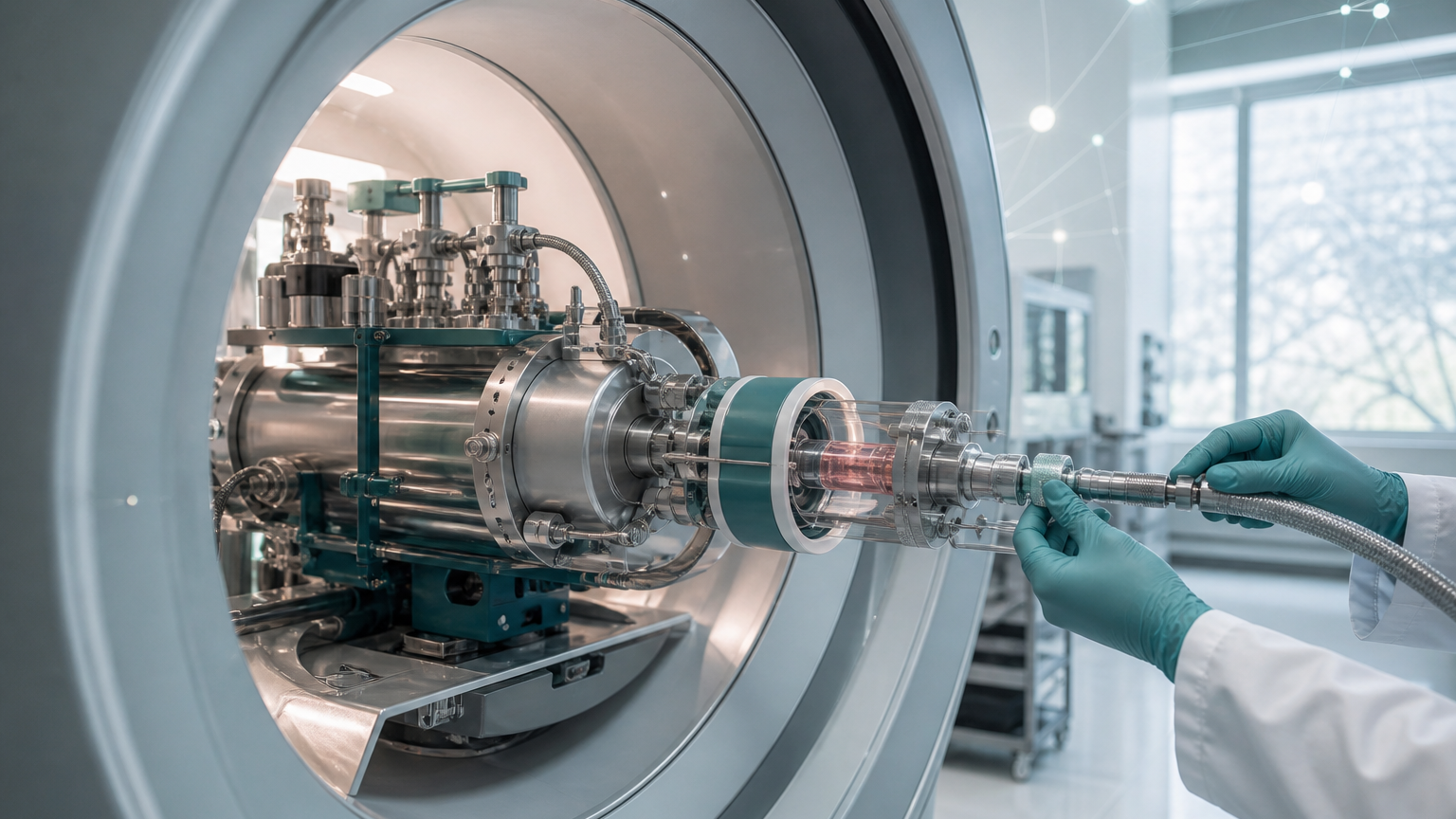
The RESQ consortium plans to install NVision's POLARIS platform at Yonsei University in early 2027. Backed by €2,572,500 in Horizon Europe funding, the three-year program joins NVision, Yonsei University, Ulm University, and Tesla Dynamic Coils. Together they are building a metabolic MRI installation for higher-resolution research on brain metastases. The public project record assigns concrete work: reproducible parahydrogen generation and storage, tailored radiofrequency pulses, compressed sensing, machine learning, and dedicated dual-tuned brain coils. These details turn a broad quantum-health ambition into a dated engineering program with named owners.
The scanner is only one part of the workflow
Hyperpolarization can strengthen the MRI signal from selected metabolic agents for a limited period, allowing researchers to study what tissue is doing alongside its anatomy. That advantage can disappear if gas preparation, sample transfer, coil performance, pulse design, or image reconstruction varies. RESQ therefore has to integrate chemistry, hardware, software, scanner time, and operating procedure. Its stated goal of doubling spatial resolution is a consortium target. The current public record does not report a completed Yonsei installation, a disease-model result, a patient study, diagnostic accuracy, or a change in treatment.
Preclinical work is the next meaningful test
Yonsei is expected to validate the workflow using preclinical brain metastasis models. That stage can show whether the complete system produces stable metabolic maps in biologically relevant models and whether smaller lesions become more visible. It cannot yet establish performance in patients. Quentir reads RESQ as a quantum-sensing implementation program at TRL 4 of 9: the underlying hyperpolarization platform operates in research settings, while the new disease-specific workflow still awaits installation and integrated preclinical validation. The decisive question for the project period ending in April 2029 is whether preparation, acquisition, coil behavior, and reconstructed images can be reproduced beyond one expert site. A portable workflow would move quantum sensing closer to useful medical infrastructure; a result dependent on one installation would leave clinical translation much farther away.