What Yonsei's Metabolic MRI Installation Has to Prove
Quentir Medicine Monitor
Evidence-based insights for quantum medicine. Published by Quentir Systems LLC · August 16, 2026.
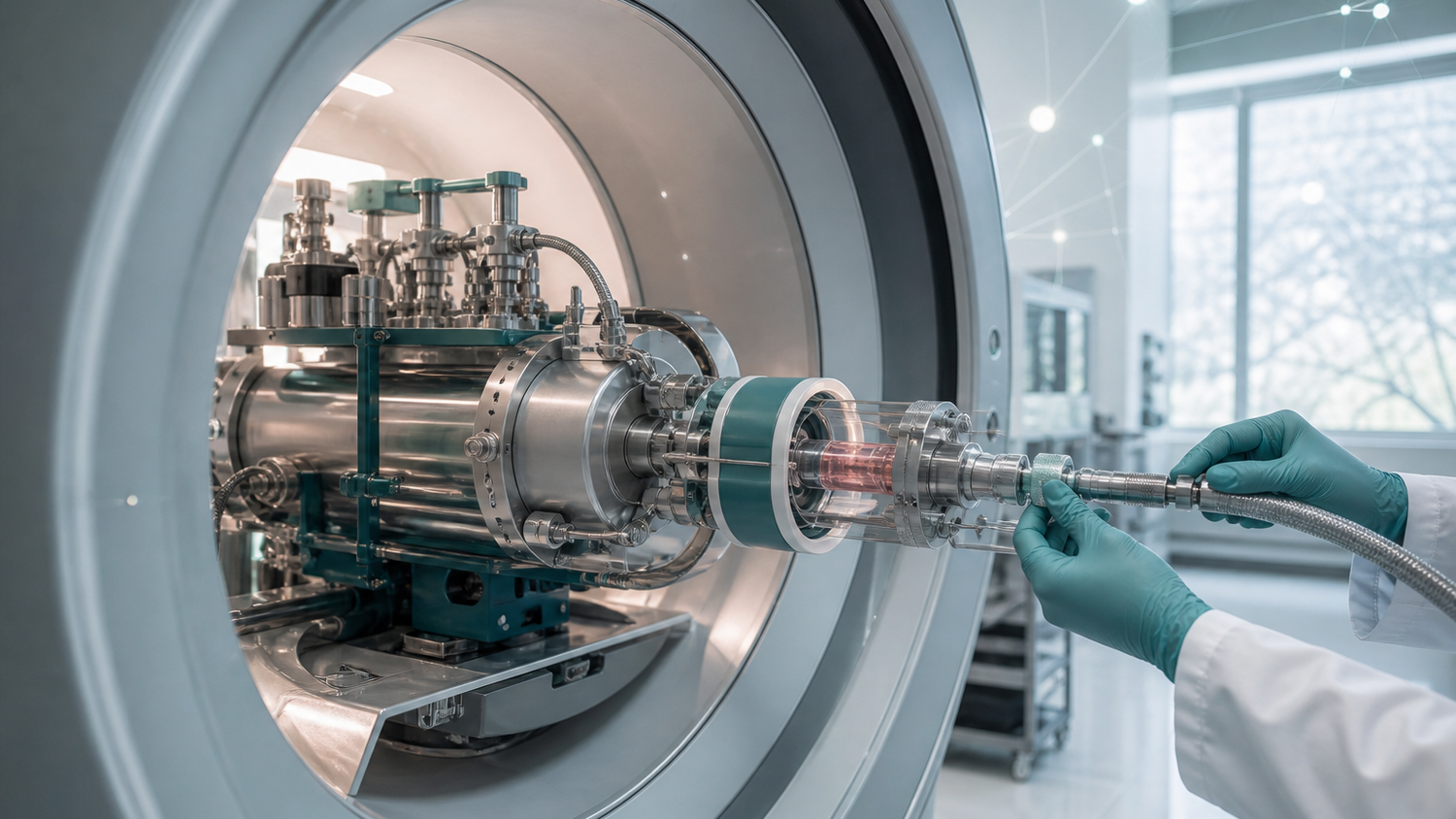
Metabolic imaging asks MRI to do more than draw anatomy. It tries to show what tissue is doing, which can matter when a small tumor and the surrounding brain look similar on a conventional structural scan.
A new European and South Korean project is turning that ambition into a metabolic MRI installation with a named site, partners, budget and delivery window. The RESQ consortium plans to install NVision's POLARIS platform at Yonsei University in early 2027, then test a higher-resolution workflow on preclinical brain metastasis models.
The project has clinical purpose, though it has not yet produced a clinical result. Its immediate value lies in the implementation stack around the scanner: hyperpolarization, gas handling, pulse design, image reconstruction, radiofrequency coils, research infrastructure, and biological validation. Each piece has to work together before metabolic images can carry dependable information about small lesions.
Practical takeaway. RESQ is a funded research installation with a concrete university medical-research setting and a preclinical endpoint. Its claims about finer images and wider translation remain project targets until the integrated system is installed, tested and reproduced.
A funded project has a concrete deployment window
NVision's July 28 announcement describes RESQ as a three-year Horizon Europe project led by NVision with Yonsei University, Ulm University, and Tesla Dynamic Coils. It schedules POLARIS for deployment at Yonsei in early 2027. The partners intend to develop a higher-resolution hyperpolarized MRI workflow for brain-metastasis research and validate it in preclinical models.
The public grant record is unusually useful here. The European Commission's CORDIS entry for grant 101297341 lists a May 1, 2026 start, an April 30, 2029 end and €2,572,500 in total cost and EU contribution. It also names the participating institutions and divides the technical work into specific parts: reproducible parahydrogen generation and storage, tailored radiofrequency pulses and compressed sensing, plus machine learning and dedicated dual-tuned brain coils.
Those details make the announcement more than a loose statement of interest. Money, owners, dates and work packages are attached. They also expose the limits of the current record. The program has started, while the Yonsei installation and disease-specific validation still lie ahead. The stated aim of doubling spatial resolution is a target for the consortium, not a measured outcome from a completed study.
The instrument is larger than the polarizer
Hyperpolarized MRI begins with a sensitivity problem. Conventional MRI detects signals from atomic nuclei, but metabolic agents often produce signals too weak or too short-lived for useful real-time imaging. Hyperpolarization prepares selected molecules in a highly ordered spin state so their signal becomes much stronger for a limited period. Researchers can then follow how the labeled molecule is converted inside tissue, which offers a view of metabolism alongside structure.
In RESQ, the polarizer is one component within an integration stack. Parahydrogen must be generated and stored reproducibly. A prepared metabolic agent has to move from the polarization system to the MRI workflow within a practical time window. The scanner needs pulse sequences that use the available signal efficiently. Reconstruction software has to turn sparse, rapidly changing measurements into interpretable images. A specialized coil must transmit and receive at the relevant frequencies while fitting the anatomy and scanner geometry.
Reliability is therefore distributed across hardware, chemistry, software and operating procedure. A stronger signal can be lost through a slow transfer, an ill-fitted coil, inconsistent preparation, motion or a reconstruction method that performs differently across samples. The clinical-research setting adds maintenance and training alongside routine performance checks and compatibility with existing MRI infrastructure. RESQ's importance comes partly from treating those dependencies as one implementation program.
The medical-research context sharpens the commercial question as well. A research center does not acquire an isolated physics effect. It hosts equipment and staff, along with gas supplies, sample handling, scanner time, software and a validation protocol. The useful unit is the repeatable workflow that survives handoffs between physicists, radiologists, engineers and laboratory teams.
Quantum pillar: sensing. Technology readiness: TRL 4 of 9. The underlying hyperpolarization platform operates in research settings, while the RESQ brain-imaging workflow still awaits installation and preclinical validation at Yonsei before any patient study.
Preclinical validation is the hinge
Brain metastases are a demanding test case because lesions can be small, numerous and difficult to characterize from anatomy alone. Treatment may also change the appearance of a lesion without resolving the question of what the tumor cells are doing. Metabolic information could help researchers distinguish active disease from treatment-related change, but that benefit must be established through carefully designed studies.
RESQ places Yonsei's planned work in preclinical brain metastasis models. That endpoint is meaningful and bounded. It can test whether the integrated workflow produces stable metabolic measurements in biologically relevant models, whether smaller lesions become visible, and whether the imaging signal corresponds to known features of the disease model. It cannot establish diagnostic accuracy in patients or show that a scan changes treatment and improves outcomes.
The consortium's resolution target deserves the same discipline. Doubling spatial resolution could make a real difference when lesions measure only a few millimeters. Yet resolution is one part of image quality. Signal-to-noise ratio, acquisition time, field uniformity, repeatability, and reconstruction bias also matter. A sharper image that varies from run to run would be difficult to use as a biological measure.
The involvement of Tesla Dynamic Coils is therefore consequential. Dedicated multinuclear brain coils are not decorative accessories. Their geometry, tuning, sensitivity profile, and reproducibility shape what the scanner can receive. Ulm's work on acquisition and reconstruction addresses another part of the same chain. The planned result is an integrated measurement system, not a single upgraded component.
The buyer sees an integration program
For a medical center, the 2027 installation will create several kinds of information at once. Technical teams will learn how the platform fits existing scanners and facilities. Imaging researchers will see whether preparation and acquisition can be repeated across sessions. Oncology investigators will learn whether the metabolic maps add useful detail in the chosen models. Procurement and research leadership will gain a clearer view of staffing, consumables, service demands and dependencies.
That makes RESQ an institutional experiment as much as a physics project. The project connects European hardware and imaging expertise with a South Korean university medical-research base. Its longer-term ideas include researcher exchanges, supply-chain development, and contributions to hyperpolarized MRI standards. Those ambitions depend on the installation generating a method that another center can reproduce without relying on tacit knowledge held by a small founding team.
Patients remain several steps away. After preclinical performance comes human-study design, ethics and regulatory review, safety work for the agent and workflow, comparison against existing imaging, and proof that the added metabolic information changes a clinically important decision. The project announcement uses the language of clinical translation. The public record places that translation beyond the current funded build-and-validate phase.
How Quentir Reads It
Quentir reads RESQ as a strong example of quantum medicine becoming an installation problem. The quantum contribution is specific: hyperpolarization increases the detectable MRI signal from metabolic agents. The development program then surrounds that effect with gas handling, pulse engineering, coils, reconstruction, and a disease model. That architecture is intellectually important because it shows where a laboratory advantage can disappear on the route to care.
The project also offers a clean way to read future announcements. Installation at Yonsei in early 2027 will be a hardware and infrastructure milestone. A reproducible preclinical result will be a biological-validation milestone. A later patient study would open a clinical chapter. Keeping those dates and endpoints separate gives the work credit for what has been funded without borrowing confidence from results that do not yet exist.
By April 2029, RESQ should be judged less by the glow of a stronger MRI signal than by whether its complete workflow can travel. If another research center can reproduce the preparation, acquisition, coil performance and metabolic maps, the project will have moved quantum sensing closer to useful medical infrastructure. If the result remains local to one expert installation, the science may still be valuable, but the path to routine care will remain narrow.
Sources
Primary source: NVision Quantum Technologies, “NVision Advances Its Quantum Platform With Expansion Into South Korea,” published July 28, 2026. Project record and consortium details: European Commission CORDIS fact sheet for RESQ, grant agreement 101297341, last updated June 12, 2026.