QClairvoyance Splits Eight Small Ligand-Like Molecules Into Fragments on IBM Quantum Computers: What Its Journal of Chemical Physics Study of 19 October 2026 Shows
What QClairvoyance ran on IBM quantum processors, and what its Journal of Chemical Physics study shows
Quentir Medicine Monitor
Evidence-based insights for quantum medicine.
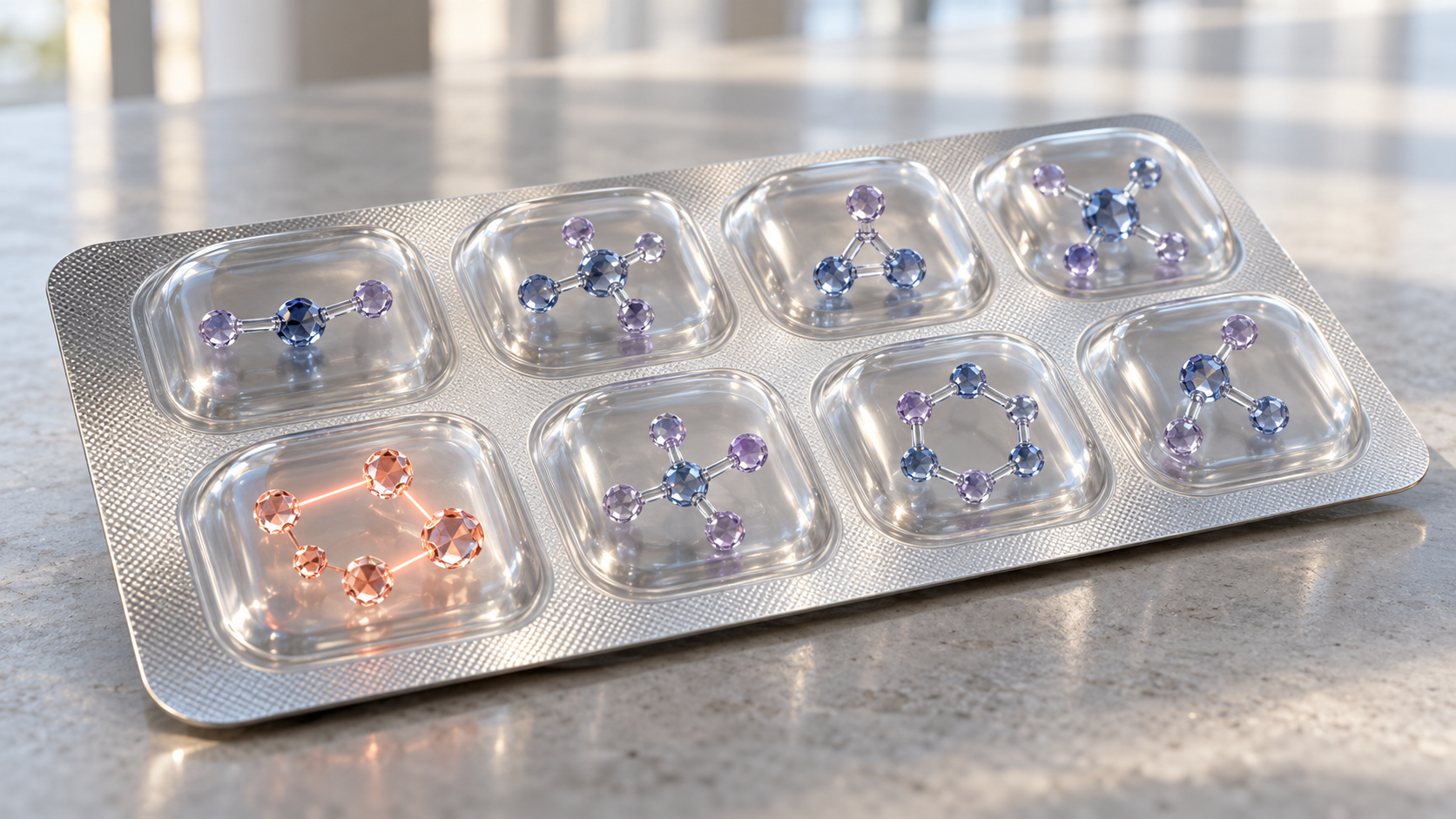
QClairvoyance Quantum Labs, a start-up in Secunderabad, India, has published a study in which eight small molecules of the kind medicinal chemists use as building blocks were simulated on IBM superconducting quantum processors. The paper appeared online in The Journal of Chemical Physics on 19 October 2026 and combines sample-based quantum diagonalization with density matrix embedding, so that each molecule is cut into pieces small enough for current hardware.
Every molecule's computed ground-state energy landed within chemical accuracy, the conventional 1 kcal/mol error benchmark in computational chemistry. The yardstick was an exact classical calculation of the same fragmented problem, which makes the result checkable. The molecules weigh between 40 and 76 daltons, while most oral drugs weigh several hundred, and the calculations used STO-3G, the smallest standard basis set.
The Economic Times, which interviewed founder Col. Sai Shankar P, a former technical manager to India's National Quantum Mission, described the findings as an initial proof of concept and not yet a breakthrough in drug discovery. That reading matches the paper itself.
The peer-reviewed article, in volume 165 of the journal as article 154108, lists Ashish Kumar Patra, Anurag K. S. V., Sai Shankar P., Ruchika Bhat, Raghavendra V., Rahul Maitra and Jaiganesh G., the corresponding author. Five work at QClairvoyance, with Bhat also at the University of Arizona. Raghavendra V. is at the SRM Institute of Science and Technology in Chennai and Maitra at the Indian Institute of Technology Bombay; the paper declares that both are paid consultants to the company. A preprint on arXiv first appeared on 27 November 2025 and was last revised on 17 July 2026.
The eight molecules are cyanic acid, formaldehyde oxime, O-methylhydroxylamine, methyl isocyanate, acetaldehyde oxime, urea, nitrosyl chloride and hydroxythiocyanate. The authors chose them because they lack the tidy symmetry of molecules used in earlier tests and mix different kinds of chemical bonds. They note that urea derivatives and compounds related to methoxyamine already have a place in medicinal chemistry. None of the eight is a drug candidate, and the paper makes no such claim.
The main runs took place on 4 and 5 June 2025 on ibm_sherbrooke, a 127-qubit IBM Eagle processor. A second experiment on hydroxythiocyanate used ibm_boston, an IBM Heron processor. The work ran on IBM Quantum Credits from the IBM Quantum Startups Program, and the authors report no specific grant funding.