Quentir Medicine Monitor
Evidence-based insights for quantum medicine. Published by Quentir Systems LLC · October 29, 2026.
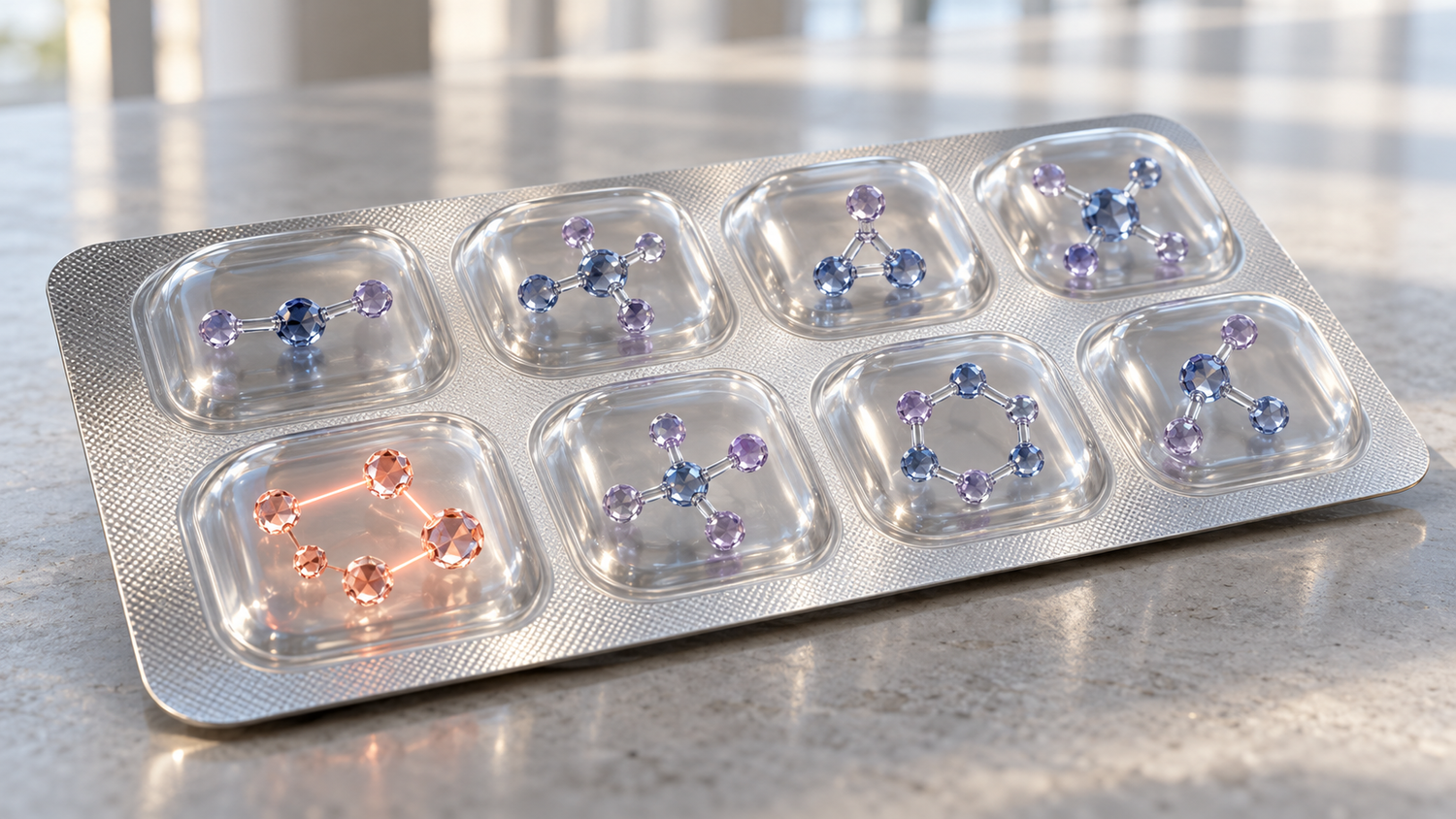
QClairvoyance Quantum Labs, a start-up in Secunderabad, India, has published a study in which eight small molecules of the kind medicinal chemists use as building blocks were simulated on IBM superconducting quantum processors. The paper appeared online in The Journal of Chemical Physics on 19 October 2026 and combines sample-based quantum diagonalization with density matrix embedding, so that each molecule is cut into pieces small enough for current hardware.
Every molecule's computed ground-state energy landed within chemical accuracy, the conventional 1 kcal/mol error benchmark in computational chemistry. The yardstick was an exact classical calculation of the same fragmented problem, which makes the result checkable. The molecules weigh between 40 and 76 daltons, while most oral drugs weigh several hundred, and the calculations used STO-3G, the smallest standard basis set.
The Economic Times, which interviewed founder Col. Sai Shankar P, a former technical manager to India's National Quantum Mission, described the findings as an initial proof of concept and not yet a breakthrough in drug discovery. That reading matches the paper itself.
What the seven authors from QClairvoyance, IIT Bombay and SRM ran on IBM's Eagle and Heron processors
The peer-reviewed article, in volume 165 of the journal as article 154108, lists Ashish Kumar Patra, Anurag K. S. V., Sai Shankar P., Ruchika Bhat, Raghavendra V., Rahul Maitra and Jaiganesh G., the corresponding author. Five work at QClairvoyance, with Bhat also at the University of Arizona. Raghavendra V. is at the SRM Institute of Science and Technology in Chennai and Maitra at the Indian Institute of Technology Bombay; the paper declares that both are paid consultants to the company. A preprint on arXiv first appeared on 27 November 2025 and was last revised on 17 July 2026.
The eight molecules are cyanic acid, formaldehyde oxime, O-methylhydroxylamine, methyl isocyanate, acetaldehyde oxime, urea, nitrosyl chloride and hydroxythiocyanate. The authors chose them because they lack the tidy symmetry of molecules used in earlier tests and mix different kinds of chemical bonds. They note that urea derivatives and compounds related to methoxyamine already have a place in medicinal chemistry. None of the eight is a drug candidate, and the paper makes no such claim.
The main runs took place on 4 and 5 June 2025 on ibm_sherbrooke, a 127-qubit IBM Eagle processor. A second experiment on hydroxythiocyanate used ibm_boston, an IBM Heron processor. The work ran on IBM Quantum Credits from the IBM Quantum Startups Program, and the authors report no specific grant funding.
How cutting each molecule into one-atom fragments kept the main benchmark on ibm_sherbrooke at 30 qubits or fewer
Density matrix embedding theory treats one atom at a time as a fragment and adds a small set of bath orbitals that stand in for the rest of the molecule. Only that combined piece goes to the quantum processor. For hydroxythiocyanate the whole molecule would have needed 50 qubits in this basis. In the main benchmark on ibm_sherbrooke the largest piece, around the sulfur atom, needed 30, and the deepest circuit in that benchmark ran to 1,081 layers of gates.
The quantum step itself follows a method IBM and RIKEN researchers described in Science Advances in June 2025. The processor samples likely arrangements of electrons, 10,000 shots per fragment in this study. A classical computer then repairs samples that noise has pushed into impossible states, keeps the most important arrangements and solves for the energy. The authors stress that the classical post-processing carries most of the computational load, and they applied no further error-handling technique to the circuits. Table 1 of the preprint lists between 62 and 165 seconds of quantum processor time per molecule.
Quantum pillar: simulation. Technology readiness: TRL 3 of 9. The method has run on real IBM quantum hardware for eight very small molecules and matched an exact classical answer, and the study does not apply it to a molecule large enough to be a medicine or use it to choose a compound for laboratory testing.
Why matching an exact classical answer for molecules under 76 daltons leaves drug design questions open
The reference calculation, called DMET-FCI, solves each fragment exactly on a classical computer. Because both methods share the same fragments and settings, any shared error cancels, and the comparison isolates how well the quantum sampler reproduced the exact solver. The reported differences stayed below 0.00001 hartree, about 160 times tighter than the chemical accuracy line. That is a clean test of the quantum step. It cannot show whether the fragmented, minimal-basis model describes the real molecules well, since the authors accept that one-atom fragments that cut through double bonds may introduce large errors of their own.
Scale is the second gap. Every problem in the study is small enough to be solved exactly on a classical machine, which is how the authors could check it. Drug design needs energies for molecules of several hundred daltons, often bound to a protein, in larger basis sets. Quentir has followed earlier hardware steps of this kind, such as the study in which A*STAR put an 18-variable drug-docking problem on six qubits of IBM's ibm_kingston; each one reports progress on problems that classical computers can still handle.
The hydroxythiocyanate experiment on ibm_boston adds a practical warning. The authors tried six settings, from 10-5 to 10-15, for the threshold that decides how many environment orbitals join each fragment. Tightening it grew the sulfur fragment from 26 to 36 qubits, and the tightest setting gave a worse energy than a middle setting, because the enlarged sulfur fragment was undersampled on the hardware. A larger fragment is therefore not automatically a more accurate one, and the right threshold has to be tuned for each molecule.
What QClairvoyance plans for pharmaceutical partners, and what hospital and drug buyers can watch for
QClairvoyance works in three areas: quantum cybersecurity, quantum education and quantum-assisted drug discovery. In an interview with The New Indian Express on 22 October 2026, Sai Shankar said the company is building a drug discovery pipeline and hopes to shorten a roughly ten-year development timeline by one or two years. He added that any such saving would have to be established through testing and that any resulting drug would still need laboratory studies and clinical trials. He also said the company sees a stronger market overseas, because much drug discovery activity takes place in Europe and the United States.
Patients and hospital formularies will see no change from this study. Three results would make the next paper more relevant to medicine: energies for molecules in the size range of real drug candidates, calculations in larger basis sets that classical methods find hard, and a case in which the quantum result changed which compound a chemistry team decided to make and test.
Sources
Primary source: the Journal of Chemical Physics article of 19 October 2026 by Ashish Kumar Patra, Anurag K. S. V., Sai Shankar P., Ruchika Bhat, Raghavendra V., Rahul Maitra and Jaiganesh G. of QClairvoyance Quantum Labs, the University of Arizona, the SRM Institute of Science and Technology and IIT Bombay, with its arXiv preprint. Also drawn on: the Science Advances paper of June 2025 by Javier Robledo-Moreno and colleagues at IBM and RIKEN, The Economic Times interview republished by inkl on 28 October 2026, The New Indian Express interview of 22 October 2026, and earlier Quentir coverage.