Tanaka Precious Metal Technologies and Nagoya University Develop Lead-Free Silver Quantum Dots for Shortwave Infrared Sensing, With Samples From January 2027
What Tanaka and Nagoya University developed for shortwave infrared sensing
Quentir Medicine Monitor
Evidence-based insights for quantum medicine.
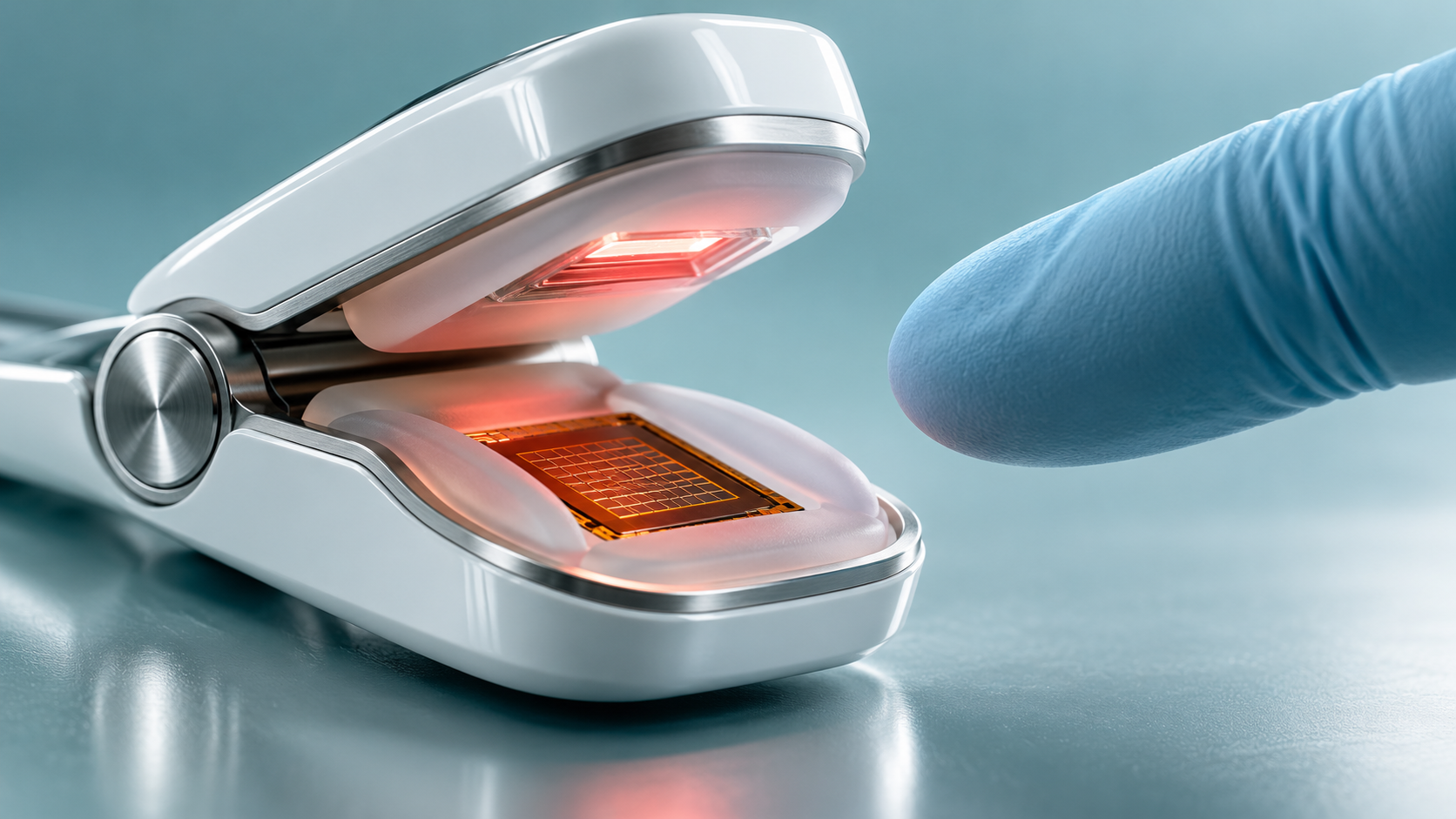
Tanaka Precious Metal Technologies and the Torimoto Laboratory at Nagoya University have developed lead-free quantum dots made of silver, sulfur and tellurium that respond to near-infrared and shortwave infrared light. The company says it will begin supplying samples of the material in January 2027 and expects uses in consumer electronics and in the medical field.
The announcement went out on 20 October 2026. In Tanaka's own test, a simple light sensor that used the silver, sulfur and tellurium dots as its light-absorbing layer reached a maximum external quantum efficiency of 18.4 percent for light between 1,200 and 1,700 nanometers, according to Dellows News' Japanese-language article based on the company's release. The trade journal Compound Semiconductor reported the same figures on 20 October, along with the two conferences where the material will be shown: Okinawa Colloids from 1 to 6 November and nano tech 2026 in Tokyo from 16 to 18 December.
The work addresses a materials problem that has slowed infrared sensing for years. The standard detector material for this band, indium gallium arsenide, detects light out to about 1,700 nanometers with high sensitivity. It is made with vacuum processes, which makes yield and cost hard to control in volume, and Tanaka notes that indium supply is under pressure from demand in other advanced industries. Quantum dots of lead sulfide can be printed over large areas instead, and the release says sensors made that way cost about one tenth as much as indium gallium arsenide sensors.
Lead is the catch. The European Union's RoHS Directive restricts ten substances in electrical and electronic equipment, with lead and cadmium among them, and it applies to every product with an electrical or electronic component unless that product is specifically excluded. Tanaka says the lead content of lead sulfide dots has limited their use in consumer electronics. The new dots contain neither lead nor cadmium and still cover a similar range of wavelengths.
For readers in medicine, the interest lies in the wavelengths. The release states that light between 1,200 and 1,700 nanometers passes readily into materials and into the inside of the body, is less affected by sunlight and bad weather, and is safer for the human eye. It lists biological sensing among the applications, alongside smartphone face recognition, 3D sensing, wearable devices and automotive lidar. Those are the company's general statements about the band. How deep the light reaches and what exposure is safe depend on wavelength, tissue and light intensity, and the announcement offers no medical-device safety data.

University of South Africa Quantum Dot Sensor Recovers Added SARS-CoV-2 Spike Protein From Wastewater Samples: The June 2026 Discover Electrochemistry Paper
Quantum dot sensor for SARS-CoV-2 in wastewater
Quentir Medicine Monitor
Evidence-based insights for quantum medicine.
Wastewater can show that an infection is spreading through a community before clinical case counts catch up. Reading that signal usually means shipping samples to a laboratory with PCR equipment and trained staff, which many rural districts and smaller municipalities do not have.
A team at the University of South Africa's Institute for Nanotechnology and Water Sustainability has built a small electrochemical sensor aimed at that gap. In a paper published in Discover Electrochemistry on 29 June 2026, Nolwazi T. Gazu, Xolile Fuku, Zikhona N. Cabunda, Bhekie B. Mamba and Usisipho Feleni describe an aptasensor that pairs the conducting polymer polyaniline with gadolinium telluride selenide quantum dots to detect the SARS-CoV-2 spike protein. The team reports a limit of detection of 0.04 femtomolar, measured in buffered saline, a figure that places the device among the most sensitive electrochemical approaches published for this target, according to a summary of the work that Bioengineer.org posted on 30 September 2026.
For hospital infection-control teams and public health laboratories, the interest lies in wastewater surveillance that could one day run closer to the treatment plant. The Monitor reads the paper as a careful laboratory result with a clear next step. The sensor has been tested on real effluent to which purified spike protein was added, and it now needs testing on wastewater that carries the virus naturally.
Polyaniline is a cheap, robust polymer that conducts electricity, which makes it attractive for low-cost electrodes. Its weakness is that conductivity drops sharply at neutral pH, the condition under which environmental water samples are usually analyzed. The researchers grew the polymer directly on a glassy carbon electrode and co-deposited the quantum dots with it. Quantum dots are semiconductor nanocrystals whose electronic properties follow from quantum confinement, the effect that appears when a crystal is only a few to a few dozen nanometers across. Here they act as electron mediators, lowering the resistance to charge transfer and compensating for the polymer's weakness at neutral pH. X-ray diffraction put the crystallite sizes between 10 and 32 nanometers, with an average of 17.