Quentir Medicine Monitor
Evidence-based insights for quantum medicine. Published by Quentir Systems LLC · October 25, 2026.
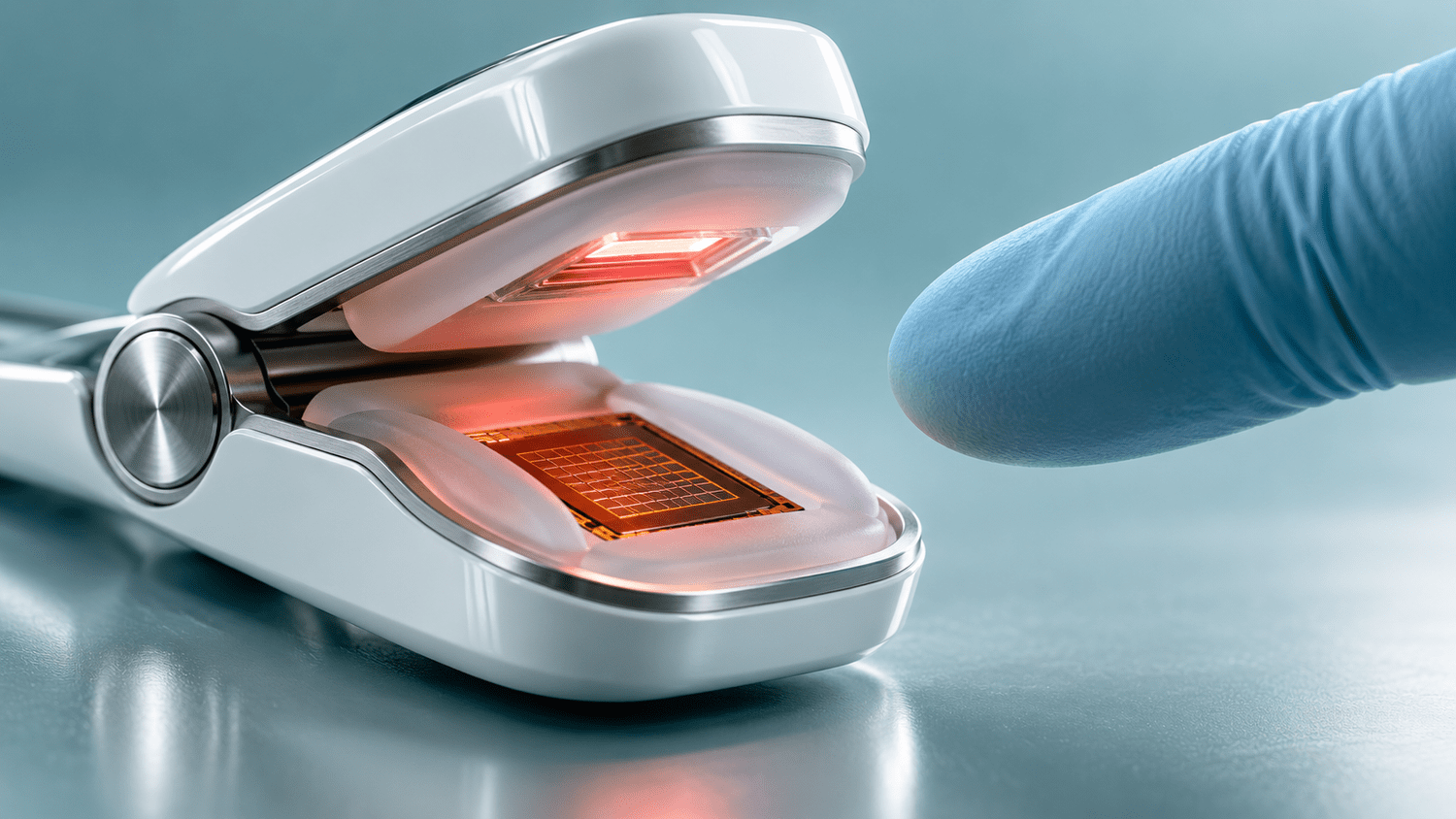
Tanaka Precious Metal Technologies and the Torimoto Laboratory at Nagoya University have developed lead-free quantum dots made of silver, sulfur and tellurium that respond to near-infrared and shortwave infrared light. The company says it will begin supplying samples of the material in January 2027 and expects uses in consumer electronics and in the medical field.
The announcement went out on 20 October 2026. In Tanaka's own test, a simple light sensor that used the silver, sulfur and tellurium dots as its light-absorbing layer reached a maximum external quantum efficiency of 18.4 percent for light between 1,200 and 1,700 nanometers, according to Dellows News' Japanese-language article based on the company's release. The trade journal Compound Semiconductor reported the same figures on 20 October, along with the two conferences where the material will be shown: Okinawa Colloids from 1 to 6 November and nano tech 2026 in Tokyo from 16 to 18 December.
The work addresses a materials problem that has slowed infrared sensing for years. The standard detector material for this band, indium gallium arsenide, detects light out to about 1,700 nanometers with high sensitivity. It is made with vacuum processes, which makes yield and cost hard to control in volume, and Tanaka notes that indium supply is under pressure from demand in other advanced industries. Quantum dots of lead sulfide can be printed over large areas instead, and the release says sensors made that way cost about one tenth as much as indium gallium arsenide sensors.
Lead is the catch. The European Union's RoHS Directive restricts ten substances in electrical and electronic equipment, with lead and cadmium among them, and it applies to every product with an electrical or electronic component unless that product is specifically excluded. Tanaka says the lead content of lead sulfide dots has limited their use in consumer electronics. The new dots contain neither lead nor cadmium and still cover a similar range of wavelengths.
For readers in medicine, the interest lies in the wavelengths. The release states that light between 1,200 and 1,700 nanometers passes readily into materials and into the inside of the body, is less affected by sunlight and bad weather, and is safer for the human eye. It lists biological sensing among the applications, alongside smartphone face recognition, 3D sensing, wearable devices and automotive lidar. Those are the company's general statements about the band. How deep the light reaches and what exposure is safe depend on wavelength, tissue and light intensity, and the announcement offers no medical-device safety data.
What Tanaka and Nagoya University's Torimoto Laboratory reported on 20 October 2026
The material is a compound semiconductor quantum dot built mainly from a precious metal. Quantum dots are crystals a few nanometers across, small enough that their size sets which colors of light they absorb and emit. That property lets chemists tune a dot to a chosen band by adjusting its composition and particle size, which is the work Tanaka says it is continuing with Nagoya University: control of composition, control of particle size, and surface modification, so that absorption and emission can be matched to a customer's needs.
Because the dots can be applied by printing, without a vacuum chamber, Tanaka expects simpler manufacturing and lower process costs. The company also plans to use its long experience in precious metal recycling. Offcuts from production and used samples would be collected and refined so that the silver can be recovered, which Tanaka says should lower the cost of first evaluations and of running production later.
The 18.4 percent figure needs careful reading. External quantum efficiency is the share of incoming photons that a detector turns into collected electrical charge. Tanaka measured it on a simplified sensor in its own laboratory, and the release does not report noise, response speed, operating stability or results from an independent laboratory. The release also mentions, in one sentence, that the company has developed a light-emitting material from highly biocompatible elements and expects biomedical uses for it. That is a separate material, and the announcement gives no further data on it.
Quantum pillar: sensing. Technology readiness: TRL 4 of 9. This is Quentir's assessment of the detector material, not of any medical device: the quantum dots have worked as the light-absorbing layer of a simple sensor in the company's own laboratory test, and samples follow in January 2027, while no medical device, animal study or patient measurement has been reported.
Why the 1,200 to 1,700 nanometer band matters for imaging through skin and tissue
Biomedical optics has studied this part of the spectrum for more than a decade. Light between roughly 1,000 and 1,700 nanometers, often called the second near-infrared window, scatters less in tissue than visible or shorter near-infrared light, and tissue gives off less background glow there. Guosong Hong, Alexander Antaris and Hongjie Dai reviewed that evidence in Nature Biomedical Engineering in 2017, describing how imaging in this window can show blood vessels and other structures more clearly and at greater depth in animal studies. Much of that imaging depends on indium gallium arsenide cameras, the same costly detector material Tanaka wants to replace.
A cheaper, printable and lead-free detector would matter most at the edges of medicine where cost and device size decide adoption. Wearable sensors, handheld scanners and disposable or semi-disposable devices are price-sensitive, and many hospitals buy them in large numbers. Tanaka does not name a medical product, a clinical partner or a target device, so any specific medical use remains the reader's projection for now.
Quantum dots already appear in medical research in other roles. Quentir looked at one of them in a University of South Africa quantum dot sensor that recovered added SARS-CoV-2 spike protein from wastewater samples, where the dots served as part of an electrochemical test. The Tanaka material works as a light detector, which places it closer to cameras and optical sensors. The Quentir Defense Monitor has covered a very different route to infrared, in which Imperial College London researchers used a silicon camera to image in a thermal infrared band it cannot detect directly. Both lines of work aim at the same practical goal: infrared images without expensive infrared detector chips.
What medical sensor makers and hospital device buyers can check once samples ship in January 2027
Several pieces of evidence would show whether the material can move from a laboratory sensor toward medical devices. The first is independent measurement of efficiency, dark current and noise across the 1,200 to 1,700 nanometer band, ideally in peer-reviewed work from the Nagoya group. The second is stability: how the printed layer holds up over months of operation, heat and humidity, which matters for any device that sits against skin or is cleaned between patients. The third is an imaging array, since a single-pixel sensor and a camera are very different engineering problems.
For buyers of medical equipment, the lead question reaches beyond European rules. A procurement team that asks suppliers about hazardous substances and end-of-life handling gets a simpler answer from a detector that contains neither lead nor cadmium. Tanaka's plan to recover silver from production scrap and used samples also touches the cost of precious metal content, which a buyer will want to see reflected in sample and volume prices.
The Okinawa Colloids meeting in early November and the nano tech exhibition in December are the next places where the group will show the material. The January 2027 sample date is the first point at which device makers outside Tanaka can test the dots in their own designs. Until then, the evidence consists of one company measurement on a simple sensor, together with a well-studied medical reason to want better detectors for this band.
Sources
Primary source: Tanaka Precious Metal Technologies' announcement of 20 October 2026 on the lead-free silver, sulfur and tellurium quantum dot material developed with the Torimoto Laboratory at Nagoya University, read through Dellows News' article based on that release and Compound Semiconductor's report of the same day. Also drawn on: the European Commission's RoHS Directive page, the 2017 review by Hong, Antaris and Dai in Nature Biomedical Engineering, and earlier Quentir coverage.