The MRI Implication of a Single Copper-Oxide Plane
The result is one atomic plane
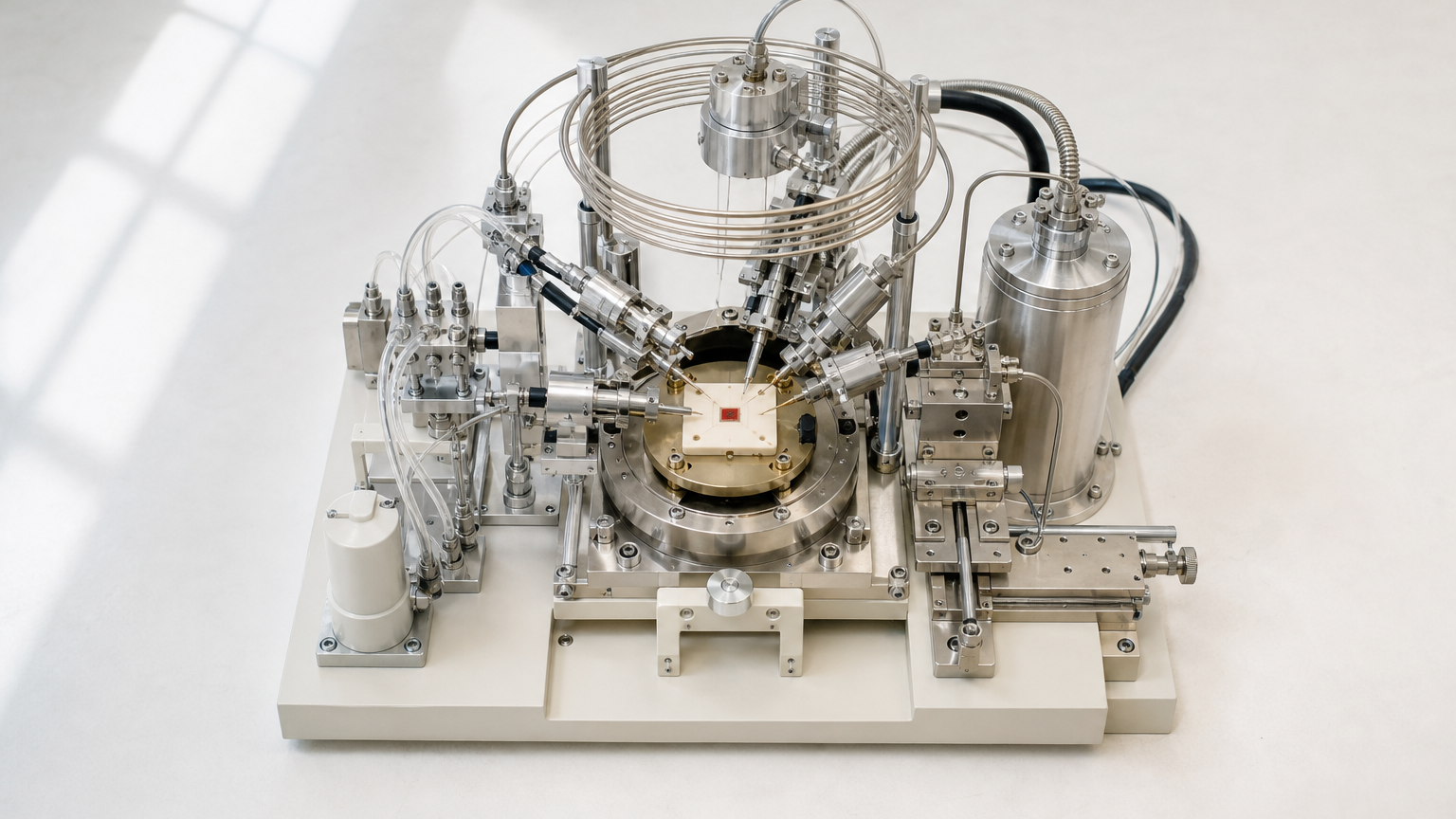
A team led by researchers at Fudan University and the University of Science and Technology of China has fabricated a single-layer cuprate containing one superconducting copper-oxide plane. Published in Nature on August 12, the experiment reduces Bi-2201 to its ultimate two-dimensional limit. The monolayer retained superconductivity, although its optimal transition temperature was about ten percent lower than in thicker material. Fine control of oxygen content then let the researchers follow the sample from an insulating state, through an anomalous metallic regime, and into superconductivity. This is a basic-physics achievement built on delicate fabrication and a laboratory instrument designed for precise in-situ tuning.
The medical relevance begins with the magnet
MRI depends on a strong, stable magnetic field to align protons in the body before radiofrequency pulses and sensors turn their response into anatomical images. That creates an MRI materials pathway for this research, but the connection sits far upstream. The paper reports no magnet winding, imaging coil, scanner prototype, patient study, or medical-device test. Its contribution is a cleaner experimental platform for understanding how high-temperature superconductivity changes when the active material is reduced to one copper-oxide plane.
The distance to care remains useful to measure
A hospital magnet requires far more than a superconducting transition. Engineers need scalable conductors, high current under strong fields, reliable joints, mechanical strength, controlled cooling, quench protection, field homogeneity, and compatibility with a complete scanner. The new monolayer does not answer those engineering questions. It helps make the earlier materials questions more exact. Quentir reads the result as a sensing story at the laboratory-materials stage: credible MRI relevance through superconducting magnet science, paired with a clear boundary around present readiness. The next meaningful step would connect the one-plane physics to a thicker, manufacturable material with measured current or field performance.