The MRI Implication of a Single Copper-Oxide Plane
Quentir Medicine Monitor
Evidence-based insights for quantum medicine. Published by Quentir Systems LLC · August 15, 2026.
Inside every MRI examination, the image begins with a physical bargain. A powerful magnetic field must remain stable enough for weak signals from the body to become anatomy that a radiologist can trust.
A new materials result from China sits far upstream of that clinical moment. Researchers fabricated a single-layer cuprate containing one superconducting copper-oxide plane and mapped how it moved from insulating behavior through an anomalous metallic state into superconductivity. The work opens an MRI materials pathway in the broadest sense: it gives physicists a cleaner experimental platform for understanding a class of superconductors that could eventually influence high-field technologies.
The distance to a scanner remains substantial. The experiment studied a delicate atomic layer in a laboratory, not a magnet winding, imaging coil, or medical device. Its value for medicine lies in what it makes measurable today and what those measurements may teach materials engineers later.
Practical takeaway. The medical importance of this paper is upstream. It improves the experimental control available for studying high-temperature superconductivity, while any benefit to MRI still depends on scalable materials and reliable magnets, followed by safe device engineering and clinical performance.
What did the team actually make?
In the Nature paper published on August 12, Hengsheng Luo and colleagues examined a monolayer of Bi2Sr2CuO6+δ, usually shortened to Bi-2201. The sample contains one CuO2 plane. Cuprate superconductors are layered materials, and those copper-oxide planes carry much of the physics associated with their superconducting state. Reducing the material to one plane gave the researchers an unusually direct view of the two-dimensional limit.
The monolayer still became superconducting, although its optimal transition temperature fell by approximately 10 percent compared with thicker material. That reduction matters because it helps separate the contribution of dimensionality from other changes that often arrive when a crystal is made thinner. The result supports the view that the essential superconducting behavior of this cuprate survives in a single plane, with a measurable cost.
The researchers also pushed the material across a wide phase diagram. By changing oxygen content, they moved the sample from an insulating state into superconductivity. Between those endpoints, at temperatures approaching zero, they observed an anomalous metallic state and a divergent critical exponent. These are basic-physics results. They bear on how superconductivity emerges and disappears when charge concentration changes in an extremely thin system.
Why does one plane change the scientific question?
A thick crystal contains many layers and interfaces. It also contains defects and multiple pathways for current. Those features can blur the cause of a measured transition. A single active plane removes much of that complexity, provided the sample can be fabricated and tuned without destroying it. The paper therefore creates a more controlled setting for asking how electrons organize near the boundary between an insulator and a superconductor.
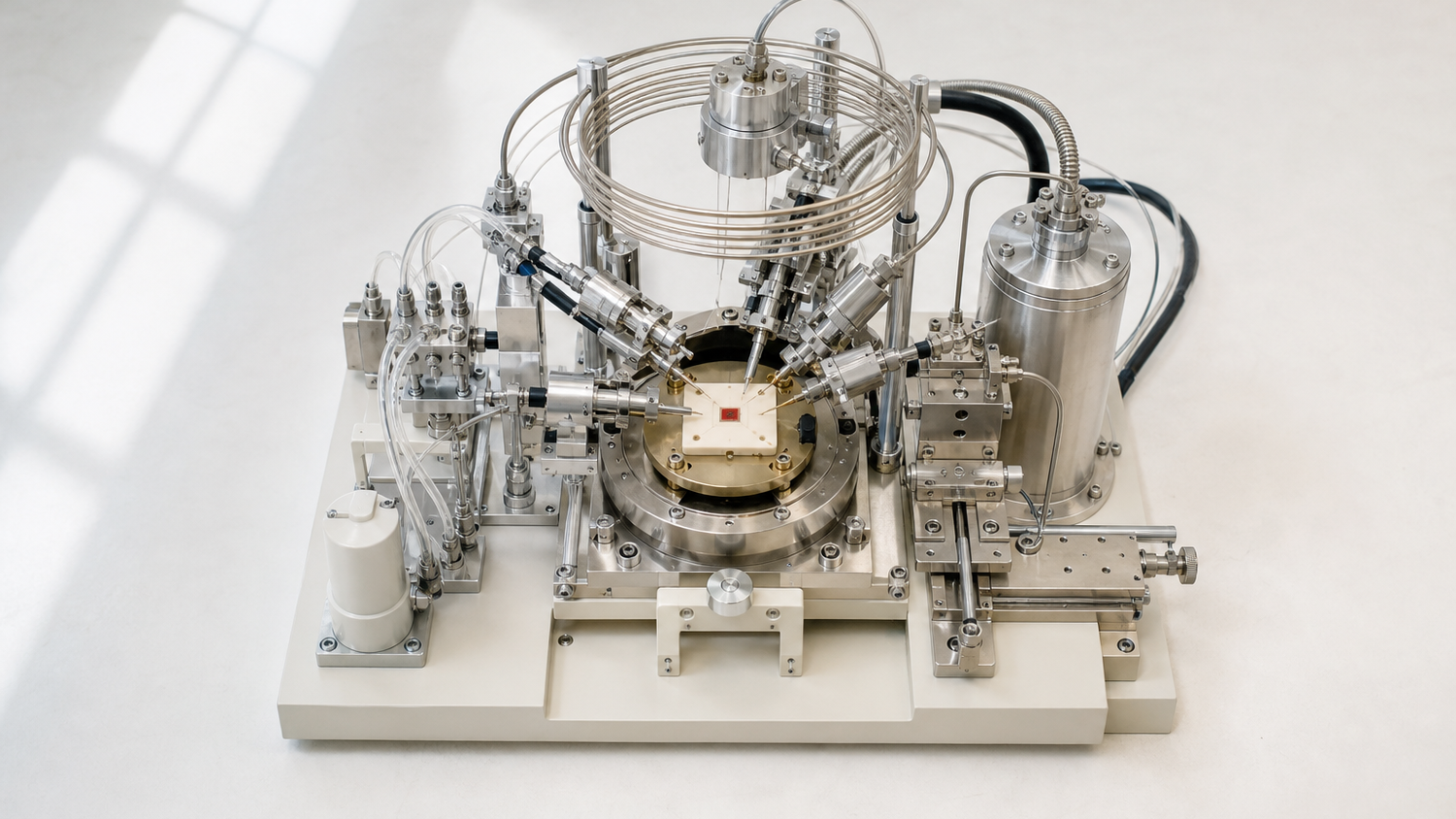
The accompanying Fudan University account carried by The Paper and Sina describes the practical difficulty. The material is fragile, sensitive to air and processing, and hard to hold at a precise oxygen concentration. The group built dedicated instruments and adjusted ozone concentration and temperature in situ. The reported doping resolution was δp ≈ 0.0005. That level of control over oxygenation allowed the team to follow the material through the superconducting dome instead of observing only a few isolated states.
The most interesting connection to medicine comes from that control. Medical hardware rarely benefits from a striking material property alone. Engineers need repeatable fabrication and predictable behavior across production batches. They also need mechanical stability and manageable cooling. The material must then integrate with larger systems. A platform that can expose why a material changes state helps clarify which variables later engineering must hold steady. It also reveals failure modes before anyone mistakes a physics result for a component specification.
Quantum pillar: sensing. Technology readiness: TRL 4 of 9. The single-layer material was fabricated and electrically characterized in a physics laboratory; no MRI magnet, imaging coil, patient study, or medical-device prototype was tested.
Where does MRI enter the story?
The US National Institute of Biomedical Imaging and Bioengineering explains MRI through a simple physical sequence. A strong magnetic field aligns protons in the body. A radiofrequency pulse disturbs that alignment. Sensors then detect the energy released as the protons return toward equilibrium, and those differences help distinguish tissues. The quality of the clinical image depends on a stable, controlled magnetic environment.
Superconducting materials matter because they can carry electrical current with vanishing resistance below a transition temperature. That property supports strong electromagnets, but the usable engineering system is much larger than the superconducting phase itself. A hospital magnet needs conductors made at scale, joints, insulation, structural support, cooling, quench protection, field homogeneity, service procedures, and compatibility with the rest of the scanner.
The Nature paper addresses none of those device requirements. It contributes to the materials knowledge beneath them. Its anomalous metal result may sharpen theories of how two-dimensional cuprates lose superconductivity. Its finely adjustable phase diagram gives researchers a platform for testing those theories. Better theory can guide material design, but a monolayer that works on a laboratory stage is many development cycles away from a conductor carrying useful current around a patient-sized bore.
The distinction protects both science and medicine. Materials physicists can celebrate a clean experimental result without promising a near-term scanner. Imaging specialists can watch the field without treating every high-temperature superconductor headline as a procurement signal. Patients benefit only after a material survives the engineering and regulatory journey that turns a quantum state into a safe, reliable machine.
What remains between an atomic layer and a scanner?
Scale comes first. A single-plane sample is useful precisely because it is controlled and small. Magnet manufacturing asks for long, uniform conductors that keep their properties while being wound and joined. They must hold those properties under cooling and mechanical stress, then through repeated energizing. The variables that make an elegant monolayer experiment possible may become harder to control across industrial lengths and complex geometries.
Performance must also be translated. Transition temperature is only one parameter. Useful magnet materials need high critical current and tolerance of strong fields. They also need mechanical and chemical stability with predictable failure behavior. A roughly ten-percent reduction in optimal transition temperature at the one-plane limit is scientifically informative. It gives no direct answer about current density or magnet economics.
Safety places another set of demands around the material. The US Food and Drug Administration's MRI overview notes that the MR environment combines a strong static field with changing gradient fields and radiofrequency energy. Each brings distinct risks. New magnet materials would enter that existing safety system. Its concerns include device compatibility and heating, as well as projectile and acoustic hazards. Field control and image quality remain separate demands.
Those requirements make the long route worthwhile to describe. A stronger or more manageable magnet could influence scanner footprint and cooling burden. It could also change attainable field strength. Lower operating cost could widen access. Each possibility depends on engineering results absent from this paper. The current achievement is a tunable experimental foundation, valuable because it makes the next materials questions more exact.
How Quentir Reads It
Quentir reads this as an upstream sensing story with an unusually clear boundary. The paper establishes a controllable one-plane cuprate system, an approximately ten-percent transition-temperature change, and an anomalous metallic regime near the superconductor-insulator transition. The Fudan account adds the instrument-building and oxygen-control work that made the phase map possible. Together, the records show serious laboratory craftsmanship and a useful new platform.
The MRI connection is credible at the level of a research trajectory. Powerful magnetic fields are central to MRI, and superconducting materials sit inside the engineering history of those systems. The paper itself offers no medical imaging demonstration. Its contribution is closer to a new wind tunnel for superconductivity: a simplified place where difficult behavior can be measured under controlled conditions before an engineer decides what can travel into a machine.
That analogy also sets the next milestone. A follow-on result that links this one-plane understanding to a thicker, manufacturable conductor with improved current handling or field performance would move the medical relevance forward. Until then, the single copper-oxide plane belongs in the foundation of the MRI story, where basic physics quietly determines which machines may become possible years later.
Sources
Primary source: Hengsheng Luo et al., ‘Superconducting 2D cuprate with a single CuO2 plane,’ Nature, published August 12, 2026, with corresponding authors Xian Hui Chen, Wei Ruan, and Yuanbo Zhang. Laboratory context: Fudan University reporting carried by The Paper and Sina. MRI context: US National Institute of Biomedical Imaging and Bioengineering and US Food and Drug Administration.