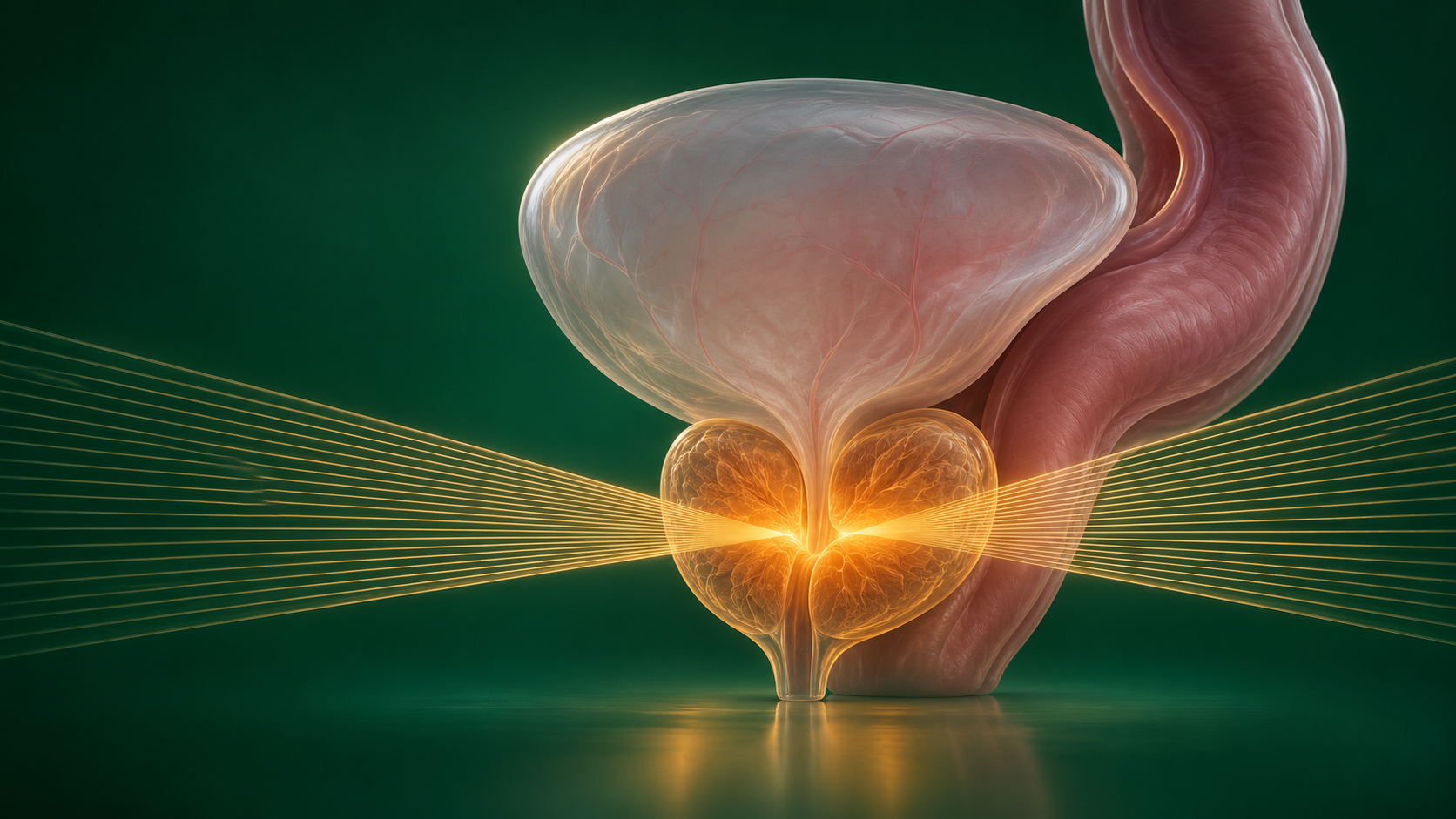
Veneto Institute of Oncology and University of Padova Encode a Prostate IMRT Radiotherapy Plan in 128 Qubits and Solve It With Classical Tensor Networks: arXiv 2611.03987, 2 November 2026
How the Veneto Institute of Oncology and the University of Padova encode a radiotherapy plan in qubits
Quentir Medicine Monitor
Evidence-based insights for quantum medicine.
Medical physicists at the Veneto Institute of Oncology IOV-IRCCS and quantum physicists at the University of Padova have published a method that writes a radiotherapy planning problem in a form a quantum computer could accept. The preprint, posted to arXiv on 2 November 2026, applies an adaptive qubit encoding to a small prostate plan for intensity-modulated radiotherapy, the standard technique that shapes radiation beams around a tumor.
The quantum part of the work stays on paper for now. The authors optimized the qubit problems produced by their method with a tree tensor network, a classical numerical method that runs on ordinary computers and is often used to emulate quantum algorithms, and every computation reported in the paper ran on classical machines. The paper reports no run on quantum hardware, no patient data and no clinical plan, and the authors call the radiotherapy case a proof of principle.
The author list joins the clinic and the physics department. Samuele Cavinato, Marta Paiusco and Alessandro Scaggion work in the IOV medical physics department; Marco Tesoro, Simone Montangero and Ilaria Siloi are at the Padova physics department, its quantum technologies research center and INFN, and Gianluca Morettini is at Université Paris-Saclay. Tesoro also lists the Garching quantum company PlanQC.
Radiotherapy planning is an optimization problem over continuous numbers. Each treatment beam is split into narrow pencil beams, called beamlets, and the planning software chooses an intensity for each one so that the tumor receives its prescribed dose while the bladder, rectum and other organs at risk receive as little as possible. A 2004 review in Cancer Imaging by Taylor and Powell, which the preprint cites, describes this inverse planning as the core of the technique.
A qubit register reads out as a binary string, so the encoding assigns each candidate intensity to one string: two qubits give four computational-basis states and therefore four candidate values. The usual way fixes that grid in advance, over a fixed range. The Padova method gives each beamlet intensity a small register of qubits and lets classical updates between steps move and rescale its four candidate values, so that two qubits can reach a continuous spread of intensities over the course of the optimization. At each step the method builds a local approximation of the cost around the current best plan and writes it as a spin-glass Hamiltonian, an energy function of interacting qubits.
That approximation is the step that matters for hardware. A quantum annealer or a gate-based quantum computer could in principle search for the low-energy state of such a Hamiltonian. In this study the tree tensor network did that work on classical machines; the acknowledgments list computing resources from Cloud Veneto, CINECA and the University of Padova.