Quentir Medicine Monitor
Evidence-based insights for quantum medicine. Published by Quentir Systems LLC · November 6, 2026.
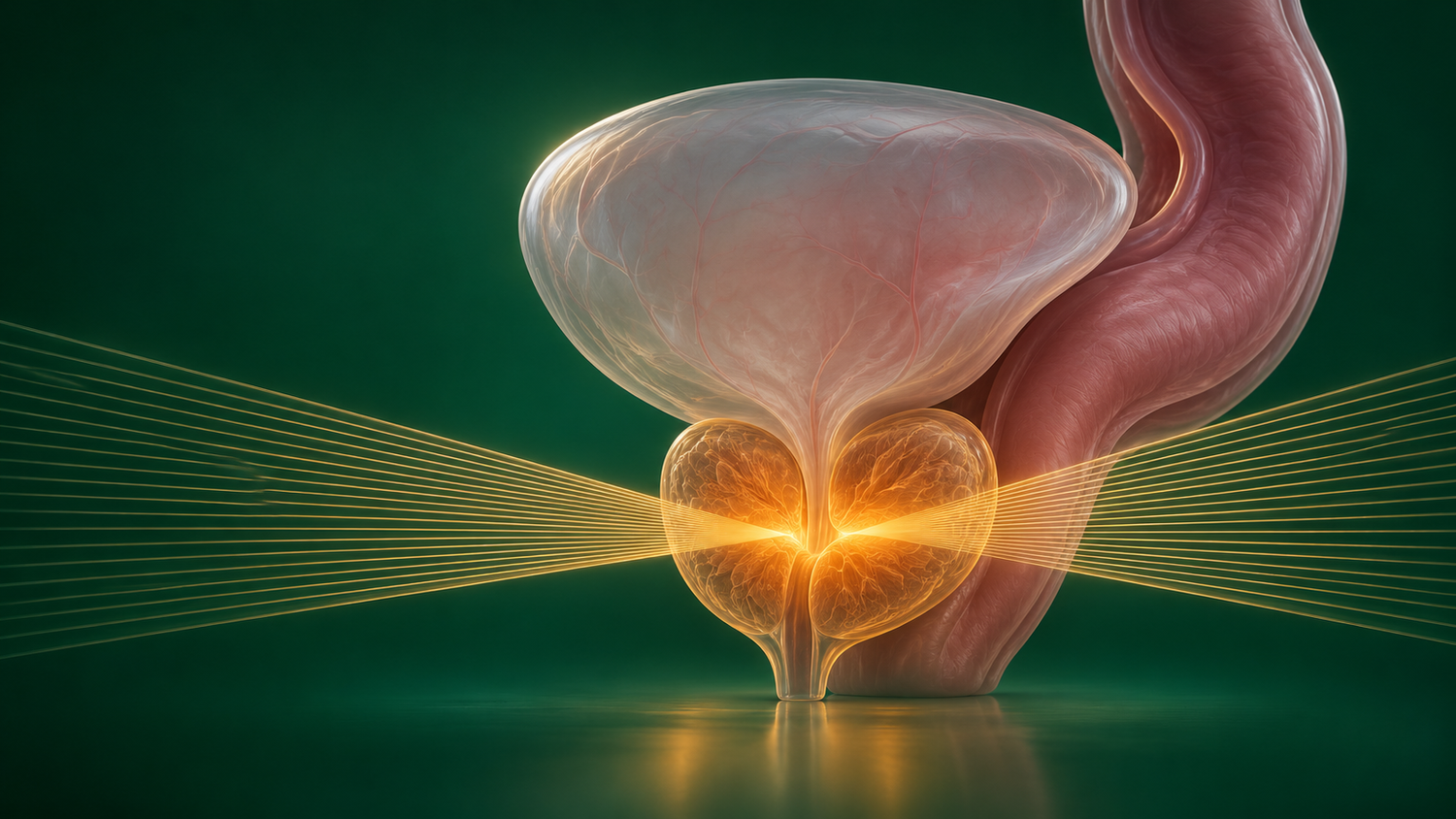
Medical physicists at the Veneto Institute of Oncology IOV-IRCCS and quantum physicists at the University of Padova have published a method that writes a radiotherapy planning problem in a form a quantum computer could accept. The preprint, posted to arXiv on 2 November 2026, applies an adaptive qubit encoding to a small prostate plan for intensity-modulated radiotherapy, the standard technique that shapes radiation beams around a tumor.
The quantum part of the work stays on paper for now. The authors optimized the qubit problems produced by their method with a tree tensor network, a classical numerical method that runs on ordinary computers and is often used to emulate quantum algorithms, and every computation reported in the paper ran on classical machines. The paper reports no run on quantum hardware, no patient data and no clinical plan, and the authors call the radiotherapy case a proof of principle.
The author list joins the clinic and the physics department. Samuele Cavinato, Marta Paiusco and Alessandro Scaggion work in the IOV medical physics department; Marco Tesoro, Simone Montangero and Ilaria Siloi are at the Padova physics department, its quantum technologies research center and INFN, and Gianluca Morettini is at Université Paris-Saclay. Tesoro also lists the Garching quantum company PlanQC.
What the Padova team built: small qubit registers that change their resolution during the search
Radiotherapy planning is an optimization problem over continuous numbers. Each treatment beam is split into narrow pencil beams, called beamlets, and the planning software chooses an intensity for each one so that the tumor receives its prescribed dose while the bladder, rectum and other organs at risk receive as little as possible. A 2004 review in Cancer Imaging by Taylor and Powell, which the preprint cites, describes this inverse planning as the core of the technique.
A qubit register reads out as a binary string, so the encoding assigns each candidate intensity to one string: two qubits give four computational-basis states and therefore four candidate values. The usual way fixes that grid in advance, over a fixed range. The Padova method gives each beamlet intensity a small register of qubits and lets classical updates between steps move and rescale its four candidate values, so that two qubits can reach a continuous spread of intensities over the course of the optimization. At each step the method builds a local approximation of the cost around the current best plan and writes it as a spin-glass Hamiltonian, an energy function of interacting qubits.
That approximation is the step that matters for hardware. A quantum annealer or a gate-based quantum computer could in principle search for the low-energy state of such a Hamiltonian. In this study the tree tensor network did that work on classical machines; the acknowledgments list computing resources from Cloud Veneto, CINECA and the University of Padova.
Quantum pillar: computing. Technology readiness: TRL 2 of 9. In Quentir's assessment the method exists as numerical simulation on classical computers using a standard test phantom, with no run on quantum hardware, no patient images and no clinical treatment plan yet.
How the TG-119 prostate plan compared with Particle Swarm optimization in the 2 November 2026 preprint
The test case is the prostate geometry from the AAPM Task Group 119 report of 2009, a shared set of test structures that radiotherapy departments use to commission IMRT planning. The team used two opposing beams at 90 and 270 degrees, split into 64 beamlets, with two qubits per beamlet for a total of 128 qubits. The plan had to cover the target volume while limiting dose to the rectum and bladder. The authors state that the dose objectives and priorities were chosen to test the algorithm and do not come from clinical treatment protocols.
The comparison method was Particle Swarm optimization, a standard classical optimizer working directly on the continuous intensities, with the same starting points and the same limit of 1.2 million function evaluations. The dose-volume histograms, the curves planners use to judge a plan, came out close for both methods. On the final cost, where a lower value is better, Particle Swarm won: for the highlighted initial discretization step of 10 the authors report 755 for Particle Swarm against 1033 for the tensor-network approach, and across all runs Particle Swarm stayed between 754 and 758 while the tensor-network runs spread from 1033 to 1387. In some runs the tensor-network plan gave the rectum a lower maximum dose and a worse result at lower dose levels.
The authors report these numbers plainly in the arXiv preprint, which has not yet been peer reviewed. They write that the current implementation did not outperform Particle Swarm on the final cost and that the results do not demonstrate clinical-scale performance. Their main claim is narrower: the encoding works with only two qubits per variable and lets non-polynomial dose penalties enter the problem without rewriting them as a global polynomial.
Why the 2021 Physics in Medicine & Biology study by Cavinato, Paiusco and Montangero sets the baseline
The same group published a first version of this idea in 2021. In Physics in Medicine & Biology, Cavinato, Felser, Fusella, Paiusco and Montangero mapped the beamlet problem for a prostate case onto an Ising-like Hamiltonian of long-range interacting qubits and solved it with a tree tensor network. That earlier formulation required a quadratic cost function. The 2026 preprint adds the adaptive resolution and the local surrogate, so maximum and minimum dose constraints can enter the problem directly.
Other recent Quentir coverage shows what the next rung looks like. In a lung cancer study from Florida Atlantic University, researchers ran a quantum classifier on a D-Wave Advantage processor and reported results from real hardware. On the routing side, Onah, Hadfield and Michielsen recovered optimal 10-city tours on IBM's 127-qubit ibm_brisbane with encodings of up to 100 qubits. The Padova plan uses 128 qubits with long-range couplings between them, which current processors handle poorly, and the paper lists reduced-connectivity Hamiltonians as future work.
How Quentir reads the Padova result: four questions for a radiotherapy department before a quantum treatment-planning pilot
The authors note that clinical cases involve far more beamlets than their 64, and they name volumetric-modulated arc therapy and helical tomotherapy as later targets. A head of medical physics who hears a vendor pitch for quantum treatment planning can ask four concrete questions. Was the plan computed on quantum hardware or on a classical emulator? How large was the case, in beamlets and structures? Did the method beat a strong classical optimizer on the same cost and the same evaluation budget? Was it tested on patient anatomy with clinical dose objectives?
For the Padova work today the answers are a classical tree tensor network solver, 64 beamlets and three structures, no, and no. The value of the paper lies in the encoding, which a future quantum or quantum-inspired solver could reuse, and in a team that pairs a cancer hospital's physicists with tensor-network specialists. Peer review and a run on real hardware would be the next evidence to watch for.
Sources
Primary source: the arXiv preprint by Samuele Cavinato, Marco Tesoro, Gianluca Morettini, Marta Paiusco, Alessandro Scaggion, Simone Montangero and Ilaria Siloi of 2 November 2026. Also drawn on: their group's 2021 Physics in Medicine & Biology paper, the AAPM Task Group 119 report by Ezzell and colleagues, the 2004 Cancer Imaging review by Taylor and Powell, and earlier Quentir coverage.