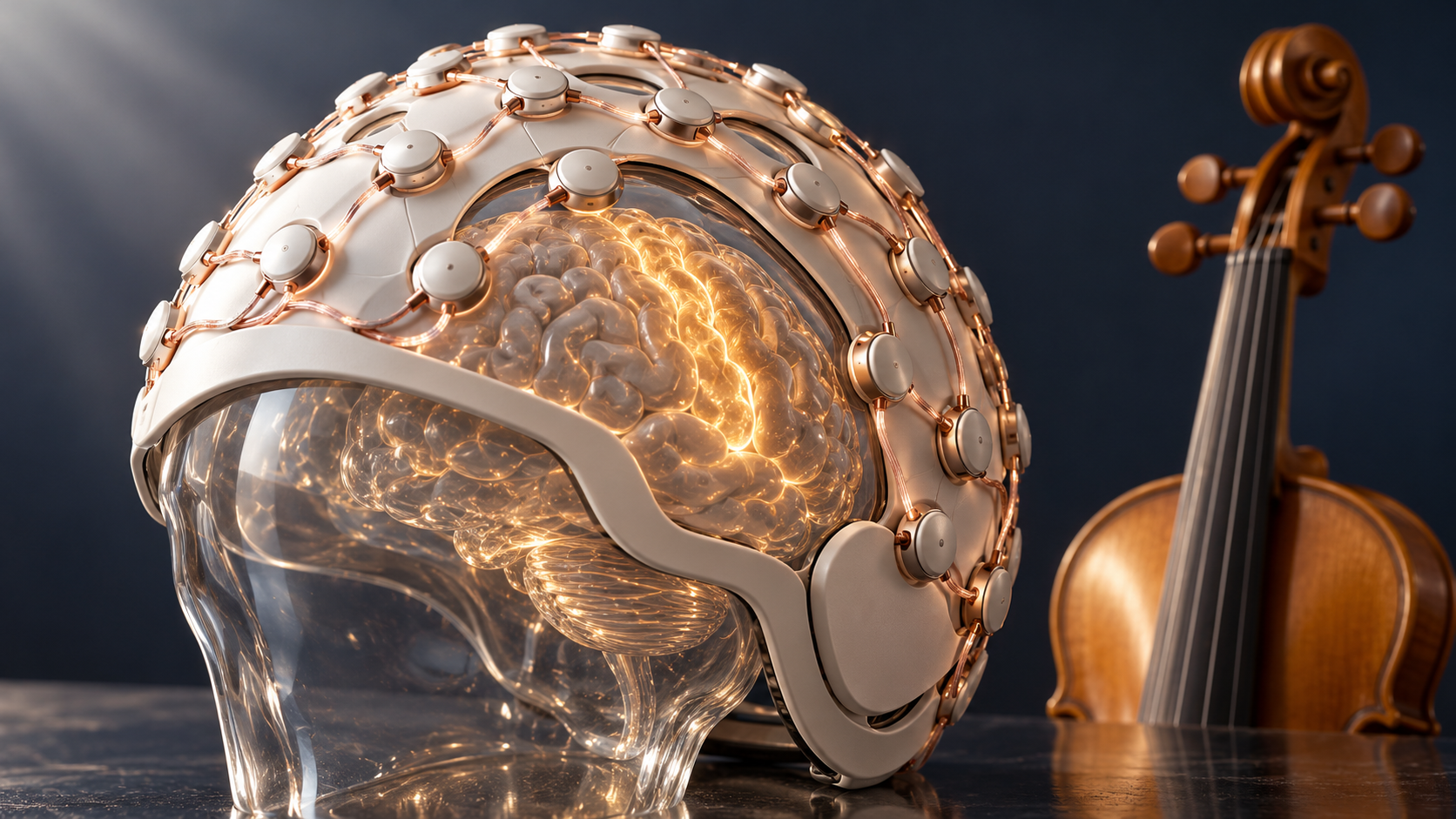
Nottingham's Wearable OPM-MEG Helmet Measures Brain Beta Rhythms While 22 Novices Learn the Violin: What the Imaging Neuroscience Study of 22 October 2026 Shows
What a wearable OPM-MEG helmet recorded while 22 novices learned the violin in Nottingham
Quentir Medicine Monitor
Evidence-based insights for quantum medicine.
Physicists at the University of Nottingham have recorded the brain activity of 22 adults while each one learned to play a violin, using a wearable helmet of optically pumped magnetometers that moved with the head. The study shows that this form of OPM-MEG can capture usable brain rhythms, after noisy trials are removed, while a seated person plays an instrument with head, neck, shoulder and arm movement, a task the paper calls difficult or even impossible in the fixed, cryogenically cooled scanners of hospital MEG suites.
The paper appeared online in the open-access journal Imaging Neuroscience on 22 October 2026, and Optics.org reported it on 29 October 2026. Its central finding concerns beta oscillations, the electrical rhythms of the brain between about 12 and 30 Hz: after a single 30-minute lesson, beta power in the motor and pre-motor areas rose while the participants played. Beta rhythms are disturbed in Parkinson's disease, multiple sclerosis and other conditions, so a scanner that records them during ordinary movement is of direct interest to neurology departments.
Matthew Brookes, who leads OPM-MEG development at Nottingham and chairs the spin-out company Cerca Magnetics, told Optics.org that some of the effects measured in the study are among those that can be affected in disorders like dementia. The study itself tested healthy volunteers only.
The peer-reviewed article, titled "Beta-band dynamics during a naturalistic motor task: An OPM-MEG study", is article IMAG.a.1405 in volume 4 of Imaging Neuroscience, published under a Creative Commons Attribution license. Joseph Gibson is the first author and Matthew J. Brookes the senior author. Ten of the eleven authors are listed at the University of Nottingham's School of Physics and Astronomy, and Matias Ison at the university's School of Psychology. The manuscript was received on 23 December 2025 and accepted on 31 August 2026.
The experiment had a simple structure. Each participant watched a short video of an expert violinist playing the first four bars of "Twinkle Twinkle Little Star", then tried to play the tune while the scanner recorded. The same expert then gave a lesson of about 30 minutes covering how to hold the violin and the bow, open-string bowing, finger spacing and the notes. A second scanning session followed, and each session lasted about 35 minutes.
The team had to build a violin with no metal parts. Moving metal near the head creates magnetic artifacts, so the researchers fitted gut strings, a bow strung with natural horsehair and wooden fittings, removed the metal fine-tuners and retuned the instrument to baroque pitch, with the A string at about 415 Hz.