Zhejiang University Pairs Diamond Quantum Sensors With Structured Illumination to Map Oxidative Stress Inside Live HeLa Cells: Nature Communications, 10 October 2026
Diamond quantum sensors map oxidative stress inside live cells in Hangzhou
Quentir Medicine Monitor
Evidence-based insights for quantum medicine.
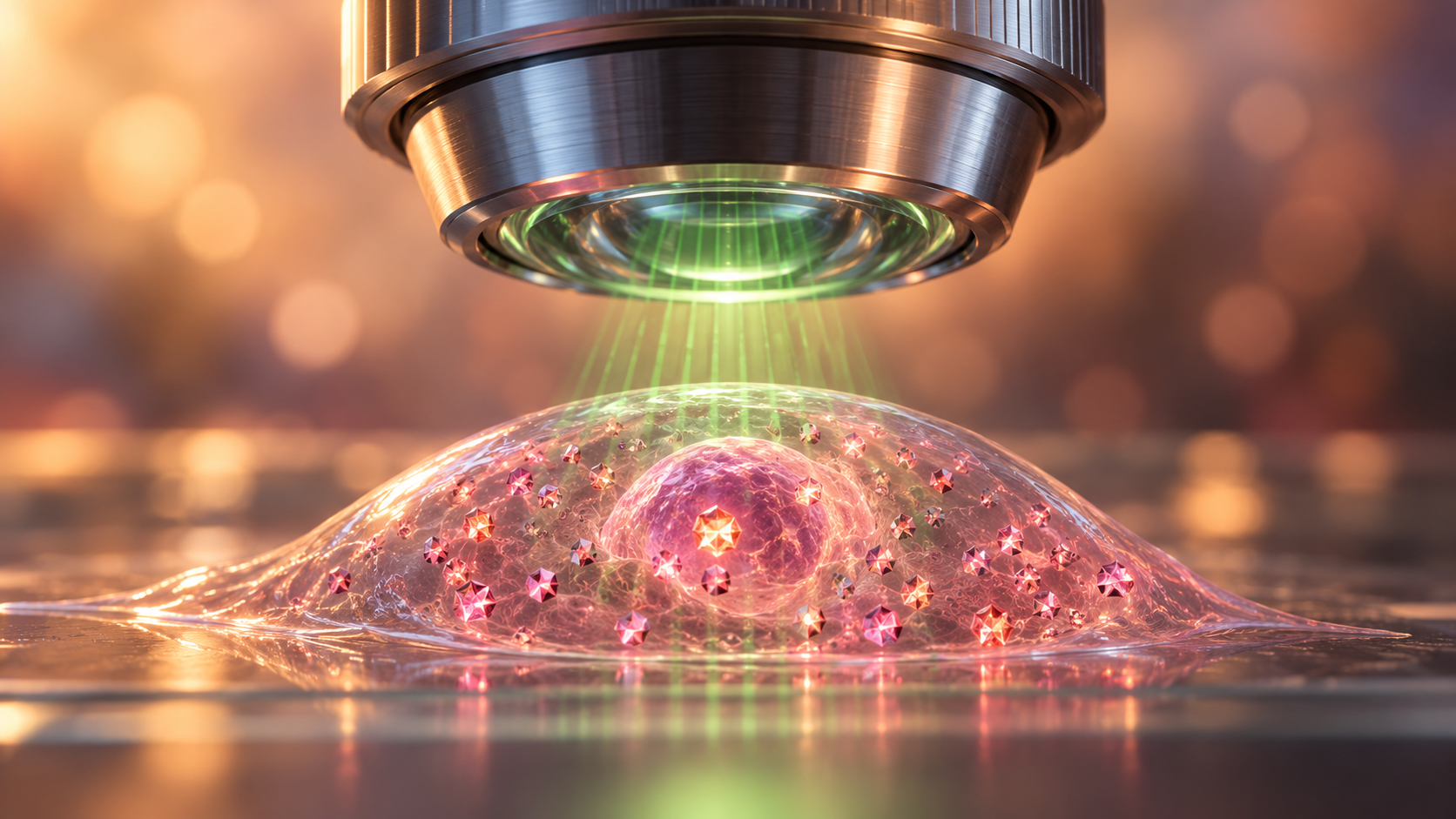
A team at Zhejiang University in Hangzhou has built a microscope that reads diamond quantum sensors inside living human cells at roughly twice the sharpness of conventional fluorescence imaging, and used it to watch reactive oxygen species change from one part of a cell to another. The paper, published in Nature Communications on 10 October 2026, reports that small diamonds in different regions of the same cell responded to two drug treatments in five distinct ways, a variety that a conventional averaged measurement smoothed into a single trend.
The performance figures in the abstract need careful reading, because they come from different experiments. The headline spatial resolution of 136 nanometers was measured on nanodiamond samples outside cells. Inside a live cell the team reports 161 nanometers for the optical image and 178 nanometers for the quantum sensing map. The 150 millisecond figure is the update interval of the sensing images, which the instrument reaches by reusing recent exposures in a rolling reconstruction. The 180 by 180 micrometer field of view is a mosaic of 5 by 5 smaller fields, captured in 12 seconds.
The article in Nature Communications (DOI 10.1038/s41467-026-78321-2) lists Yuxian Lu, Yibo Yang and Ke Xu as equal first authors, with Jiandong Feng as corresponding author. Most of the eleven authors work in the Laboratory of Experimental Physical Biology in Zhejiang University's Department of Chemistry, with co-authors from the university's College of Optical Science and Engineering, Zhejiang Normal University and China Jiliang University. The journal has released the accepted manuscript ahead of the final Version of Record.
The sensing element is the nitrogen-vacancy center, a defect in diamond where a nitrogen atom sits beside a missing carbon atom. Its electron spin responds to temperature and to magnetic noise in its surroundings, and the defect reports that response as a change in red fluorescence. The team fed HeLa cells, a standard human cancer cell line, with fluorescent nanodiamonds about 100 nanometers across, which the cells took up over roughly a day.