Prof. Mauritz Kop Chairs CIGI's Quantum Nexus Panel and Roundtable: What Sarrao, Karanicolas, Dekker, Murphy, and Minssen Said (Video)
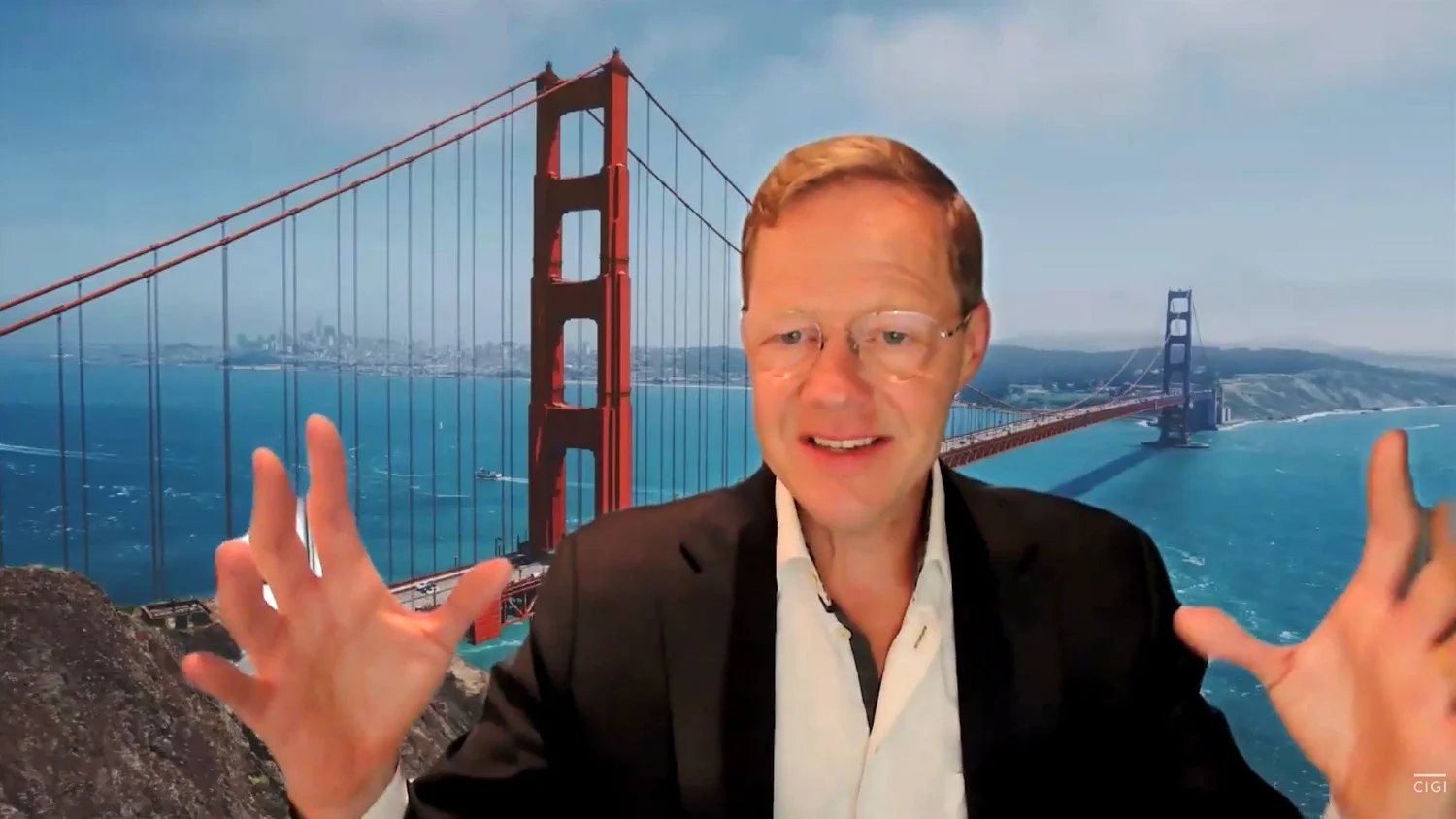
On October 21, 2026, the Centre for International Governance Innovation (CIGI) convened The Quantum Nexus: A Framework for Canadian Strategic Advantage in a Contested Domain, a public expert panel followed by a closed-door roundtable. Both sessions were chaired by our founder Prof. Mauritz Kop, CIGI Senior Fellow and Principal Investigator of the project, which the Department of National Defence supports through its MINDS program. CIGI has now published the recording of the public panel. The hour brought SLAC Director John Sarrao, Dalhousie's Michael Karanicolas, patent lawyer Tina Dekker, Queen's University's Michael P. A. Murphy, and Copenhagen's Timo Minssen together with CIGI Research Director Tracey Forrest, with 228 people registered for the session. This article summarizes what each speaker said, how the roundtable was organized, and what the discussion means for companies that build, buy, or invest in quantum technology. We previewed the workshop earlier this month.
Kop's Opening on October 21: Secrets Safe, Science Open
Kop opened with his own current work. He leads a project with colleagues at Stanford Medicine and Engineering to build quantum sensing technology for clinical use, "turning our philosophical frameworks into medical devices with new functionality for doctors and patients." He used it to show the dual-use character of the field: "The same sensors that serve the clinic serve navigation and defense." From there he posed the question that ran through the day: "How do democracies keep their secrets safe and their science open?"
He described a quantum event horizon, "a governance tipping point after which these systems shift strategic power in ways that are hard to reverse," and noted that the clock is already running, because adversaries harvest encrypted data today to read it once a strong enough quantum computer exists. His answer is the Nexus. Patents and trade secrets, export and import controls, supply chains, rare earths, and technical standards are treated as one holistic governance control plane, and each strategic measure is tested with his LSI test: is it least trade-restrictive, security-sufficient, and innovation-preserving? In legal terms, the LSI test is a proportionality test with a built-in subsidiarity check that places legal friction at the layer of the quantum stack where it can affect the targeted capability. "The goal is to let innovation breathe and accelerate with security surgically where it matters," Kop said. "Quantum is too powerful for laissez faire and clean up later, for permissionless innovation. But a precautionary stance doesn't win us the race with China."
Tracey Forrest: CIGI's Quantum Program and Policy Brief No. 222
Forrest then placed the workshop in CIGI's wider quantum program: the call she made in 2024 with the late Raymond Laflamme to treat quantum as an opportunity to develop capabilities for new national security threats and to make progress on NATO defense spending targets, the Think 7 process CIGI led during Canada's G7 year, principles for quantum governance developed with Michael Murphy, and CIGI Policy Brief No. 222, Global Quantum Governance: From Principles to Practice, which she wrote with Kop. The brief calls for international standards that make crypto-agility a baseline requirement and for like-minded nations to harmonize export controls, investment screening, and supply-chain security. Forrest explained that Kop later advanced this work into the LSI test.
John Sarrao, SLAC Director: Lean Open, With Prudence
Sarrao, speaking in his individual capacity, made balance his theme. On research priorities he argued for quantum computing together with sensing, communications, networking, and the materials science beneath them, without picking winners too early. He observed that new algorithms are significantly reducing the number of qubits needed for a relevant calculation, which matters directly for how controls are calibrated. The Department of Energy sorts research topics into green, yellow, and red in its science and technology risk matrix, and Sarrao described it as a compliance regime and, more importantly, a framework for education, awareness, and training. Controls on materials and supply chains are useful, he said, yet they can also spur the innovation that makes them ineffective, as China's indigenous high-performance computing shows.
"The key resource is actually ideas and people," Sarrao said, "and importantly the best defense is a good offense. Therefore, one should lean open while being prudent and cognizant of the very real risk that exists." He added that SLAC's expertise in cryogenics, built to cool its superconducting accelerator, makes the laboratory an attractive partner for quantum companies. His recommendation was to keep the conversation going and to stay aware of "the opportunity cost of being overly protective and restrictive."
Michael Karanicolas, Dalhousie: Post-Quantum Migration and Privacy
Karanicolas focused on government readiness for post-quantum cryptography. He credited federal leadership from the Treasury Board and the Canadian Centre for Cyber Security, whose roadmap ITSM.40.001 asks departments to migrate high-priority systems by the end of 2031 and the rest by the end of 2035. He reminded the audience that provinces and territories hold large amounts of sensitive data, which makes the effort "13 different conversations." Uncertainty about when encryption will break weakens both planning and motivation, he argued, though the sensitivity of much harvested data declines over time. For banks and other firms where security and privacy are paramount, he said, there is "no excuse for not prioritizing this."
He also warned that the transition could become a pretext for a two-tier system, with quantum-safe protection for national security and a weaker standard for everyone else that security agencies could walk through. His principle: "sovereignty without privacy is an empty vessel." His operational advice: do not forget the provinces.
Tina Dekker, Patent Lawyer: Support for Quantum Startups
Dekker, a patent lawyer at COPA Copenhagen Patents, spoke from practice. Quantum companies have to ask early what underlying capability their technology carries, who may access it, and how know-how can be transferred, often before they can afford specialist counsel. Her central caution concerned export controls: "IP ownership does not necessarily mean permission to transfer a technology in the context of disclosure or an export." A patent application discloses the invention to the public, so patent strategy, financing, and defense procurement interact even when founders handle them separately. She asked allies to define sensitive capabilities through measurable technical thresholds and high-risk use cases, asked governments to build the capacity to assess and clear companies within predictable time frames, and recommended a coherent framework with support programs that span the relevant agencies.
Michael Murphy, Queen's University: Standards Need Implementation
Murphy brought a defense-policy view. NATO recognizes the operational advantages of new technologies and the defensive imperative to integrate post-quantum planning into all its operational modes, yet its standardization agreements depend on voluntary ratification, allow national reservations, and offer few enforcement mechanisms. Because military secrets must stay secret for long periods, he called setting standards "a necessary but not a sufficient condition" for cryptographic resilience across the alliance. Within Canada a similar gap separates Ottawa from the provinces and municipalities, some of which now run online voting in their elections. He asked the quantum community to respect the enduring constraints of policy institutions, and policymakers to recognize the unusual operational impact of cryptographic vulnerabilities.
Timo Minssen, University of Copenhagen: Conditions for Publicly Funded Testbeds
Minssen asked who will control the terms on which others can use quantum once it becomes critical infrastructure. Europe's experience with the AI Act and its medical device rules led him to argue for regulating risk without regulating emerging technologies out of the market, and against a premature, all-purpose, overly restrictive quantum act, while seeing value in the emerging EU Quantum Act if it is well designed. A medical quantum sensor, a cryptographic service, and a quantum computing platform pose different risks. Market power in quantum may come from control over cloud access, software development kits, compilers, interfaces, performance claims, and the ability to move workloads between providers. It is much harder, he said, to unwind lock-in after it has become entrenched than to preserve contestability at the design stage.
His recommendation was concrete. The EU, Canada, and if possible the United States should agree on common interoperability and IP conditions for selected publicly funded quantum testbeds and procurement pilots. Participating providers would document usable interfaces, permit independent benchmarking, offer practical portability where technically feasible, and disclose potentially standard-essential rights with transparent licensing commitments, subject to narrowly defined security exceptions. Firms would keep their trade secrets and would not have to open-source their hardware.
Audience Questions on the G7, Middle-Power Diplomacy, and Europe
A policy lead for the G7 and G20 at Global Affairs Canada asked what the G7 should do next with its quantum agenda as the United States takes over the presidency in 2027. Murphy noted that quantum stayed clear of political conflict in 2025, when the G7 agreed on its Kananaskis common vision, and that recent quantum legislation in the U.S. House of Representatives is bipartisan; he urged an expert-led, detail-driven process. Sarrao added that like-minded allies need to keep working together, since "overly atomizing and siloing the environment won't lead to any good for anybody." On Canada's role as a middle power, Karanicolas argued for a broad and diverse set of research relationships that keeps as many doors open as possible. Minssen described how European states double-invest in the same fields and urged partners to identify the niches where each can lead.
The Closed-Door Roundtable Under the CIGI Rule
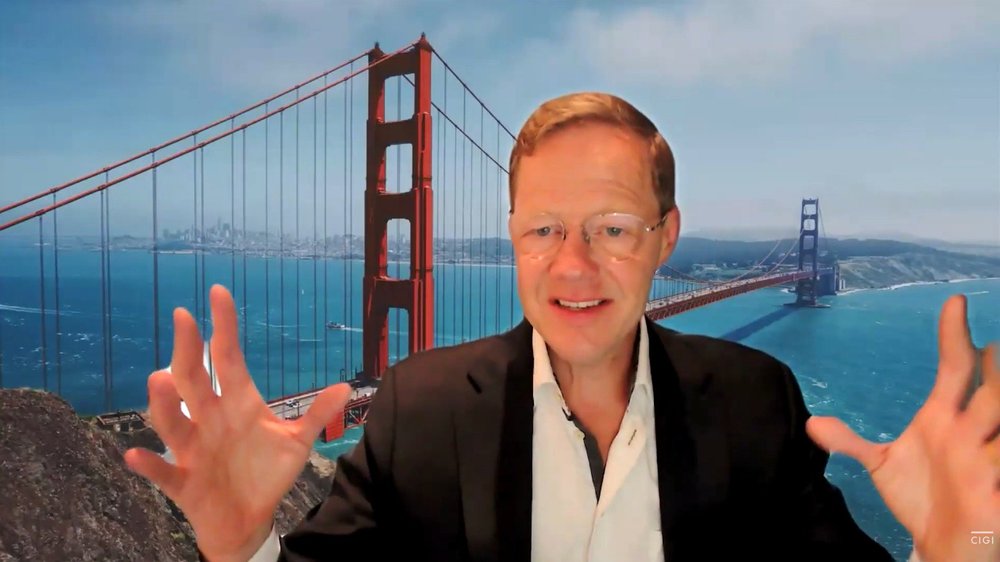
After the panel, Kop chaired a closed-door roundtable under the CIGI Rule, which allows participants to use the information they receive and to disclose who took part, while no view may be attributed to any participant. The session was not recorded. Around the table were officials from the Government of Canada and the Department of National Defence, the Canadian Intellectual Property Office, Michele Mosca of the Institute for Quantum Computing, former U.S. Assistant Secretary of Commerce for Export Administration Kevin J. Wolf, Los Alamos materials physicist Alan Hurd, Aubrey Davis of the U.S. Air Force Academy, Catherine Lefebvre of the Open Quantum Institute, industry experts, and the six Emerging Scholars: Matya Stavnitzky, Tyler Stevenson, Angela Dong, Natalie Frigon, Phone Min Thant, and Katlego Khoza.
Kop framed the session around calibration. "Too little security lets capabilities leak to strategic competitors through IP theft, talent, hardware and know-how," he said. "Too much security builds a Silicon Curtain that fragments research and slows the ecosystems that give democracies their lead. We are looking for security-sufficient openness." The agenda moved from practitioner reflections to the coordination of post-quantum migration among allies, an LSI pressure test on one physical-stack input, and a decision round on one institutional decision to take before the 2027 G7 and the next NATO Summit.
Kop closed with a global outlook. "The race to quantum first is a contest for power, and also a contest between ways of innovating," he said. Kop developed that theme with Joseph Federici, Senior Policy Analyst at the bipartisan U.S.-China Economic and Security Review Commission, in their War on the Rocks essay Before Q-Day: The Race to Quantum First, which sets out their strategic policy recommendations. Democracies, in his words, "innovate through open science, industrial policy, free enterprise, independent courts and the consent of their citizens." He called on Canada and the United States to build a shared quantum talent pool, with joint training, funded exchanges, and predictable routes for researchers and engineers to work across the border, adding that "legal certainty for talent is a strategic asset."
Six Emerging Scholars and the Final CIGI Report
The six scholars followed the panel and gave their own interventions at the roundtable. Kop told them that the rules of the road for the quantum age are still being written, "and many of them will carry your ideas." They meet him again for a masterclass on November 4, 2026, and their analytical notes will appear in an Emerging Scholars annex to the final CIGI Quantum Nexus report.
How Quentir Reads It
The panel gave companies a practical agenda. Canada's federal post-quantum roadmap now has dated milestones, and Karanicolas's warning to banks applies to every firm that holds long-lived sensitive data. Dekker's point on disclosure and export authorization belongs in the patent and fundraising plan of every quantum startup. Minssen's testbed conditions would shape which platforms and interfaces win public contracts, and Sarrao's remark about falling qubit requirements matters for how the thresholds in export and investment rules are calibrated. Quentir followed one such move in its analysis of Treasury's COINS Act proposal on quantum algorithms and outbound investment.
We thank CIGI, Tracey Forrest, the panelists, the roundtable participants, and the six scholars, and we look forward to the final report. Kop's closing words at the panel speak directly to investors and executives: "There is a misconception that early smart and sensible governance will impede innovation. It's the opposite. I feel it will foster trust and adoption with companies and the wider public."
Sources and Further Reading
- CIGI recording: The Quantum Nexus: A Framework for Canadian Strategic Advantage in a Contested Domain (October 21, 2026)
- CIGI event page
- Kop and Forrest, Global Quantum Governance: From Principles to Practice, CIGI Policy Brief No. 222 (February 5, 2026)
- Kop, The Nexus of Quantum Technology, Intellectual Property, and National Security (NASA ADS, Harvard & Smithsonian)
- Canadian Centre for Cyber Security, Roadmap for the Migration to Post-Quantum Cryptography for the Government of Canada (ITSM.40.001)
- The CIGI Rule
Published intelligence, built to inform your own decisions. Published: October 23, 2026.