
Prof. Mauritz Kop, Principal Investigator, Leads CIGI's Quantum Nexus Workshop on Canadian Strategic Advantage, With Six Emerging Scholars
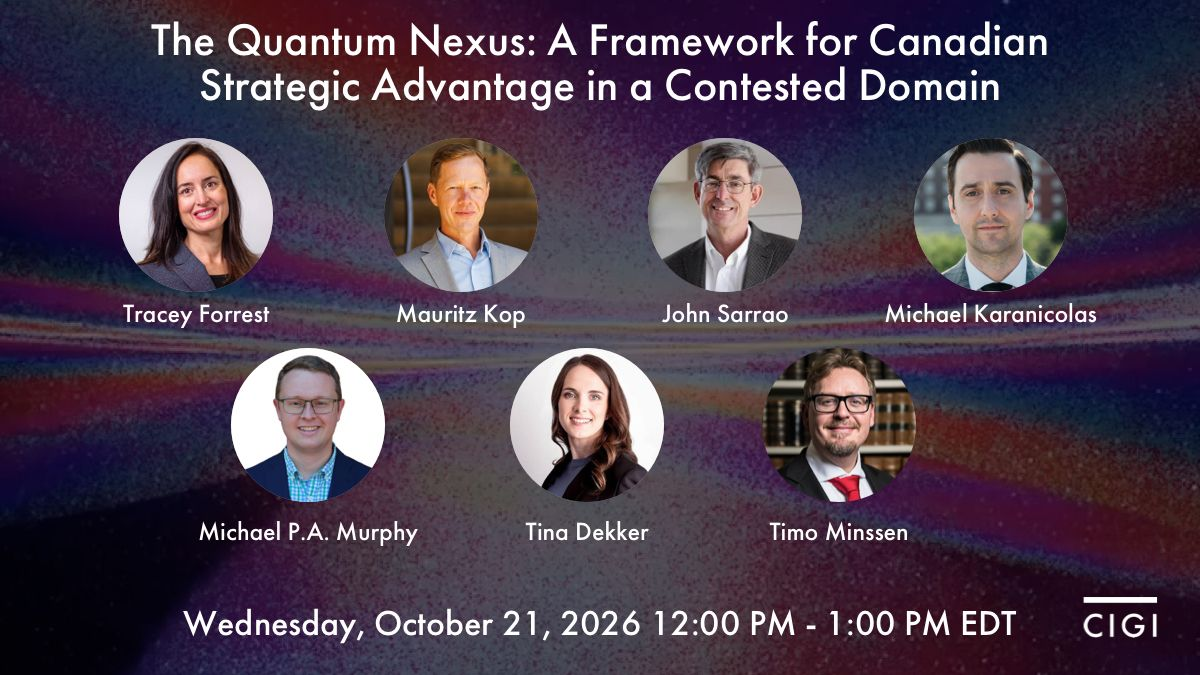
Canada has world-class quantum science, a strong alliance network, and a decade of public investment in quantum research. The question the Centre for International Governance Innovation (CIGI) puts to its experts this month is how to turn those assets into lasting strategic advantage. On Wednesday, October 21, 2026, Prof. Mauritz Kop, CIGI Senior Fellow and Principal Investigator and founder of the Stanford Center for Responsible Quantum Technology (Stanford RQT) and of Quentir, chairs the workshop of the CIGI project The Quantum Nexus: A Framework for Canadian Strategic Advantage in a Contested Domain. The day opens with a public online panel from 12:00 to 1:00 PM Eastern Time and continues with a closed-door roundtable.
The project is funded through the Department of National Defence's Mobilizing Insights in Defence and Security (MINDS) Targeted Engagement Grant program. It examines the convergence of quantum technology, artificial intelligence, intellectual property, and national security, and it asks how Canada and its allies can protect what is strategically sensitive while keeping science open and the democratic industrial commons strong. That focus on strategic advantage makes the workshop a useful read for anyone who invests in, buys, or regulates quantum technology.
The Public Panel on October 21: Supply Chains, AI, Standards, Strategy, and Europe
Kop moderates the panel, which opens with Tracey Forrest, Research Director for Transformative Technologies at CIGI and co-author with Kop of CIGI Policy Brief No. 222, Global Quantum Governance: From Principles to Practice. Forrest is a professional engineer and adjunct professor at the University of Waterloo who previously directed its Transformative Quantum Technologies program. Five panelists each take one front of the quantum competition.
John Sarrao, Director of the SLAC National Accelerator Laboratory and former Deputy Director for Science, Technology and Engineering at Los Alamos, speaks on critical materials and quantum supply chains. Michael Karanicolas, James S. Palmer Chair in Public Policy and Law at Dalhousie University, addresses the convergence of quantum and AI. Tina Dekker, a former associate at BLG, speaks on standards, procurement, and interoperability among allies. Michael P. A. Murphy, Director of the Centre for International and Defence Policy at Queen's University, addresses Canadian quantum strategy in light of the lessons of AI policy. Timo Minssen, Head of the Centre for Advanced Studies in Bioscience Innovation Law at the University of Copenhagen, brings Europe's lessons on AI regulation, competition, and strategy; he is also Kop's co-author on the Ten Principles for Responsible Quantum Innovation.
A Closed-Door Roundtable With Officials From Ottawa and Experts From Washington, Los Alamos, and Stanford
The roundtable that follows follows the CIGI Rule: information may be used and participants' identities and affiliations disclosed, while no view is attributed to any individual participant. Its membership reads like a cross-section of the institutions that will shape the quantum order. From Ottawa come Dominic Rochon, Deputy Secretary to the Cabinet for National Security and Intelligence at the Privy Council Office; Kurtis H. Simpson, Special Advisor for Indo-Pacific Affairs at the Department of National Defence; and Konstantinos Georgaras, CEO of the Canadian Intellectual Property Office. Bessma Momani of the University of Waterloo, a CIGI Senior Fellow and Fellow at the NATO Defense College, brings the alliance perspective.
The American participants include Kevin J. Wolf, partner at Akin Gump and former Assistant Secretary of Commerce for Export Administration; Larry Diamond, William L. Clayton Senior Fellow at the Hoover Institution and Mosbacher Senior Fellow in Global Democracy at Stanford's Freeman Spogli Institute; Alan J. Hurd, materials physicist at Los Alamos National Laboratory; and R. Aubrey Davis, Director of Law and Emerging Technology at the U.S. Air Force Academy. The quantum sector is represented by Michele Mosca, co-founder of the Institute for Quantum Computing and of evolutionQ, whose 2018 paper examined how much time organizations have to prepare for quantum-era cybersecurity; Joe Spencer of Global Quantum Intelligence; and John Young of Quantum eMotion. The panelists, Tracey Forrest, and the project's six emerging scholars complete the table.
Six Emerging Scholars: the Next Generation of Quantum Policy Thinkers
Kop personally selected and mentors the program's six emerging scholars. In September 2026 CIGI announced the inaugural cohort of the Quantum Nexus Emerging Scholars Program, six scholars from across Canada whom Kop personally selected after a national call. The news was picked up by BNN Bloomberg, Business Insider, and Quantum Zeitgeist.
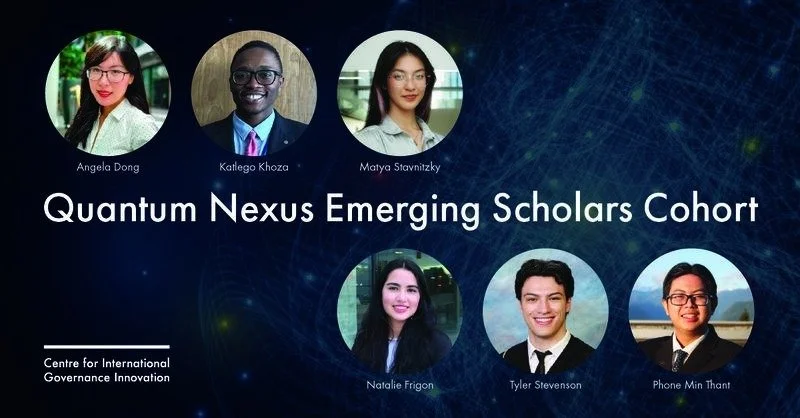
The cohort spans international affairs, medicine, computer science, and emergency management. Phone Min Thant of Simon Fraser University studies quantum sensing for maritime intelligence, surveillance, and reconnaissance, and how procurement can assess experimental capabilities without mistaking promise for readiness. Natalie Frigon of Carleton University's Norman Paterson School of International Affairs examines research security and allied cooperation. Katlego Khoza of Brandon University draws on nuclear verification and Arctic governance. Angela Dong, a physician at the University of Toronto, studies quantum-AI in clinical practice and health infrastructure. Tyler Stevenson of the University of Toronto analyzes allied standards and procurement, and Matya Stavnitzky of the University of Waterloo works on accountability by design in human-in-the-loop quantum-AI systems.
Each scholar receives one-on-one mentorship from Kop, takes part in the October workshop, and joins a masterclass on November 4, 2026. Their analytical notes will appear in an Emerging Scholars annex to the project's final CIGI report. Related reading on the questions they study includes the Council of Canadian Academies report Quantum Potential, Mosca's Cybersecurity in an Era with Quantum Computers: Will We Be Ready?, and the G7 Kananaskis Common Vision for the Future of Quantum Technologies.
From the Laflamme Panel to the Quantum Nexus: Kop's Work With Canada and Its Allies
Kop's ties to Canada's quantum policy community go back years. He served on the Council of Canadian Academies Expert Panel on the Responsible Adoption of Quantum Technologies, chaired by the late Raymond Laflamme, founding director of the Institute for Quantum Computing, a father of quantum error correction and a doctoral student of Stephen Hawking, whose 2023 report Quantum Potential set out a national agenda for responsible adoption. Laflamme was also a pioneer of the Stanford RQT framework papers, with Mark Brongersma, Director of Stanford's Geballe Laboratory for Advanced Materials, including the Ten Principles for Responsible Quantum Innovation (IOP, 2024). Stanford RQT, inaugurated in 2023 by Mark Rutte, now Secretary General of NATO, was made possible by Stanford Law School's Mark Lemley and Jenny Martinez, now Provost of Stanford University. In 2024 Kop and Mark Lemley hosted a Canadian government delegation at Stanford to inform Canada's G7 presidency, and Stanford RQT's work informed the G7 Kananaskis quantum policy agenda adopted in 2025. A year later Kop gave a quantum governance seminar at CIGI and joined the institute as a Senior Fellow.
The intellectual core of the workshop is Kop's paper The Nexus of Quantum Technology, Intellectual Property, and National Security (2026), indexed in the NASA Astrophysics Data System at the Center for Astrophysics | Harvard & Smithsonian, and its LSI test for measures that are least trade-restrictive, security-sufficient, and innovation-preserving. Kop has published two essays in War on the Rocks, A Bletchley Park for the Quantum Age and Before Q-Day: The Race to Quantum First, the latter written with Joseph Federici, Senior Policy Analyst at the bipartisan U.S.-China Economic and Security Review Commission and author of its report Vying for Quantum Supremacy. He advises the U.S. Government, including the Pentagon and the Department of State, on quantum strategy and policy, teaches at the U.S. Air Force Academy, and serves as a quantum ecosystem expert on the von Neumann Commission and a Subject Matter Expert at NATO StratCom. Quentir set out the wider picture in Quantum First: One Race, Five Fronts, One 2030 Goal.
CIGI and Canada's Quantum Industry: Waterloo, Toronto, Vancouver, and Sherbrooke
CIGI was founded in 2001 by Jim Balsillie, then co-CEO of Research In Motion, maker of the BlackBerry, with a founding gift from his fellow co-CEO Mike Lazaridis, the founder of Waterloo's Perimeter Institute for Theoretical Physics. Supported by the Governments of Canada and Ontario and led today by President Paul Samson, CIGI works on the governance of AI, data, and transformative technologies. In Waterloo, known as Quantum Valley, it shares the city with the Institute for Quantum Computing and the Perimeter Institute.
Canada's quantum sector gives the workshop its commercial stakes. The country launched its National Quantum Strategy in 2023, and its companies cover the main hardware approaches: D-Wave, founded in British Columbia, pioneered commercial quantum annealing; Xanadu in Toronto builds photonic quantum computers; Photonic in the Vancouver area works on silicon spin-photon systems; and Nord Quantique in Sherbrooke develops bosonic qubits for error correction. Canada also hosts quantum-safe security firms such as evolutionQ. For these companies, export controls, research-security rules, and allied procurement standards decide which customers and partners they can reach.
What the Quantum Nexus Project Will Deliver: a Final CIGI Report With an Emerging Scholars Annex
The workshop is a working session for a larger product. Its findings feed a final CIGI report, with the scholars' analytical notes in a dedicated annex. The project's six research areas give a good map of where the quantum competition is now fought: post-quantum cryptography migration, dual-use technologies and export controls, critical materials and quantum supply chains, quantum-AI convergence, standards and allied interoperability, and the balance between national security and open science.
The project also follows a clear method. Kop's recent work asks policymakers to frame each issue as a decision that one institution can own and deliver within a fixed time. His Bletchley Park essay applied that method to federal purchasing of post-quantum cryptography, and the CIGI policy brief applied it to international coordination.
Why Canada's Quantum Choices Matter to American and European Companies
Canada is a member of the G7, a founding member of NATO, and part of the Five Eyes, a partner in allied research security, and home to quantum companies and laboratories with global reach. Its choices on export controls, research security, and procurement standards travel through these alliances. Mutual recognition of security evaluations among Ottawa, Washington, London, Canberra, and Brussels can spare a quantum company duplicate testing as it sells across allied markets. When their rules diverge, companies face duplicate certification, delayed sales, and the risk of a fragmented quantum market.
That is why the roundtable brings together export-control law, intellectual property administration, defense science, and national security policy in one conversation. American firms selling into allied markets, European firms building quantum supply chains, and Canadian startups seeking capital all depend on the same question: whether allies can protect what is strategically sensitive in the least restrictive way, while keeping science open and the democratic industrial commons strong. Kop used exactly those words when CIGI announced the scholars program.
How Quentir Reads It
The workshop shows how concrete quantum policy has become. In 2026 it covers helium-3 supply, export-control lists, procurement clauses, patent strategy, and allied certification, discussed by a deputy secretary to the cabinet, a patent office chief, a former senior export-control official, and laboratory directors in one session. Decisions on these questions will shape which firms can sell into allied markets, which components remain available, and how quickly critical infrastructure can migrate to post-quantum cryptography, the subject Quentir followed in why post-quantum migration is a 2026 board item.
For investors and executives, the message is to watch Canada and its allies closely as rule-makers. Kop's LSI test offers companies and governments a framework to weigh the security, trade, and innovation effects of proposed controls, and shared allied standards can widen the market for firms that meet them. Quentir's Insights follow these developments with the evidence behind every result. We congratulate CIGI, Tracey Forrest, the panelists, and the six scholars, and we look forward to the final report.
Sources and Further Reading
- CIGI event page: The Quantum Nexus: A Framework for Canadian Strategic Advantage in a Contested Domain (October 21, 2026)
- CIGI: CIGI Welcomes Six Emerging Scholars to Explore the Future of Quantum Technology, Security and Governance (September 10, 2026)
- BNN Bloomberg press release (September 10, 2026)
- Business Insider press release (September 10, 2026)
- Quantum Zeitgeist: CIGI Picks Six Scholars to Study Quantum Security and Policy
- Kop and Forrest, Global Quantum Governance: From Principles to Practice, CIGI Policy Brief No. 222 (February 5, 2026)
- Kop, The Nexus of Quantum Technology, Intellectual Property, and National Security (NASA ADS, Harvard & Smithsonian)
- Council of Canadian Academies, Quantum Potential (2023)
- Mosca, Cybersecurity in an Era with Quantum Computers: Will We Be Ready? (IEEE Security & Privacy, 2018)
- Kop and Federici, Before Q-Day: The Race to Quantum First, War on the Rocks (July 20, 2026)
- CIGI history
- The CIGI Rule
Published intelligence, built to inform your own decisions. Published: October 8, 2026.