
Prof. Mauritz Kop Speaks at Quantum Innovation 2026 in Nagoya, Japan, With Elham Kashefi, Dorit Aharonov, and Google Quantum AI
Prof. Mauritz Kop, founder of the Stanford Center for Responsible Quantum Technology and of Quentir, speaks at Quantum Innovation 2026 in Nagoya, the International Symposium on Quantum Science, Technology and Innovation organized by Japan's Quantum Technology Innovation Hubs from December 8 to 11, 2026. His talk, Before Q-Day: Responsible Quantum Innovation, Standards, and the Post-Quantum Transition, closes the Practical Quantum Computing session on December 8, and he will also visit a quantum computer in Japan with the delegation.
Japan's Quantum Ecosystem in One Program
Co-organized by the Cabinet Office, three ministries, JST, RIKEN, AIST, NICT, Q-STAR, and leading universities, and sponsored by Fujitsu, Toyota, Toshiba, and Hitachi, the symposium brings keynotes by Dorit Aharonov, Amir Yacoby, and Hoi-Kwong Lo and invited talks by Elham Kashefi and leaders from Google Quantum AI, IonQ, Intel, the Weizmann Institute, the University of Toronto, and RIKEN.
Standards, Assurance, and Allied Cooperation
After two talks on quantum cryptanalysis, Kop closes the session from 5:40 to 6:10 PM Japan time with a talk on responsible quantum innovation, standards, and the post-quantum migration. Our article also profiles Japan's quantum hardware at RIKEN, Fujitsu, Quantinuum, and IBM, the industrial setting of Nagoya, and Japan Quantum Week.
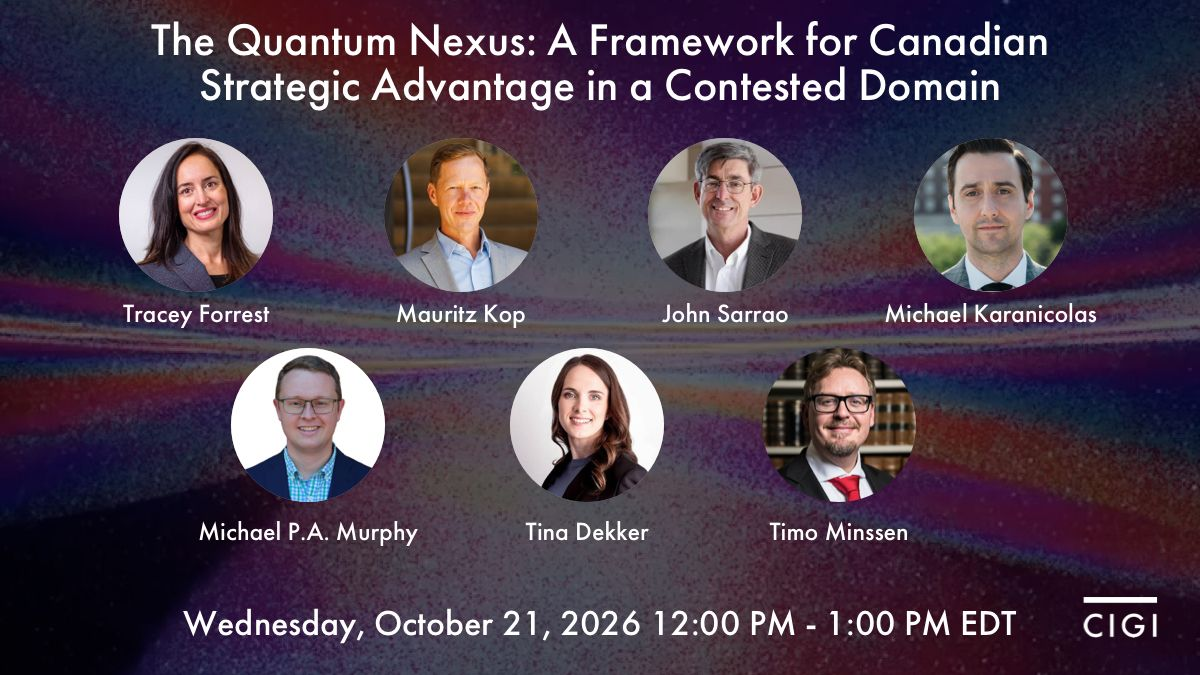
Prof. Mauritz Kop, Principal Investigator, Leads CIGI's Quantum Nexus Workshop on Canadian Strategic Advantage, With Six Emerging Scholars
On Wednesday, October 21, 2026, Prof. Mauritz Kop, Senior Fellow and Principal Investigator at the Centre for International Governance Innovation (CIGI), leads the workshop of the CIGI project The Quantum Nexus: A Framework for Canadian Strategic Advantage in a Contested Domain. A public online expert panel from 12:00 to 1:00 PM Eastern Time is followed by a closed-door roundtable with senior officials, laboratory leaders, and legal and industry experts from Canada, the United States, and Europe.
Supply Chains, Quantum-AI, Standards, and Allied Strategy
SLAC Director John Sarrao, Dalhousie's Michael Karanicolas, Tina Dekker, Queen's University's Michael P. A. Murphy, and Copenhagen's Timo Minssen each take one front of the quantum competition, with CIGI's Tracey Forrest opening the session. The roundtable includes Dominic Rochon of the Privy Council Office, CIPO's Konstantinos Georgaras, former U.S. export-control chief Kevin J. Wolf, Michele Mosca, and Larry Diamond. The project, funded by the Department of National Defence's MINDS program, aims at strategic advantage for Canada and its allies.
Six Emerging Scholars and the Founding of CIGI
Six emerging scholars, personally selected and mentored by Kop, join the workshop and will contribute to the final CIGI report. Our article also traces Kop's work with Canada, from the Council of Canadian Academies panel chaired by the late Raymond Laflamme to the Nexus paper, and the history of CIGI, founded in 2001 by BlackBerry's Jim Balsillie in Waterloo's Quantum Valley.

Prof. Mauritz Kop Invited to the Inaugural ACM PQQS 2026 in Silicon Valley, With Dan Boneh, Bart Preneel, and Google Quantum AI's Ryan Babbush
Prof. Mauritz Kop, Founder of the Stanford Center for Responsible Quantum Technology and of Quentir, has been invited to speak at ACM PQQS 2026, the first ACM Conference on Post-Quantum and Quantum-based Security, held from November 2 to 4, 2026 in Silicon Valley near San Jose. The program lists his affiliations at CIGI and the U.S. Air Force Academy, and his talk is titled The Race to Quantum First: Building a Secure and Responsible Quantum Future.
A New ACM Venue for Quantum-Era Security
ACM's security community built PQQS as a new annual forum for post-quantum cryptography, quantum cryptography, and the security of quantum computing systems. The program combines twenty-six peer-reviewed papers with keynotes by Stanford's Dan Boneh, Google Quantum AI's Ryan Babbush, ETH Zurich's Renato Renner, and Cisco Research's Ramana Kompella, invited talks by Bart Preneel, Reza Nejabati, Vipul Goyal, Yevgeniy Dodis, and J.R. Rao, and a panel with Dustin Moody, who leads the NIST post-quantum cryptography project, and Michele Mosca.
Kop's Talk: Procurement, the LSI Test, and Allied Coalition Scale
Kop's talk treats the race to quantum first as a contest for power and proposes a governance agenda that makes responsible innovation an instrument of strategic leadership: public procurement that accelerates post-quantum adoption, the LSI test for security measures, a hospital example for critical infrastructure, coalition scale among allies, and a European Quantum Act architecture. It builds on Stanford RQT's foundational work and on his War on the Rocks essays read across the U.S. national security community.
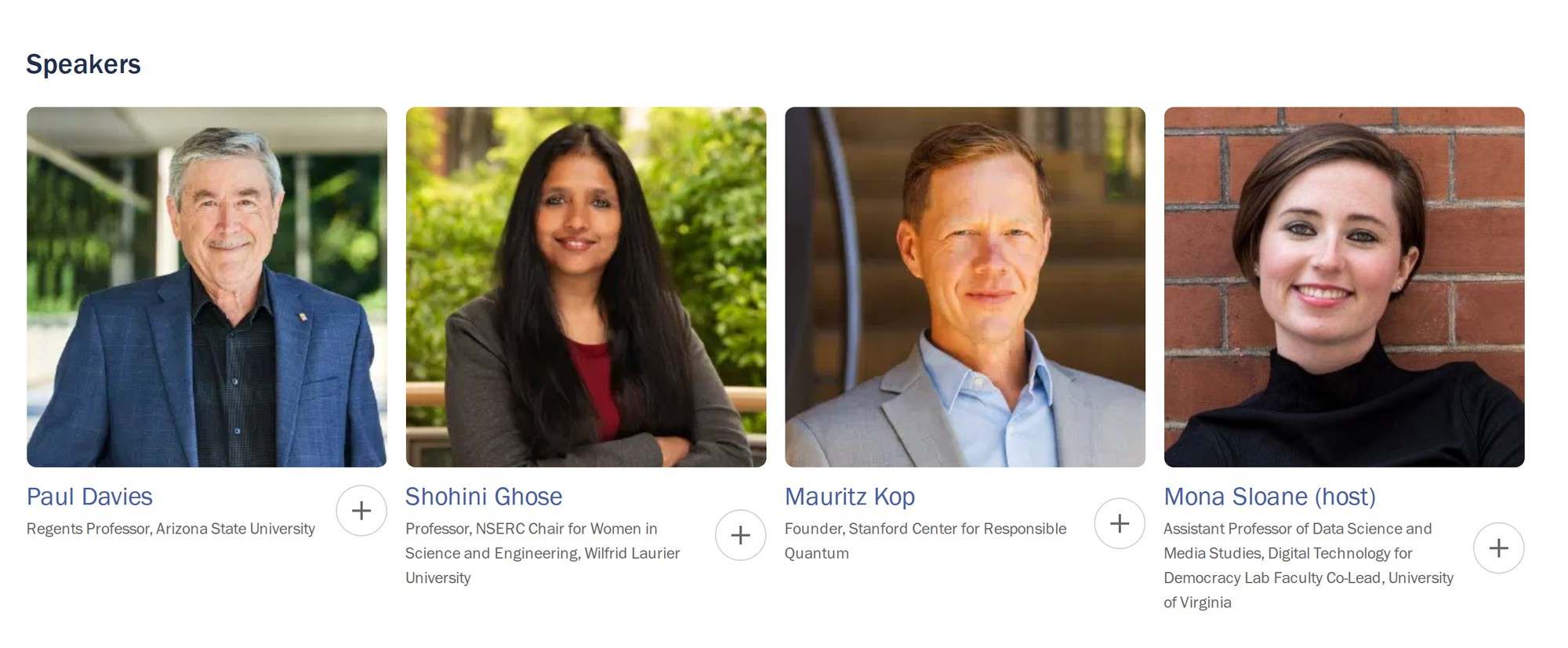
Prof. Mauritz Kop Invited to Co-Opting AI: Quantum at the University of Virginia, on Quantum, AI, and Geopolitics With Paul Davies and Shohini Ghose
Prof. Mauritz Kop, Founder of the Stanford Center for Responsible Quantum Technology and of Quentir, has been invited to speak at Co-Opting AI: Quantum, the University of Virginia's public conversation on Wednesday, October 28, 2026, from 4:00 to 5:15 PM Eastern Time. The online event is hosted by UVA's Digital Technology for Democracy Lab, NYU's Institute for Public Knowledge, and Sloane Lab, with the physicists Paul Davies and Shohini Ghose and with Professor Mona Sloane as host.
Co-Opting AI: Quantum on October 28 Examines What Quantum Inherits From AI
The organizers frame the episode around an inheritance: quantum computing is arriving into institutions, supply chains, and geopolitical formations already shaped by AI. Quantum computers already reach users through the cloud platforms that serve AI, and both technologies now sit inside export-control and supply-chain strategy. That is where Kop's work on the race to quantum first applies, and where decisions taken before 2030 will shape the quantum order.
Davies, Ghose, Kop, and Sloane on One Program
Davies, director of the Beyond Center at Arizona State University, and Ghose, who served on the Advisory Council for Canada's National Quantum Strategy, bring physics and national strategy. Sloane, who has convened Co-Opting AI since 2019, brings the sociology of technology. Kop brings the Stanford RQT scholarship, his War on the Rocks essays, and his advisory work for the U.S. Government, including the Pentagon and the Department of State, on quantum strategy. The session is open to the public and will be recorded for registered viewers.
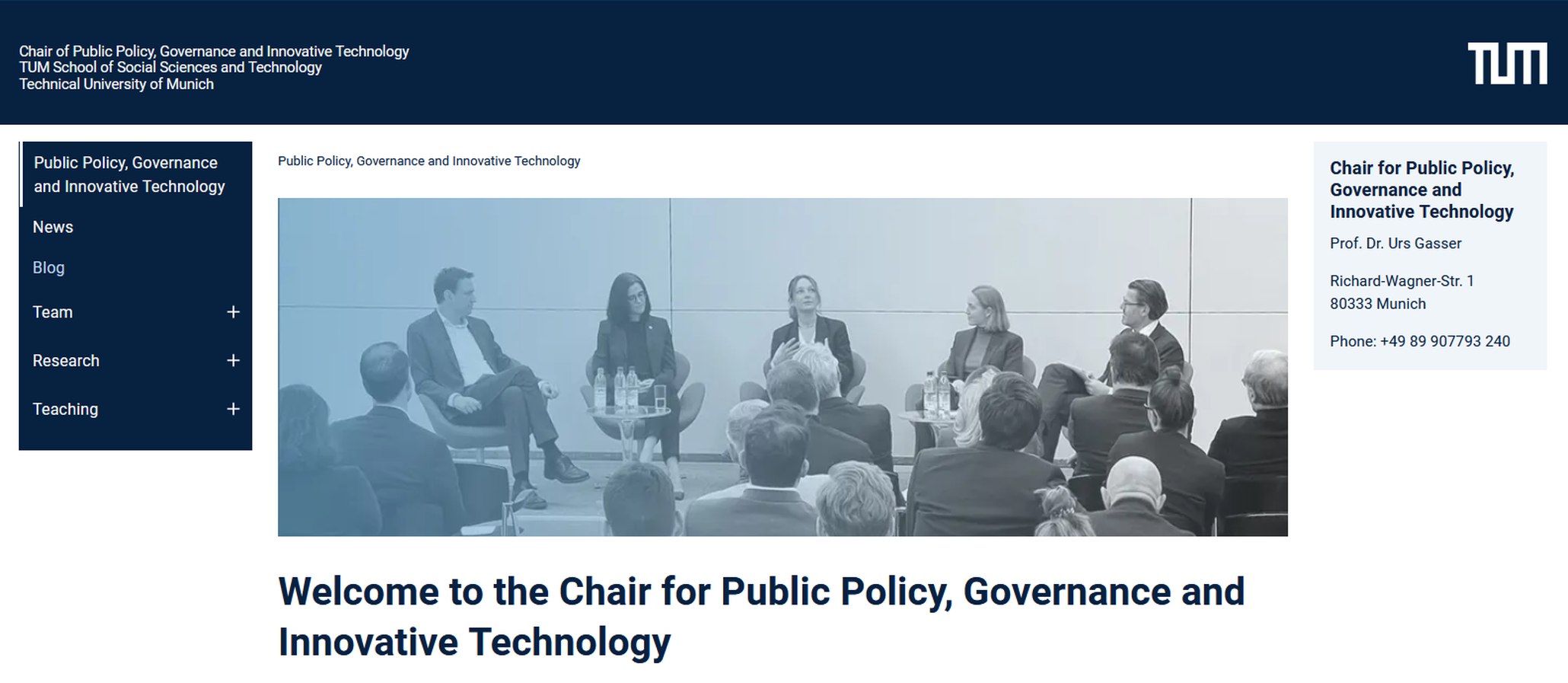
Prof. Mauritz Kop Brings Quantum Governance to TUM's Public Interest Technology Course With Urs Gasser and Fabienne Marco
On August 24, 2026, Prof. Mauritz Kop taught a Quantum-ELSPI overview at the Technical University of Munich with Urs Gasser and Fabienne Marco, as part of a one-week Public Interest Technology course piloted in TUM's new Data & Society master's program at Gasser's Chair for Public Policy, Governance and Innovative Technology.
Teaching Engineers to Build for the Public Interest
The course took technically trained students through competing understandings of the public interest, digital rights, GovTech, digital public infrastructure, public-interest AI, and democracy, with cases from OpenAI's governance crisis and AlphaFold to Aadhaar, Ushahidi, and vTaiwan, and guest contributors including MacArthur Foundation president John Palfrey. Kop, founder of Stanford RQT and of Quentir, who developed Quantum-ELSPI in a Stanford–Oxford collaboration with Luciano Floridi, added quantum technology as a field where public-interest choices can still shape what gets built, from medicine to security.
Kop, Gasser, and Marco at TUM and XPANSE Abu Dhabi
The session builds on Kop and Gasser's research collaboration, from the 2023 Festival of Ideas at TUM's Raitenhaslach Monastery to their joint publications in Nature Physics and Science, and on their engagements with Marco, who moderated the 2024 XPANSE panel on global quantum governance in Abu Dhabi and whose Quantum Social Lab hosted the 2025 International Quantum Forum in Munich. Further reading connects Kop's quantum governance research with responsible innovation and design justice.