
Rigetti and D-Wave Disclosed the Equity Terms on Their $100 Million CHIPS Quantum Awards: What the 4-8 September 2026 Agreements Say the Government Gets
On 22 August 2025 the United States government bought 433.3 million shares of Intel common stock at $20.47 a share, converting $8.9 billion of already-awarded CHIPS and Secure Enclave money into a 9.9 percent holding. It was treated at the time as a special arrangement for a company too large and too strategically placed to fail quietly. Thirteen months later the same instrument reached three companies whose combined annual revenue would not cover a fortnight of Intel's payroll.
The Department of Commerce announced letters of intent with nine quantum computing companies for about $2 billion in May 2026. Quentir covered that announcement in August, when the whole arrangement still rested on letters of intent and a prospectus, and the open questions were all about terms nobody had filed yet. This post is the update those questions were waiting for: in the first week of September the first three awards became binding agreements, two of them with disclosed equity terms. Everything specific below — voting carve-outs, transfer and registration mechanics, march-in rights — comes from the September filings, not from the earlier letters of intent.
What Rigetti, D-Wave and Quantinuum Signed Between 4 and 8 September 2026
The dates matter, because three different things happen on three different days. Rigetti Computing and D-Wave Quantum both date their award agreements with Commerce to 4 September 2026. Rigetti's filing states that it entered the accompanying securities agreement on 8 September, with issuance of the shares expected that day. D-Wave's filing is a step behind: it says the company will enter its securities agreement and will report the issuance afterward. Quantinuum, which has traded as QNT since completing its initial public offering on 5 June 2026, announced on 8 September that it had finalized its $100 million award with the CHIPS Research and Development Office. That release confirms the award and the manufacturing partners behind it and states no equity, voting, transfer or issuance terms, so everything below about how a federal stake behaves rests on the Rigetti and D-Wave filings, not on Quantinuum's. The award, the securities agreement and the issuance are three separate events, and only the first has closed for all three companies.
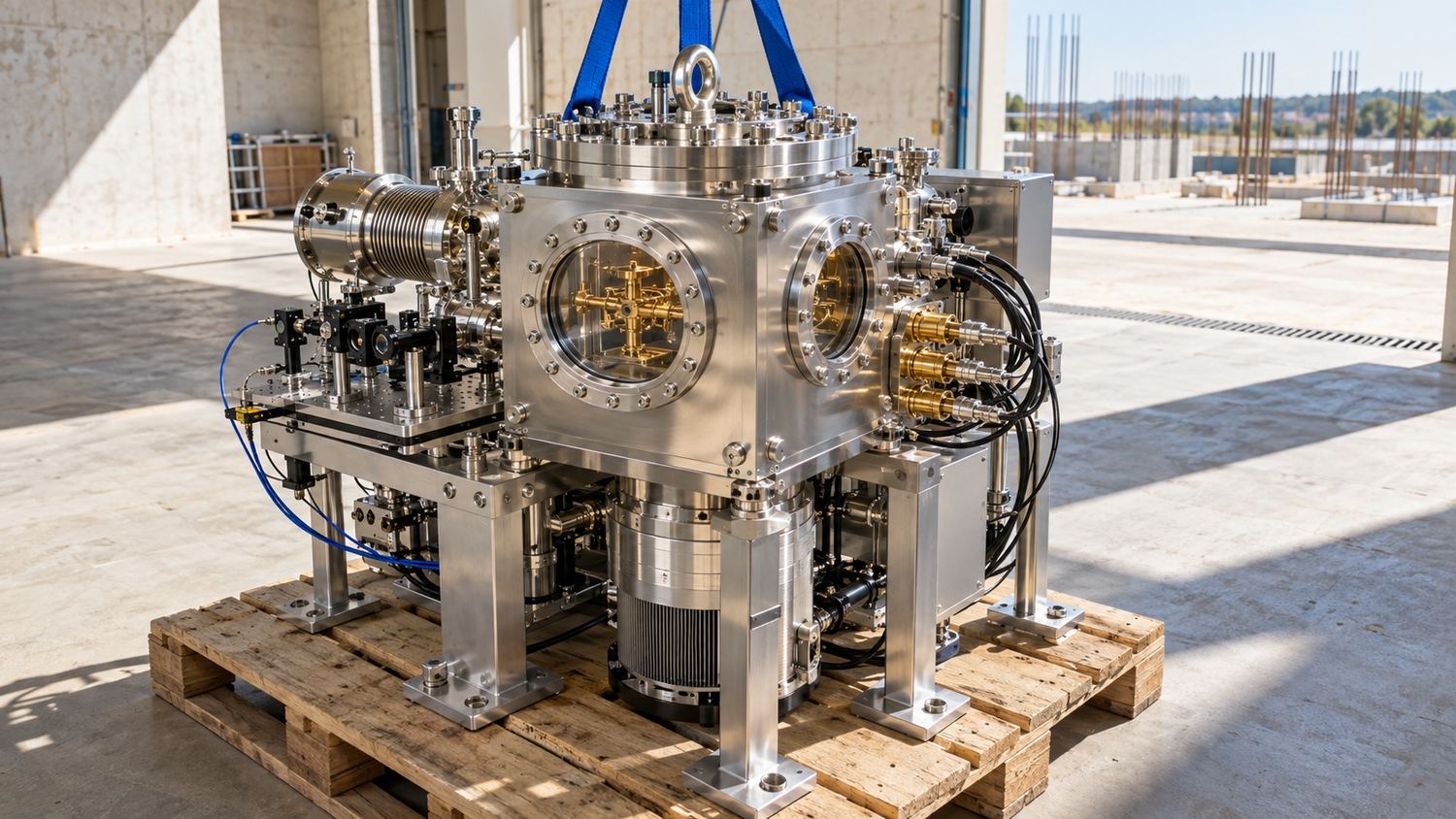
The money funds hardware. Rigetti's award supports integrated readout electronics, expanded cryogenic capacity and fabrication of high-connectivity superconducting chips — the unglamorous middle of a quantum stack, where a machine either scales or stops. Quantinuum's funds go to domestic quantum semiconductor manufacturing: 300-millimeter wafer fabrication of next-generation ion traps with GlobalFoundries, plus laser and optical components with Monarch Quantum. Quantinuum states it is the only trapped-ion company in the CHIPS research tranche. D-Wave gains access to up to $100 million toward a 100,000-qubit annealing system and a 10,000-qubit gate-model machine intended to carry 100 logical qubits through more than a million operations.
Practical takeaway. If your organization contracts with, invests in, or licenses technology from a US quantum vendor, the counterparty analysis has a new line in it. Read the award agreement alongside the securities agreement: the government's voting rights are deliberately narrow, and the operative constraints live in transfer restrictions, registration rights, repurchase mechanics, IP licensing and march-in provisions.
What a Federal Shareholding Actually Carries: Narrow Votes, and Powers Written Into the Award
A grant has an end: milestones are met, money is drawn down, an inspector general can audit the file, and the relationship closes. Stock has no such terminus. Someone has to value it, hold it, eventually sell it, and disclose enough about each step that the decisions are reviewable.
The governance question is narrower than it first looks, and more interesting. Rigetti's securities agreement generally bars Commerce from voting its shares, reserving votes for specified class-rights and business-combination matters; D-Wave describes similarly limited rights. The Intel stake was structured the same way, expressly passive, with no board seat and no governance or information rights. Without votes, the government does no steering through the share register. Its leverage sits in the award documents: transfer restrictions and lock-ups, registration rights that control how and when the position can be sold, repurchase mechanics, intellectual property licenses back to the government, march-in rights over funded inventions, and the ordinary remedies for missed award milestones. Those are the clauses a counterparty needs to read.
What the shareholding does create is an exposure. The Bureau of Industry and Security sits inside the Department of Commerce, and since its September 2024 interim final rule it administers worldwide controls on quantum computing items, including certain cryogenic and control equipment. Whether any particular component needs a license turns on its classification, destination, end user and end use, so the overlap is narrower than the headline suggests — and it is real. Where a licensing decision does touch a company in which the department holds stock, the value of the government's own position moves with the outcome. Senator Elizabeth Warren pressed the Commerce Secretary on the same structural point after the Intel conversion in August 2025. The quantum tranche generalizes it from one company to nine, and to companies whose share prices are claims about the 2030s.
Rigetti makes that last point in numbers. Its market capitalization stood near $5.07 billion on 4 September 2026 against $13.35 million of revenue over the trailing twelve months and a net loss of $238.67 million; the second quarter of 2026 produced $5.1 million of revenue and a $52.6 million loss. Its chief financial officer sold 25,000 shares under a 10b5-1 plan adopted in June, reported on Form 4 days before the award agreement. Nothing there is improper. It does describe what the taxpayer is being handed: a position in a security marked daily by a market that has repriced this sector twice in a year.
The Other Public Payment: Cook County's Class 8 MICRO on the South Works Site
Federal money and federal stock both report somewhere. A third public payment is far harder to see. The Illinois Quantum and Microelectronics Park occupies the former U.S. Steel South Works on Chicago's Southeast Side, anchored by PsiQuantum with IBM, Diraq and Infleqtion among the tenants. To land it, the Cook County Board created the Class 8 MICRO incentive, which reduces the assessment rate at a qualifying site from 25 percent to 10 percent for thirty years. Reported estimates put the resulting relief for developer Related Midwest at about $175 million over that period. The county's own announcement describes a classification a site must apply for, with the application running through city and county review; the public record available on 8 September does not by itself establish that the abatement is operative.
A Chicago Tribune commentary published on 7 September 2026 put the full public package at around $9 billion and asked who collects the return. It reaches back for a comparison to the 1989 incentive package that moved Sears to Hoffman Estates, still Illinois's best-known test of what a large relocation subsidy produces. Meanwhile a coalition including Friends of the Parks, ETHOS and the Alliance of the Southeast has asked for a legally binding community benefits agreement — 25 percent local hiring in the first three years, protection against displacement, limits on pollution, and an abatement for residents mirroring the developer's. No such agreement has been signed.
Three currencies, then, and three visibility regimes. Appropriated research money reports to Congress. Federal stock reports through securities filings. A thirty-year assessment reduction lands on one county's tax base, and the people carrying it have no countersigned instrument at all.
How a Shareholder Would Measure Return in a Field That Audits Itself in Weeks
The awkward part of holding equity in a scientific field is that the science keeps checking its own work in public. On 28 July 2026, IBM and the University of Chicago posted Sampling hard circuits with verifiably high fidelity (arXiv:2607.25941). The first version ran doped Clifford sampling across 70 data and 27 ancilla qubits at depth 70, with 468 T gates and spacetime codes catching most first-order errors, publishing 2,051 usable samples and a certified fidelity floor of 0.284. On 13 August, Manabe and Pan at the Singapore University of Technology and Design with Gu at NVIDIA posted arXiv:2608.13110: a time-transverse tensor-network contraction at certified width 35, against a heuristic estimate of 2^43, computing exact amplitudes for the published outputs in 37.3 minutes on 256 H100 GPUs and returning a log-XEB diagnostic of 0.35 that sits inside IBM's own floor.
Two qualifications keep that from being a refutation, and both are the point. The classical work computed amplitudes for the published output batches and produced a compatible fidelity diagnostic; it did not reproduce the full sampling task or show the experiment to be wrong. And the story since has been convergence: the current version of the IBM paper, posted 2 September, describes a revised 64-qubit, depth-73, 314-T-gate experiment and lists Manabe, Gu and Pan among its authors. The classical team that audited the claim is now inside it.
The mechanism deserves attention, because it cuts in an unexpected direction. What made the audit cheap was the certification itself: publishing certified outputs and a numerical fidelity floor handed the classical side an exact target and a scoring rule. Verification protocols that make a quantum claim trustworthy also make it checkable for the price of a few hundred GPU-hours — a healthy property for a scientific field, and an uncomfortable one for an investor whose position can be revalued three weeks after a headline by a preprint that costs less than a conference booth.
The same weeks supplied the corporate version of the lesson. NEC's confirmed exit from building gate-based quantum computers, twenty-seven years after its Tsukuba lab produced the first superconducting qubit, was a capital-allocation decision by a company that had been in the field longer than almost anyone. Fujitsu answered on 8 September with a tin-vacancy diamond-spin prototype and a roadmap to 250 logical qubits in FY2030. That is the spread of informed opinion the United States has taken nine positions inside.
How Quentir Reads It
Public support for quantum research is defensible on its own terms, and the fabrication work these awards fund is the least speculative part of the sector: wafers, cryostats, lasers, readout. The instrument is what deserves attention. A state that holds stock acquires an economic interest in companies it also licenses for export, and it acquires that interest before writing the rule that governs how it will behave when the two roles meet. One conversion could be argued as an exception. Nine positions is a portfolio, and a portfolio is a policy.
For boards and general counsel the consequences are near-term and documentary. A minority, substantially non-voting federal holding may or may not trip a given change-of-control clause, and the answer is specific to the drafting: the definition in use, its ownership thresholds, its aggregation rules, and whether it addresses government ownership at all. Test that clause against these terms before assuming either result. Beyond it, diligence needs a government-ownership and award-rights representation: read the securities agreement and the award agreement together, since the transfer, registration, repurchase and march-in terms are where the government's actual powers live. And export-control advice on quantum components now runs through a department holding a financial position in some applicants, which is a disclosure question long before it is a scandal.
The civic question underneath is older than quantum computing. When the state invests on behalf of citizens, the return has to be measurable in something they can observe. Federal stock is observable, if imperfectly, through filings. A thirty-year assessment reduction on the Southeast Side of Chicago is observable only as an absence, which is why the residents asking for a countersigned commitment are asking for the one thing that would make the arrangement symmetrical. Quentir has argued before that quantum technologies land on civic ground before they land on technical ground; a share register and a county assessment roll are two concrete pieces of that ground.
These threads — federal industrial policy, vendor capital structure, verification of performance claims, and the local instruments that pay for the plant — surface in different weeks and rarely in the same publication. The All-access membership opens the whole archive, so the CHIPS equity condition, the NEC withdrawal and the public auditing of a certified sampling claim can be read as the single argument about capital and proof that they are.
The remaining questions are answerable from documents, and the documents are coming: whether D-Wave's securities agreement carries Rigetti's voting carve-outs or different ones, what the six unclosed awards in the nine-company tranche look like when they land, and how Commerce values and eventually exits a portfolio of pre-revenue positions. The first case where an export decision and a shareholding sit in the same building on the same company will be the one worth reading closely.
Sources. Rigetti Computing, Form 8-K (award agreement dated 4 September 2026; securities agreement entered 8 September 2026 with issuance expected that day; voting generally barred except on specified class-rights and business-combination matters), and the company's announcement of 8 September 2026 for the award scope. D-Wave Quantum, Form 8-K dated 4 September 2026 (award agreement; securities agreement to be entered and issuance to be reported subsequently; similarly narrow voting rights), with system scope in the company's award announcement. Quantinuum, "Quantinuum Finalizes $100 Million CHIPS R&D Award with U.S. Department of Commerce", 8 September 2026 (GlobalFoundries 300 mm ion-trap fabrication; Monarch Quantum lasers and optics; sole trapped-ion recipient); Quantinuum has traded as QNT since its initial public offering completed on 5 June 2026, per its Form 10-Q for the quarter ended 30 June 2026. NIST / U.S. Department of Commerce, "Department of Commerce Announces Letters of Intent with 9 Companies for $2 Billion", May 2026. All nine awards carry the same top-line minority-equity condition; the detailed terms are established here only for Rigetti and D-Wave, from their filings. Intel Corporation, "Intel and Trump Administration Reach Historic Agreement", 22 August 2025 (433.3 million primary shares at $20.47; 9.9 percent; expressly passive, with no board, governance or information rights). U.S. Senate Committee on Banking, Housing, and Urban Affairs, "Warren Presses Commerce Secretary on Trump's Deal to Give the U.S. 10% Stake in Intel", August 2025. Cook County, "Cook County Board Approves New Class 8 MICRO Property Tax Incentive" (assessment rate 25 percent to 10 percent for thirty years; site applications subject to city and county review). The $175 million estimate for Related Midwest and the community-benefits coalition's positions are as reported by Crain's Chicago Business. Yunus Emre Tozal, "Chicago's quantum park comes with a $9 billion price tag. Who actually benefits?", Chicago Tribune commentary, 7 September 2026 — also the source for the Sears/Hoffman Estates comparison. Rigetti quarterly figures from the company's Form 8-K exhibit of 6 August 2026; market capitalization and trailing-twelve-month figures as of 4 September 2026 ($5.07 billion market capitalization, $13.35 million trailing-twelve-month revenue, $238.67 million net loss) from stockanalysis.com; the 25,000-share sale under a June 10b5-1 plan is taken from the Form 4 filed with the SEC. U.S. Bureau of Industry and Security, "Department of Commerce Implements Controls on Quantum Computing and Other Advanced Technologies" — worldwide controls on specified quantum items; licensing turns on classification, destination, end user and end use. Fujitsu, announcement of its tin-vacancy diamond-spin prototype and logical-qubit roadmap, 8 September 2026. IBM and University of Chicago, Sampling hard circuits with verifiably high fidelity, arXiv:2607.25941v1, 28 July 2026 (the 70-data-qubit, depth-70, 468-T-gate run and the 0.284 certified floor cited above), and the current version of 2 September 2026, which reports a revised 64-qubit, depth-73, 314-T-gate experiment and adds Manabe, Gu and Pan as authors. K. Manabe and F. Pan (SUTD) with M. Gu (NVIDIA), arXiv:2608.13110, 13 August 2026 (certified width 35; exact amplitudes for the published outputs in 37.3 minutes on 256 H100 GPUs; log-XEB 0.35 compatible with the certified floor). Public sources checked 8 September 2026.
Published intelligence, built to inform your own decisions. Published: September 8, 2026.