
NEC Stopped Building Quantum Computers in March 2026, Twenty-Seven Years After Its Tsukuba Lab Made the First Superconducting Qubit
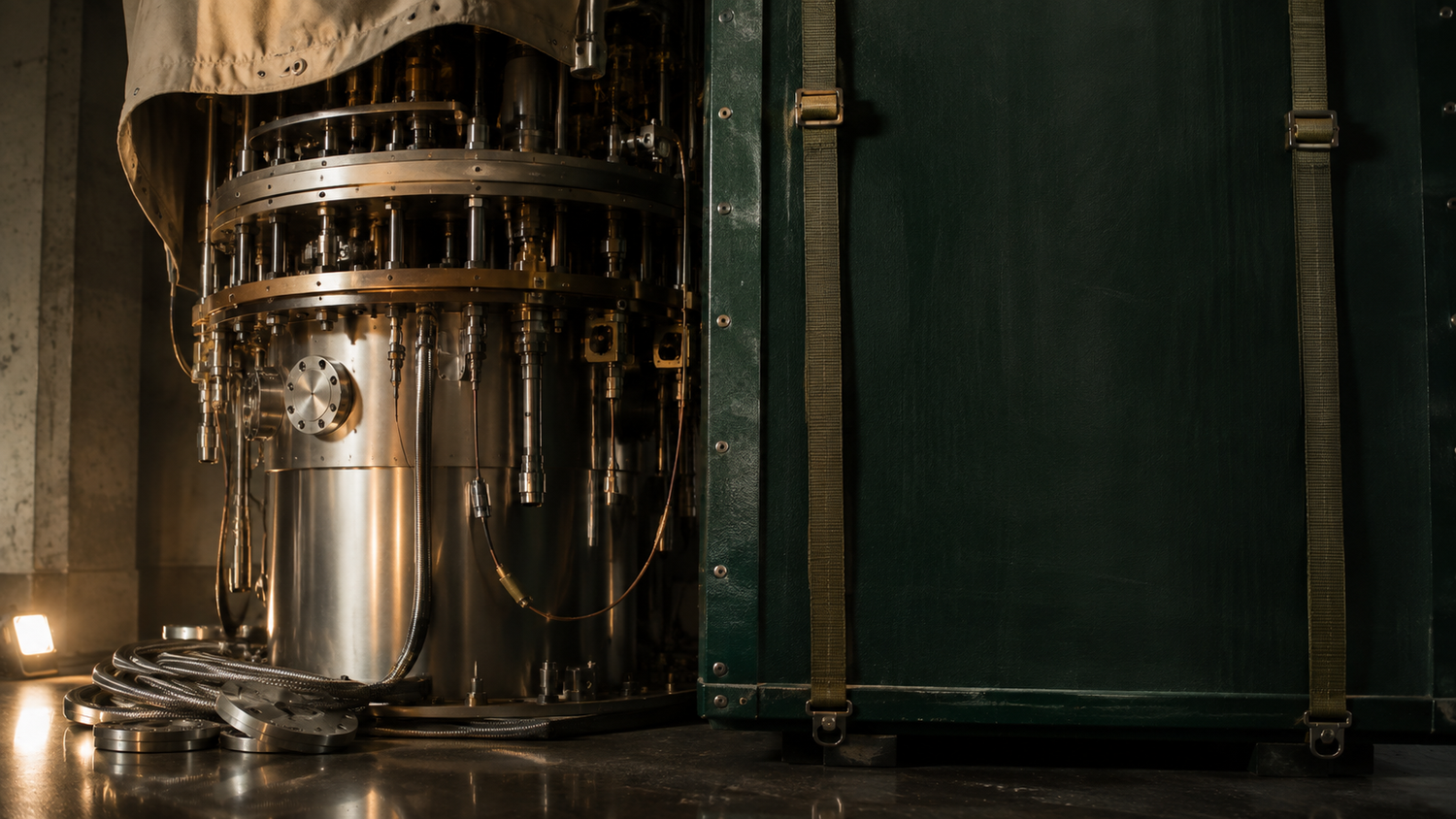
In a laboratory in Tsukuba, Yasunobu Nakamura, Yuri Pashkin and Jaw-Shen Tsai cooled a small aluminum circuit to a few hundredths of a degree above absolute zero and hit it with a voltage pulse. The circuit answered by oscillating between two quantum states in a way they could steer. Nature received the paper on 26 January 1999 and published it on 29 April as Coherent control of macroscopic quantum states in a single-Cooper-pair box. It was the first coherently controlled superconducting qubit, and it came out of the fundamental research arm of a Japanese electronics company: NEC.
The transmon qubits used today at Google, at IBM and in the machine Fujitsu built with RIKEN descend from that circuit — the single-Cooper-pair box is the origin of the charge-qubit line, though not of every superconducting architecture in the field. NEC gave that line its starting object.
At the close of its fiscal year on 31 March 2026, NEC stopped building them.
Practical takeaway. A supplier development chart submitted to a national government is not a commitment that survives the supplier's own capital review. NEC's four-to-1,000-qubit ladder went to Japan's Cabinet Office in December 2022; the halt came three years and four months later, and newspapers reported it five months after that. If a quantum or post-quantum plan leans on a specific vendor's hardware milestone, the useful question is what that vendor has installed and where, not what it has published.
What NEC Shut Down on 31 March 2026, and What It Kept Running
The company ended its internal program to build superconducting quantum computer hardware. It kept quantum annealing research, the quantum-inspired annealing it runs on its own SX-Aurora vector supercomputers, the classical emulation layer, and the combinatorial optimization services it sells around them. According to the reporting, the reason is the one that governs most industrial withdrawals: commercialization sits too far out to justify the capital, and no single hardware modality has won clearly enough to bet on. NEC itself has confirmed none of that.
NEC issued no announcement. Diamond Online broke the story on 4 September 2026 and Nikkei followed on 5 September, after which The Quantum Insider (6 September), Quantum Computing Report and XenoSpectrum (both 7 September) carried it. Asked to comment, NEC's press office said only that it continues technical assessment toward practical application. Five months separate the decision from the first public account of it. What partners, ministries or research collaborators knew privately in that interval is not established by the reporting, and this article does not assume they knew nothing.
The interval still matters. A supplier may discontinue internal research; what follows depends on its contractual and funding commitments, and nothing in the reporting suggests NEC breached any of its own. Retiring a capability that appears in a national technology plan is still a different act from closing an ordinary project, because the plan continues to be read by people making funding and procurement decisions until someone tells them otherwise.
The 6 December 2022 Cabinet Office Deck: Four Parametron Qubits, Then 100, Then More Than 1,000
On 6 December 2022, NEC submitted a deck to the third meeting of the Cabinet Office working group on practical quantum applications, under the name of Motoo Nishihara, then executive vice president and chief technology officer. It remains on the Cabinet Office site as 量子コンピューティングの早期産業化に向けたNECの取組と提言 — NEC's activities and recommendations for the early industrialization of quantum computing.
Page 10 is the one to read. It shows NEC's qubit layout scheme: a basic unit of four superconducting parametron qubits plus coupling circuits, repeated to reach 100 qubits and then more than 1,000, with cryogenic electronics work to cut in-refrigerator wiring at scale. This ladder is for the quantum annealer, not for a gate machine — a distinction the summaries of NEC's withdrawal have mostly dropped. Page 2 sets the surrounding schedule: problem-solving models offered through both annealing and gate approaches by 2030, and fault-tolerant systems pursued through the JST Moonshot program looking toward 2040 and beyond.
The audience was the body that shapes Japanese quantum funding, at the moment that funding was being allocated. It had every reason to treat the qubit ladder as a plan with a company behind it. Because the ladder and the delivered machine are both parametron annealing hardware, the comparison is direct rather than a mismatch of paradigms: the top of the chart is more than 1,000 qubits and the announced machine is eight. One limit belongs with that comparison. Page 10 attaches no delivery date to the 100-qubit or 1,000-qubit rungs, so the gap measures scale ambition against announced hardware. It is not a missed deadline, because no deadline was published.
This is the same failure mode Quentir has argued about in a narrower technical setting: a qubit count with no error budget attached carries little information about what a machine will do, and hardware claims stated without one should be read as marketing until the fidelity figures arrive. A roadmap is that same object stretched over time. Four to 100 to 1,000 describes an ambition; it becomes a schedule only when each rung carries a date, a fabrication route and a coherence target.
The Machine NEC Announced: Eight Parametron Qubits, Built with AIST, Reached from Tohoku Over the Internet
NEC's announced hardware was modest and real. Working with Japan's National Institute of Advanced Industrial Science and Technology, it built an eight-qubit quantum annealing machine using superconducting parametrons on the ParityQC architecture, and announced joint research with Tohoku University on 28 June 2023. The machine is reached from Tohoku over the internet — Japan's first domestically built annealing machine offered that way. What sits physically at Tohoku is the SX-Aurora TSUBASA vector supercomputer running NEC Vector Annealing, which the same project uses alongside the quantum machine.
Eight working parametron qubits in a shared research service is respectable engineering. It is also less than one hundred and twenty-fifth of the figure at the top of the 2022 chart, which reads "more than 1,000". No public announcement of a 100-qubit NEC machine — the middle rung — has been found.
Alongside it, NEC sold quantum products that need no NEC quantum processor of its own: simulated annealing on its vector engines, which is classical, and resale access to D-Wave's cloud service, which runs on D-Wave's hardware. The 2022 deck lists the two separately. Those lines continue. Stripped of the hardware program, NEC's quantum business becomes an optimization software business with a strong classical compute story — a reasonable place for the company to stand, and a different business from the one the 2022 deck described.
Japan's national position changes less than the headline suggests, though the Diamond and Nikkei reports add that a number of NEC's quantum researchers have moved to Fujitsu. Fujitsu, working with RIKEN, carries domestic corporate superconducting development, and IBM and Quantinuum systems operate on Japanese soil at Kobe and Kawasaki. What Japan loses is redundancy: one fewer independent industrial route to a technology its strategy treats as foundational, in the country where the first coherently controlled superconducting qubit was made. Redundancy is the thing a national strategy loses first and notices last.
Why Copenhagen and Brussels Answered the Same Question Differently
NEC's judgment was that the payback horizon is too long. Two European decisions reported in the same week as the halt answered the question the other way. The three are not three decisions taken in one week — NEC's was taken in March and surfaced in September — but they are three positions on the same question, visible at once.
In Copenhagen, the Novo Nordisk Foundation and Quantum Foundry Copenhagen confirmed plans for a 5,300-square-meter quantum chip fabrication facility. A philanthropic funder answers to a grant strategy and a board rather than to quarterly earnings, which is a different pressure from the one acting on a listed manufacturer, though not an absence of expectations.
In Brussels, at a European Parliament event on 3 September, Thomas Skordas, deputy director-general of DG CNECT, said the forthcoming EU Quantum Act "is not about budget" and that what it provides is stimulus and coordination; reporting on the event describes the act as arriving without a dedicated budget line. He added that Europe cannot afford to have 78 quantum start-ups each going it alone, and that some consolidation is expected. Europe's legislative answer to the capital question is therefore a framework, due at the end of 2026 or later, aimed at companies facing the arithmetic NEC has just resolved by leaving.
How Quentir Reads It
Reading these three together, the variable that separates them looks less like confidence in the physics and more like how long each institution can hold a position: a listed manufacturer on a payback horizon, a foundation on a grant strategy, and a regulator with coordination powers and no dedicated budget announced for the proposed act. That is Quentir's interpretation rather than anything the three parties have said about each other, and it is the interpretation we would test first against the next withdrawal or the next fabrication commitment.
The NEC case also gives procurement teams something they rarely get: a supplier development chart submitted to a government, an announced machine, and a withdrawal, all publicly locatable and all dated. The distance between them is measurable, and it sets a realistic ceiling on how much weight a vendor technology plan should carry in a purchasing or partnership decision.
For organizations planning post-quantum cryptographic migration, the reading runs against the obvious one. NEC's exit does not show that the cryptographic threat receded. The company withdrew from building quantum computers because its commercial payback is slow, which speaks to NEC's cost of capital and to modality uncertainty. It says nothing about Google's program, about the trapped-ion route, or about a state actor with no payback requirement at all — the actor whose harvest-now-decrypt-later behavior sets migration deadlines. An industrial retreat and a security timeline are separate clocks, and NEC's decision moves only the first.
Quentir follows these industrial and regulatory movements across quantum computing, post-quantum cryptography and AI governance, and the connection between them usually appears only across weeks of coverage. The All-access membership opens the full archive, so the Copenhagen fabrication plant, the Quantum Act's missing budget line and NEC's withdrawal can be read in one place as the single argument about capital patience that they are.
The question worth carrying into next quarter: which other 2022-era corporate quantum development chart has already lapsed, and how would anyone outside the company find out?
Sources. Y. Nakamura, Yu. A. Pashkin and J. S. Tsai, "Coherent control of macroscopic quantum states in a single-Cooper-pair box," Nature 398, 786–788, received 26 January 1999, published 29 April 1999. NEC (Motoo Nishihara), 量子コンピューティングの早期産業化に向けたNECの取組と提言, submitted to the Cabinet Office working group on practical quantum applications, third meeting, 6 December 2022; the parametron qubit ladder is on page 10 and the 2030/2040 schedule on page 2. NEC and Tohoku University, joint research announcement on the 8-qubit quantum annealing machine developed with AIST, 28 June 2023. Diamond Online, first report of the halt, 4 September 2026; Nikkei, NEC ends development of quantum computer hardware, 5 September 2026 (both subscription). The Quantum Insider, 6 September 2026. Quantum Computing Report, 7 September 2026. XenoSpectrum, 7 September 2026. The Next Web, remarks by Thomas Skordas at a European Parliament event of 3 September 2026. Public pages checked 7 September 2026.
Published intelligence, built to inform your own decisions. Published: September 7, 2026.