
DOE's Genesis Q Sample Agreement Specifies Verification Circuits Standardized Across Awardees: What DE-FOA-0003657, Published 17 September 2026, Asks for 100 Logical Qubits
What DE-FOA-0003657 defines, and what it standardizes
The Department of Energy's Quantum Genesis Q Competition, announced on 17 September 2026 with up to $215 million in planned funding, defines its terms rather than borrowing them. The request for applications defines a logical qubit, defines a hard operation as the scarce resource in a fault-tolerant computation, and adds scientific relevance as a third metric. The sample Other Transaction Agreement goes further: the circuits an awardee must run to claim an incentive milestone are specified by the verification and validation team and are standardized across awardees, with completion judged on hard operations, space-time volume and the correctness of the outputs.
What it still negotiates
Around that common test sit two negotiated layers. DOE and each applicant specify, during negotiation, the methodology used to define and evaluate the metrics, and architectures not naturally measurable in total logical qubits may propose equivalent technical metrics, acceptable at DOE's sole discretion, covering the final milestone and both bonus pools. Payment follows a fixed sequence: $250,000 on approval of a validation plan, $1,250,000 on a validated prototype, then a synchronized Quarter 8 evaluation of the $100 million general incentive pool and the two $50 million bonus pools. All of it is subject to the availability of appropriated funds.
Why the same-date arXiv paper matters
Matthias Troyer, Chetan Nayak and John Martinis posted Scalable logical qubits on 17 September 2026 to make logical-qubit progress measurable and comparable across platforms, characterizing the unit along four coupled dimensions. This post reads the competition documents and the paper against each other, and against the oldest working example of an independent assay.
DARPA Is Buying the Copies, Not the Discovery
A program bought units, not a demonstration
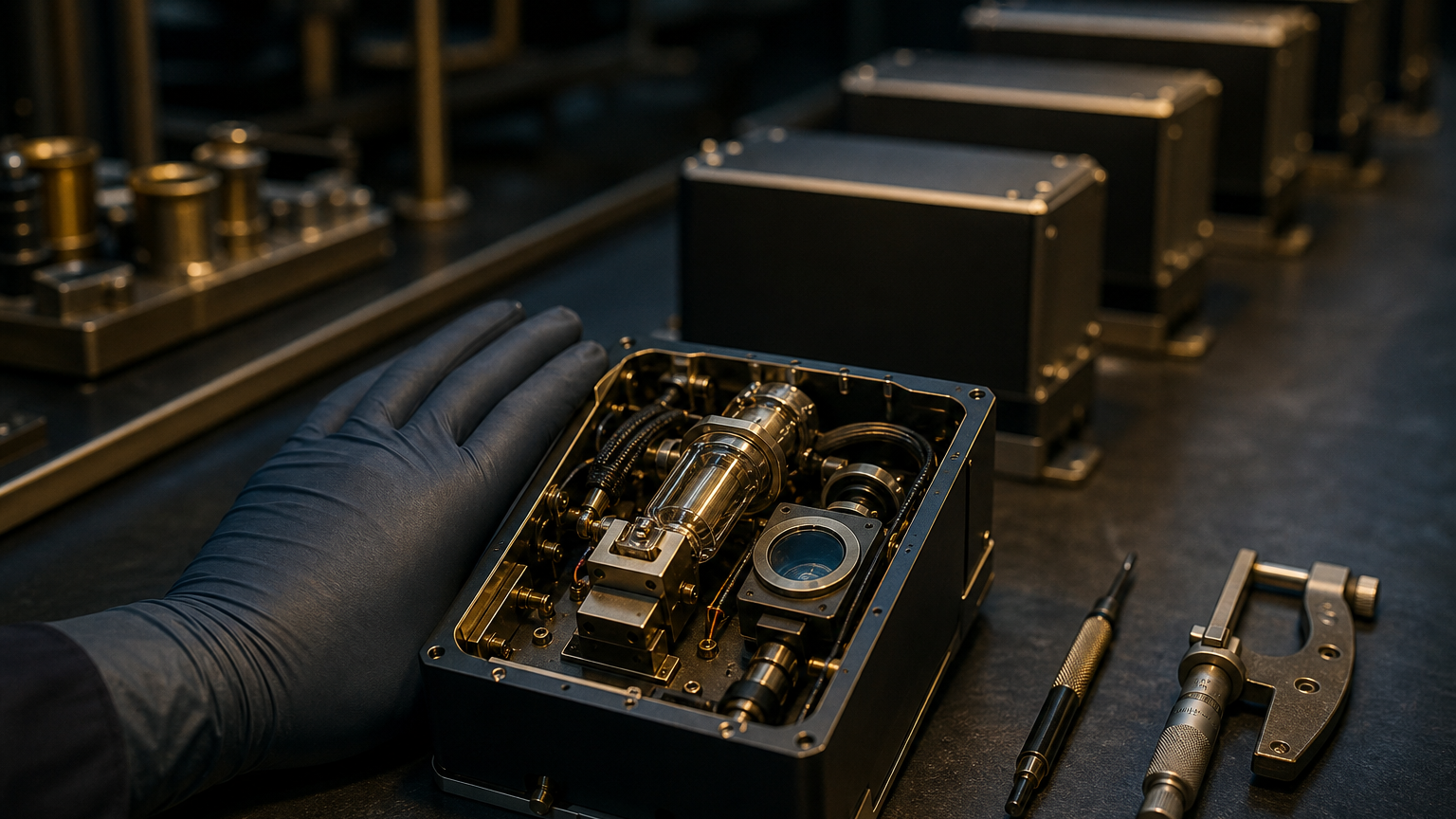
On August 6, 2026 the Defense Advanced Research Projects Agency announced It's About Time, a program whose stated aim is a pilot manufacturing pipeline for tactical-grade optical clocks. On the same day IonQ said it had received a $28 million contract extension covering manufacturing development and 25 Evergreen-05 optical atomic clocks, with an unexercised $30 million option for a further 100 units, and that it would add $15 million of its own capital for production space, equipment and staff. A facility is expected to open by mid-2027.
Timing is the capability arriving first
The Evergreen-05 sits in a five-liter enclosure, roughly one seventy-fifth the volume of an active hydrogen maser, and is specified at 50 femtoseconds of stability at one second with nanosecond-level holdover across ten days. Holdover is the number that matters operationally: it describes how long a platform keeps defensible time after the satellite signal stops. Against a documented rise in GNSS jamming and spoofing across the Baltic, the Black Sea, the eastern Mediterranean and the Middle East, that is a civil infrastructure question as much as a military one.
The qualification route is unnamed
DARPA's companion OASIC effort is building fee-based, certification-style testbeds open to outside users, and its atomic-clock testbed team is Vector Atomic — the company IonQ acquired in October 2025 — with the University of Colorado. Yet neither the DARPA announcement nor the IonQ release says whether the delivered clocks will be qualified there, or anywhere else: no national metrology institute, no international comparison, no cited military standard is named for the units. Meanwhile the same physics is being assessed on a separate civilian calendar, where the international committee responsible for the second is working toward a possible redefinition around 2030. A quantum instrument is entering pilot manufacturing while the reference frame it will be judged against is itself under revision.