ESA's QKDSat Photon Source Passed Space Qualification in Valencia on 1 September 2026, and the NCSC Will Not Accept QKD for UK Government Use
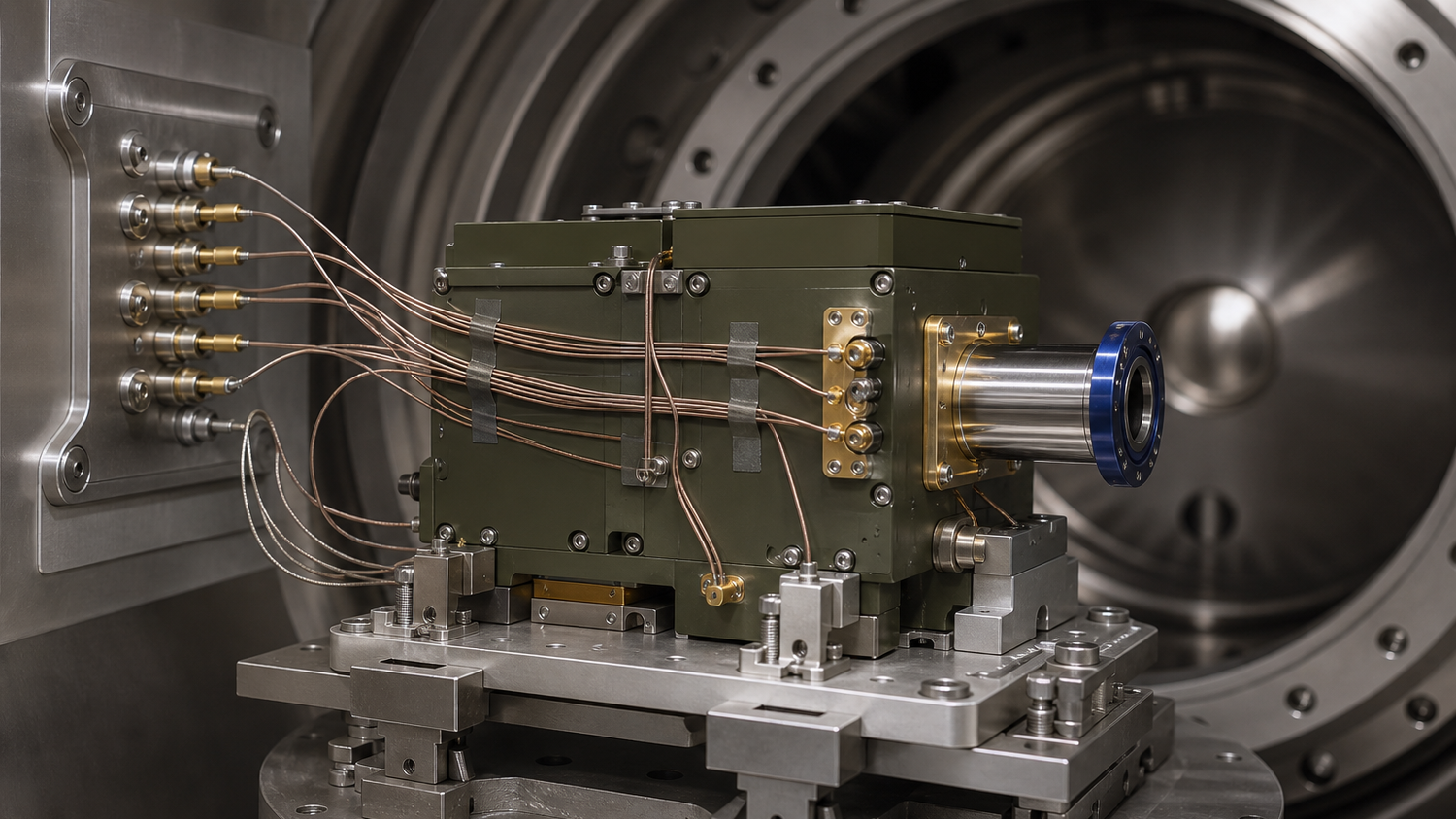
A thermal-vacuum chamber is one of the few places in engineering where a machine is judged against a written profile and the answer is not open to interpretation. The chamber is pumped down, the temperature is driven to the extremes the mission will see, the unit is switched on and measured throughout, and at the end there is a signed document saying whether it held. On 1 September 2026 the European Space Agency announced that a quantum optical source built in Valencia had come through that campaign qualified.
The published position of the United Kingdom's national cyber security authority is that a system built from such a source should not count towards a security assessment of government traffic.
Practical takeaway. Europe is qualifying flight hardware for satellite quantum key distribution while one of its most influential security authorities will not support QKD for government or military use and tells other sectors not to rely on it alone. The disagreement is about authentication and about what a deployment entitles an operator to claim, not about whether the physics works. An organisation with a quantum-link offer on the table should ask which authority has published acceptance criteria for the specific configuration on offer, and at which level — component, network or complete system.
What DAS Photonics qualified in Valencia, and where the unit goes next
ESA's own release, Quantum laser pulse generator ready to power ESA's QKDSat, dated 1 September 2026, states that DAS Photonics has qualified the Engineering Qualification Model of the Faint Pulse Source to the requirements of the European Cooperation for Space Standardisation, at the ESA-VSC testing facility in Valencia, and delivered it to Redwire Europe. The FPS is a software-defined optical source: it generates digitally configurable optical pulses of the kind a QKD protocol needs, with security mechanisms built into the source itself. ESA's superlative is narrowly worded and worth quoting as written — this is “the most advanced qualified Faint Pulse Source with embedded security mechanisms in Europe for a satellite-based QKD system.”
Laurent Jaffart, who runs ESA's Directorate of Connectivity and Secure Communications, put it in institutional terms: “Europe's future depends on trusted, secure communications, and space has a central role to play in delivering them.” Marta Beltrán of DAS Photonics called the qualification “a key milestone for DAS Photonics and for the advancement of European quantum-secure communications.”
QKDSat is an ESA Partnership Project under the ARTES programme. ESA's release names Honeywell Aerospace, Redwire Europe and DAS Photonics; the agency's project page records an industrial consortium led by Honeywell UK with Redwire Space in Belgium and QTLabs in Austria, alongside companies in Czechia, Switzerland, Canada and the United Kingdom, under a contract signed on 16 September 2025. The reason for putting the source in orbit is specific: a satellite can serve two distant ground stations without the chain of intermediate relay nodes that long-distance terrestrial fibre QKD needs, and those relay nodes are where a terrestrial network has to trust an operator with key material in clear form. That removes the relay chain from the ground; where the remaining trust sits depends on the satellite's architecture and key management, which the material published so far does not specify.
What the NCSC published on 5 August 2025, and which organisations it applies to
The National Cyber Security Centre's paper Quantum networking technologies, published on 5 August 2025 at version 1.0, says the thing plainly for one class of user: “The NCSC will not support the use of QKD for government or military applications.” It then addresses the accreditation question directly — “the use of QKD systems should not constitute evidence towards assessments of security of data-in-transit under the NCSC's Cyber Assessment Framework.” Outside that scope the wording is softer and should not be reported as a ban: “for other sectors, the NCSC recommends that QKD should not be solely relied upon for generating and distributing cryptographic keys.” This is a standing position from 2025 rather than a reaction to this week's hardware. What is new on 1 September 2026 is a qualified flight component arriving against a policy that has not moved.
The reasoning turns on authentication. “QKD does not provide authentication, nor do any other quantum techniques,” the paper states. A QKD exchange produces a shared secret between two endpoints and can reveal that someone measured the channel; it says nothing about who is at the far end. That has to come from elsewhere. If it comes from public-key signatures, the deployment depends on exactly the classical or post-quantum cryptography QKD was sold as replacing. If it comes from pre-shared symmetric keys, the NCSC's objection is operational: such systems “do not have general purpose applicability as the distribution and management of these authentication keys makes scaling and managing systems difficult in practice.”
The NCSC's own migration schedule, Timelines for migration to post-quantum cryptography, published 20 March 2025, is built entirely on standardised algorithms: a full discovery exercise and a migration plan by 2028, the highest-priority migration activities by 2031, and complete migration of all systems, services and products by 2035. QKD does not appear in it as a route.
Madrid already has hospitals and a bank on a quantum network
The demand side of this argument is not hypothetical in Spain. The MADQuantum-CM programme concluded with an announcement on 26 May 2026 describing MadQCI, a metropolitan quantum communications network connecting 30 locations over more than 700 kilometres of optical fibre. Its named use cases are institutional rather than experimental: secure links between hospitals in the Vithas group, cryptography work in Banco Santander operating scenarios, and the Spanish Centre of Metrology's quantum optical frequency standard distributing ultra-precise timing over the same fibre. The consortium was coordinated by the Universidad Politécnica de Madrid with IMDEA Networks, IMDEA Software, the National Institute for Aerospace Technology, the Universidad Autónoma and the Universidad Complutense.
That last item is worth pausing on, because metrology is the discipline that made the distinction this whole dispute rests on. A frequency standard is only useful when there is an unbroken chain of traceability from the instrument in the rack back to the definition of the second. A component that passes its own calibration proves the component. The chain is what lets somebody sign for the measurement. ESA's campaign proves the source against a mission profile; the Cyber Assessment Framework asks a different question, about what an operator may claim for a whole deployment, and nothing published so far joins the two.
The estate at the far end of the link: 6 per cent of connected medical devices
While European programmes qualify photon sources, the ordinary equipment those links would serve sits a long way behind. Forescout's Vedere Labs research team published its device-class breakdown on 24 June 2026, from internet-wide scans of more than 160 million SSH hosts plus enterprise telemetry. Servers supporting post-quantum key exchange grew from 11.5 million to over 19 million in a year, a 72 per cent rise, which moved the share from 6.2 per cent to 11.88 per cent. Inside enterprise networks Forescout measured the proportion of devices running PQC-capable versions of OpenSSH — capability, not confirmed use of a post-quantum key exchange — and found IT devices at 50 per cent, IoT at 28, operational technology at 16, and connected medical devices at 6 per cent, the lowest on that measure. At the TLS layer the ranking changes: IT at 8 per cent, IoT and medical devices at 5.6, and operational technology last at 0.8 per cent.
Set those figures beside the Madrid programme. Hospitals in the Vithas group are among the named users of a metropolitan quantum network; across a separate and much larger population of enterprise equipment, connected medical devices are the least capable class on the SSH measure and close to last on the TLS one. The two datasets do not describe the same machines, and no Forescout figure is a statement about any Madrid hospital. What they show together is a mismatch of layers: a quantum link protects a path between two endpoints, and does nothing for the cryptography inside the infusion pump, the imaging workstation or the archive at either end. The same asymmetry runs through the retention problem we described when BSI dated the end of classical asymmetric cryptography and FINMA set a mid-2027 roadmap date: the data that has to stay confidential for decades is mostly sitting still, not moving down a link.
How Quentir Reads It
Two European public programmes are buying the same technology on two different theories of proof. ESA's theory is the one engineering has used for sixty years: define an environmental profile, put the unit in the chamber, and record whether it held. Britain's theory is an assurance case: a written argument that a system delivers a stated security property, which a public body can be held to. QKD passes the first comfortably and, in the NCSC's reading, cannot yet be made to carry the second for government traffic, because the authentication it needs has to be imported from somewhere else and the pre-shared key management that avoids that import does not scale.
The gap is not that nobody has written criteria. ETSI's GS QKD 016 is a Common Criteria protection profile specifying security requirements for prepare-and-measure QKD modules, and European QCI programmes have their own accreditation processes. Those are component and network instruments. What is missing is the level above them: a published acceptance case under which a complete satellite-based system could carry government traffic. Until one exists, public money is qualifying a supply chain whose eventual customers cannot be told what the finished product would entitle them to claim, and that lands on national accreditation bodies rather than on ESA. A space agency qualifying hardware and a security authority setting national criteria are doing different jobs; neither is contradicting itself.
The reading we would take into a purchasing decision is narrow. Treat satellite QKD as a key-delivery mechanism that removes the terrestrial relay chain, ask where the architecture puts the trust it does not remove, and treat identity, endpoint security and stored data as unchanged by it. Ask any vendor to name the authority and the document behind the acceptance criteria for the configuration on offer, and at which level those criteria sit. Our Signature Brief line is where supervisory positions and criteria sets like these are tracked as they are published, with the dated sources behind each; the running free coverage stays on Quentir Intelligence.
The next dated moment belongs to Redwire Europe, which now has the Faint Pulse Source and has to test it with the rest of the quantum payload. When that campaign finishes, the hardware question will be closed and the accreditation question will be exactly where it is today.
Sources: European Space Agency, “Quantum laser pulse generator ready to power ESA's QKDSat”, 1 September 2026 (page read 1 September 2026) — the qualification of the Faint Pulse Source Engineering Qualification Model to ECSS requirements, the ESA-VSC testing facility in Valencia, the handover to Redwire Europe, the ARTES programme, the partners Honeywell Aerospace, Redwire Europe and DAS Photonics, the quoted superlative, and the quotations from Laurent Jaffart and Marta Beltrán are all taken from this release. The milestone was also carried the same day by Infodefensa and El Español. ESA, QKDSat partnership project page (read 1 September 2026) for the consortium structure — led by Honeywell UK with Redwire Space (Belgium), QTLabs (Austria) and companies in Czechia, Switzerland, Canada and the United Kingdom — and the contract signature of 16 September 2025. National Cyber Security Centre, “Quantum networking technologies”, published 5 August 2025, version 1.0 (read 1 September 2026) — every quoted NCSC sentence here is from that paper: the refusal to support QKD for government or military applications, the Cyber Assessment Framework sentence, the recommendation that other sectors not rely on QKD alone, the statement that QKD does not provide authentication, and the passage on pre-shared symmetric authentication keys. The page displays no update date. National Cyber Security Centre, “Timelines for migration to post-quantum cryptography”, published 20 March 2025 (read 1 September 2026), for the 2028 discovery-and-plan, 2031 highest-priority and 2035 completion milestones. ETSI GS QKD 016, “Common Criteria Protection Profile — Pair of Prepare and Measure Quantum Key Distribution Modules”, version 2.1.1 (read 1 September 2026), cited here for the existence of component-level security requirements, not as an acceptance criterion for a complete satellite system. IMDEA Networks, “MADQuantum-CM concludes with a pioneering quantum network in Spain”, 26 May 2026 (read 1 September 2026), for MadQCI's 30 locations and more than 700 kilometres of fibre, the Vithas hospital links, the Banco Santander cryptography work, the Spanish Centre of Metrology optical frequency standard, and the consortium membership. The programme conclusion was announced in May 2026; Spanish regional coverage repeated it in late August 2026. No size ranking of European quantum networks is claimed here. Forescout Research — Vedere Labs, “PQC Adoption Gaps”, 24 June 2026 (read 1 September 2026), for the SSH growth from 11.5 million to over 19 million servers (72 per cent) and the share moving from 6.2 to 11.88 per cent, the enterprise split by device class of IT 50 per cent / IoT 28 / OT 16 / IoMT 6 measured as devices running PQC-capable OpenSSH versions, and the enterprise TLS split of IT 8 per cent / IoT and IoMT 5.6 / OT 0.8. These are vendor telemetry and internet-scan figures covering Forescout's own measured population, not an official statistic and not a measurement of any named organisation. The description of trusted-relay nodes in terrestrial QKD and of what a QKD exchange does and does not establish is a general account of the technology, consistent with the NCSC paper cited above, and is not a claim about any named network.
Published intelligence, built to inform your own decisions. Published: September 1, 2026.