Prof. Mauritz Kop on The Prode: the Quantum Race, Q-Day Deadlines, and US National Security — the August 31, 2026 Interview
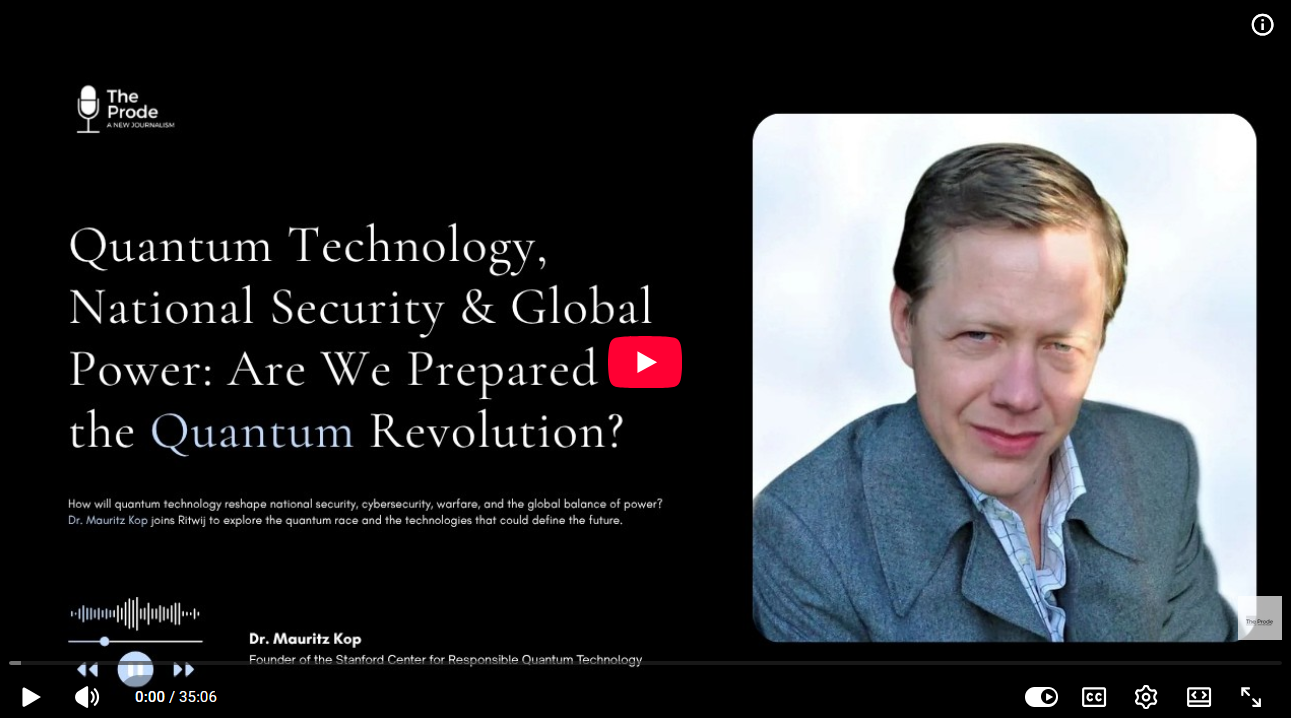
The Prode released its interview with Prof. Mauritz Kop on August 31, 2026: a thirty-five-minute conversation with host Ritwij Raj on the emerging quantum race and its implications for defense and national security. Kop, founder of the Stanford Center for Responsible Quantum Technology and of Quentir, walks through six questions now facing the US national-security and technology-policy communities: when a cryptographically relevant quantum computer may arrive, how national security encryption holds up, how the US, UK, and EU programs compare, what quantum sensing changes for stealth and deterrence, how quantum regulation should differ from AI regulation, and how government and industry close the valley of death together. The full conversation is embedded below.
The Prode: an Independent Interview Platform Where John Bolton and Prof. Kop Share the Front Page
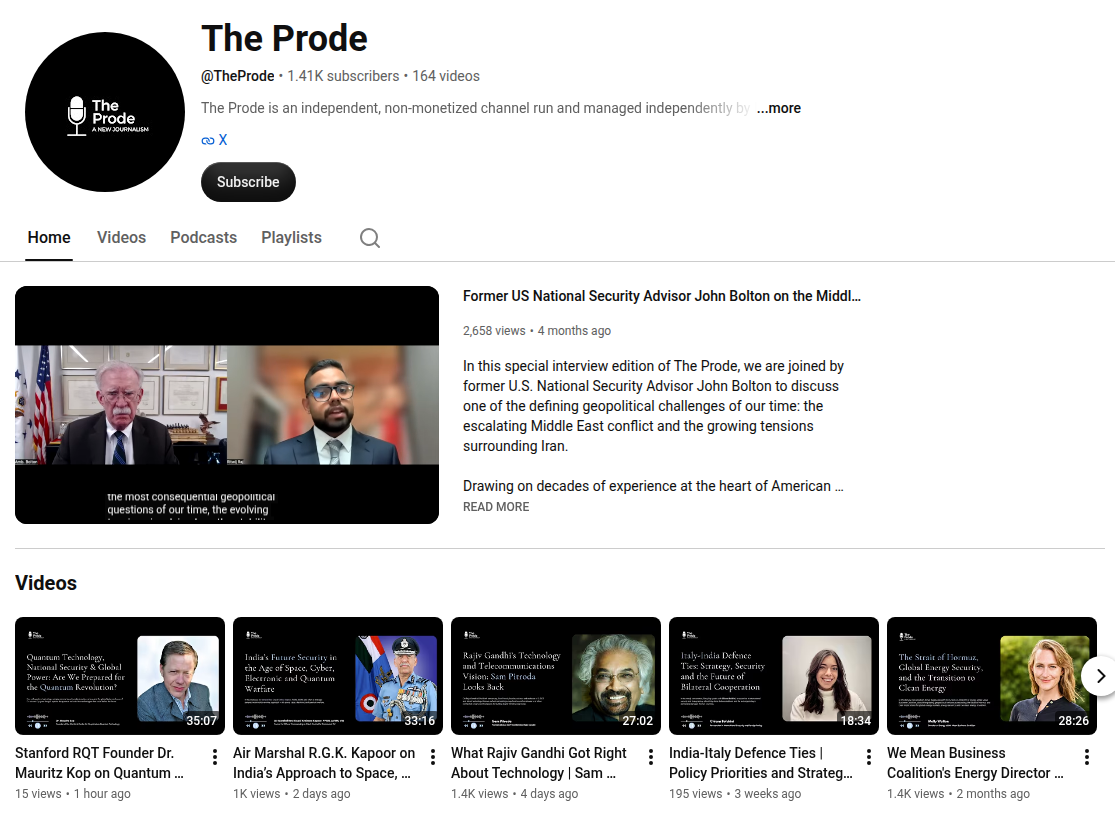
The Prode is an independent, non-monetized interview platform founded in 2020 by Indian author and journalist Ritwij Raj, who publishes under the pen name Ritwij Shandilya and trained at the London School of Journalism. The channel specializes in long-form conversations on geopolitics, geo-economics, defense, and international relations, and it draws its guests from across the political and geographic spectrum: recent episodes feature former US National Security Advisor John Bolton on the Middle East, Air Marshal R.G.K. Kapoor on India's approach to space and electronic warfare, technology policy veteran Sam Pitroda on India's digital revolution, and former US Assistant Secretary of Commerce Raymond Vickery on India-US relations. That editorial breadth across countries, administrations, and schools of thought gives the interviews a nonpartisan, international setting — on the channel's front page on August 31, 2026, the featured Bolton episode sits directly above the videos row that opens with Kop's. Quentir congratulates Ritwij Raj on building a platform where strategy gets discussed at full length.
Nobody Can Date Q-Day: the March 2026 Resource Estimates and Mosca's Migration Math
Asked for a timeline, Kop begins with the state of play: no publicly known quantum computer can currently break RSA or elliptic-curve cryptography at useful scale, and nobody can name the date when one will. What changed this March, he explains, is the engineering target. Two papers produced lower resource estimates for machines that could run Shor's algorithm against deployed cryptography: one architecture using as few as 10,000 reconfigurable neutral-atom qubits, and a Google-led estimate putting the break of the P-256 elliptic curve below 500,000 physical qubits on a superconducting system. These are calculations, and the machines do not exist — a distinction this site examined when the new attack estimate moved no federal deadline — yet the target may be smaller than many planners assumed.
The planning instrument Kop keeps returning to is Michele Mosca's theorem: add the years your information must stay secret to the years a migration takes, and compare the sum with the uncertain arrival of a capable machine. A weapons platform, an industrial control system, or a satellite upgrades on decade timescales. Q-Day, he adds, will likely arrive as a series of events spread over months. And because AI already automates quantum-device calibration and improves error decoding, quantum and AI have begun to accelerate each other — feedback effects that could compress the timeline further. Kop calls the moment a metaphorical quantum event horizon: a governance tipping point where today's choices lock in path dependencies that become, in practice, points of no return.
The US Planning Horizon: NIST 2024 Standards, NSA's January 2027 Rule, and the June 2026 Executive Order
For the timeline question, Kop points planners to the public deadlines that already exist. NIST finalized its first post-quantum standards in 2024. NSA requires new national security system acquisitions to use quantum-resistant standards from January 2027 and aims to complete the transition by 2035. The White House executive order of June 2026 sets 2030 and 2031 milestones for key establishment and digital signatures on specified federal systems. The United Kingdom and the European Union both work toward 2035. In the interview Kop restates the argument he and Joe Federici of the US-China Economic and Security Review Commission make in "Before Q-Day: The Race to Quantum First" in War on the Rocks: the United States should treat cryptography, quantum networks, sensing, AI, and the supply chain as parts of one quantum strategy. He also notes that he discussed quantum strategy with the Pentagon the week before the interview, which, he says, shows how immediate these questions have become.
Harvest Now, Decrypt Later Reaches Genomes: Why Kop Calls for Anticipatory Data Stewardship
On the resilience of national security encryption, Kop draws the line an outside analyst should draw: nuclear command-and-control architecture is classified, so no outsider can declare it secure or vulnerable. The cryptography itself he can explain. Shor's algorithm threatens the public-key systems used for key exchange and digital signatures; strong symmetric encryption has a smaller exposure that larger keys address, which is why AES-256 remains in NSA's approved suite. The transition should therefore concentrate on vulnerable public-key components, software signing, and the trust infrastructure around them.
What worries him sooner is the data already flowing. Diplomatic cables, defense-industrial information, personnel files, health records, and software update chains may stay sensitive for decades, and an adversary can store the ciphertext today and wait — the harvest-now-decrypt-later pattern that European supervisors now plan around, as Quentir analyzed for BSI's 2030-2035 end dates and FINMA's mid-2027 roadmap. Kop makes the problem concrete with genomics: a password can be changed, a genome cannot, and it carries information about your relatives as well as yourself. His prescription is the concept he introduced in earlier work as anticipatory data stewardship — if future decryption is foreseeable, it belongs in today's duty of care. Find the vulnerable cryptography first, protect the longest-lived secrets, identify the hardest-to-replace infrastructure, then build crypto-agility in software and hardware.
Quantum Sensing as the Ultimate GPS Backup: Field Trials, Submarine Caution, and Deterrence by Denial
On sensing, Kop separates scientific possibility from operational reliability. Military value will appear first in positioning, navigation, and timing when GPS is jammed or spoofed — the trajectory this site tracked as quantum navigation leaves the laboratory bench. DARPA's Robust Quantum Sensors program marks the real state of the field for him: compact sensors on a government-provided helicopter, where vibration and electromagnetic interference are severe — worthwhile prototyping, and far from a capability in service. Claims that quantum sensing will soon make the oceans transparent go well beyond public demonstrations, and he treats the submarine question as a strategic-stability problem: even an exaggerated belief that submarines have become easy to find can change behavior in a crisis.
The stakes he frames as deterrence by denial: convincing an adversary that aggression would fail. That rests on guaranteed navigation and timing, quantum-secure command and control, and sensing and communications that stay up under attack — quantum as the ultimate GPS backup, with chokepoint controls working as levers for denial. On China, Kop weighs both sides of the ledger: Beijing's quantum-communications infrastructure and its capacity to absorb and scale technology are real, and the democratic counterweight is strong frontier research, private-sector dynamism, trusted standards, and alliances that widen the talent and manufacturing base.
The Golden Triangle: NIST's Open Competition, DARPA's Hard Tests, and a First Paying Customer
Asked how government and the private sector deepen collaboration, Kop puts NIST's post-quantum competition first: government defined a problem in 2016, invited the world to attack candidate algorithms, and delivered standards the market could build on by 2024 — the model Washington now extends across federal migration, a development this site connected to Kop's Bletchley Park recommendations of November 2025. DARPA adds unusually hard test conditions and independent comparison; NATO helps allies agree on interfaces. Between research grant and purchase, good science still gets stuck in the valley of death, and Kop's answer is the golden triangle of academia, policy, and industry: a real mission, a first paying customer, and a test an independent team can challenge. He founded the Stanford Center for Responsible Quantum Technology in 2023 and the Stanford Quantum Incubator in 2024 to build that bridge, and carries the program forward at CIGI, the US Air Force Academy, and Quentir — where the same test-what-is-deployed discipline drives the daily Defense Monitor and its evidence registers.
The interview closes with an invitation that doubles as method: begin with the values worth protecting, test scientific claims carefully, and build practical safeguards while the technology is still shapeable.
How Quentir Reads It
For US organizations the interview compresses into three working instructions. First, the migration clock runs on the public deadlines, and January 2027 is the nearest one: acquisition teams touching national security systems should already be specifying quantum-resistant standards. Second, the data question comes before the machine question — inventory what must stay secret past 2035, because that is the material harvest-now-decrypt-later already reaches. Third, buy against field evidence: the distance between a laboratory result and a fielded capability is where budgets get wasted, and it is exactly the distance Kop's test-what-is-deployed discipline measures. Those three instructions are what Quentir's daily Monitors and evidence registers operationalize, one primary source at a time.
Published intelligence, built to inform your own decisions. Published: August 31, 2026.