
Prof. Mauritz Kop Speaks at Quantum Innovation 2026 in Nagoya, Japan, With Elham Kashefi, Dorit Aharonov, and Google Quantum AI
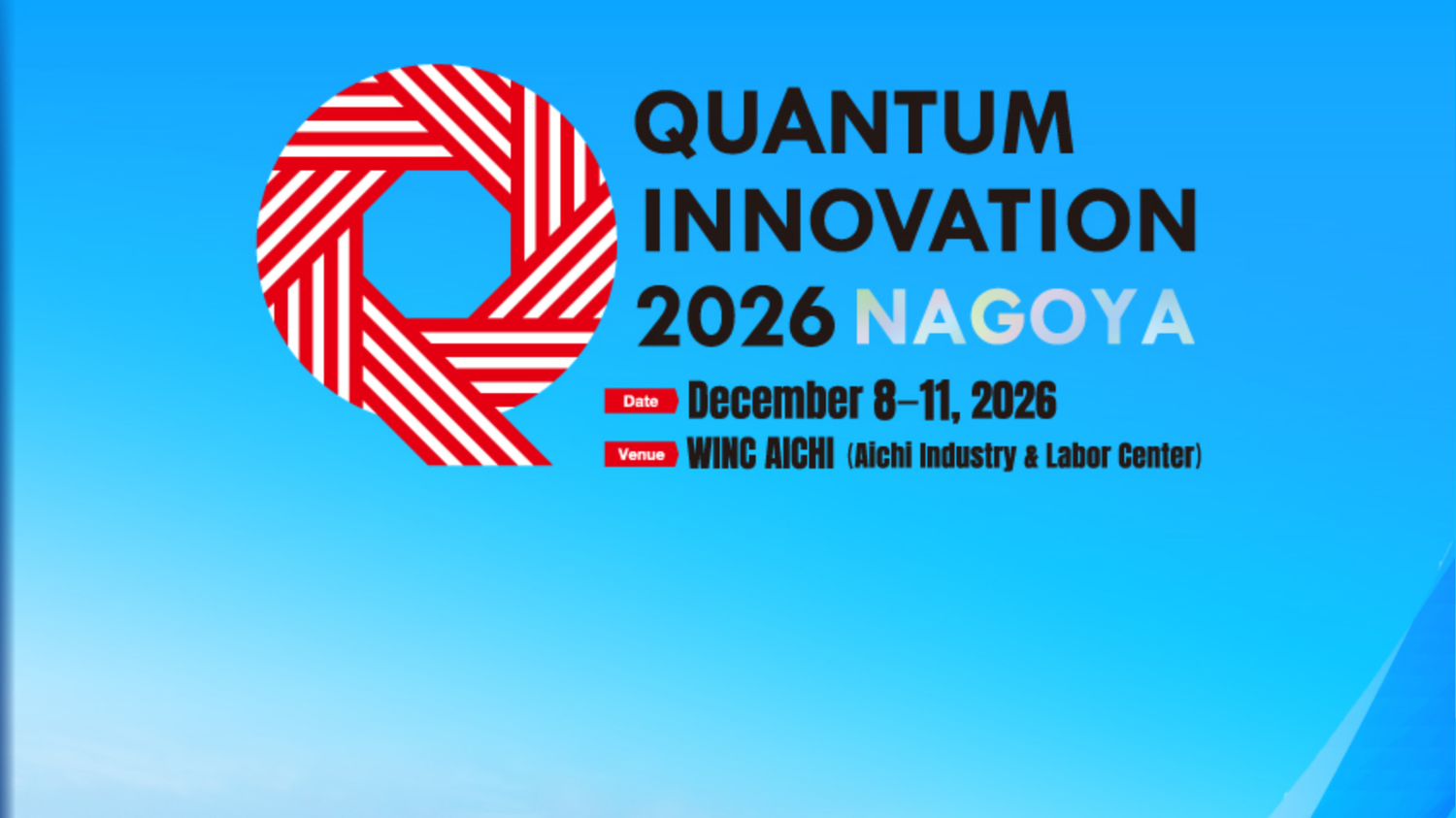
Japan is one of the few countries that builds quantum computers at home, funds a national program toward fault tolerance, and brings its largest industrial companies into the effort. In December 2026 that ecosystem meets in Nagoya. Prof. Mauritz Kop, founder of the Stanford Center for Responsible Quantum Technology (Stanford RQT) and of Quentir, speaks at Quantum Innovation 2026, the International Symposium on Quantum Science, Technology and Innovation, from December 8 to 11 at WINC AICHI. His talk, Before Q-Day: Responsible Quantum Innovation, Standards, and the Post-Quantum Transition, closes the session on Practical Quantum Computing on December 8.
For readers who follow the race to quantum first, the symposium brings Japan's research institutes, industrial sponsors, and international collaborators into one program. It is organized by Japan's Quantum Technology Innovation Hubs, supported by the Government of Japan and the Japan Science and Technology Agency, and sponsored by Fujitsu, Toyota, Toshiba, Hitachi, and more than thirty other sponsors and exhibitors. During the week, Kop will also visit a quantum computer in Japan together with the delegation.
Quantum Innovation 2026 in Nagoya: Organizers, Sponsors, and Program
The annual symposium began in Tokyo in 2021 and moved to Osaka in 2025. The 2026 edition takes place in Nagoya, the heart of Japan's automotive and manufacturing industry, over four days, December 8 to 11. Three tracks cover quantum computing, quantum sensing, and quantum cryptography and communication, and the final day is dedicated to the Moonshot Research and Development Program's goal of a fault-tolerant universal quantum computer by 2050. Shigeki Kiyonaka of Nagoya University is General Chair, and François Le Gall of Nagoya University chairs the quantum computing track.
The co-organizers include Japan's Cabinet Office, three ministries (Education, Culture, Sports, Science and Technology; Internal Affairs and Communications; and Economy, Trade and Industry), the Japan Science and Technology Agency, the national research institutes RIKEN, AIST, NICT, NIMS, and QST, the Okinawa Institute of Science and Technology, the industry alliance Q-STAR, five universities including the University of Tokyo and Kyoto University, and the Tokai National Higher Education and Research System. Fujitsu is the Diamond sponsor; Toyota, Toshiba, Hitachi, and Bluefors are Platinum sponsors; and the Gold sponsors include NEC, Mitsubishi Electric, DENSO, Quantinuum, and QuEra. Participation is free; advance registration closes at 11:59 PM Japan time on November 22, 2026, or earlier if capacity is reached.
Ten Speakers to Watch: Aharonov, Kashefi, Yacoby, Lo, and Leaders From Google, IonQ, Intel, and RIKEN
The program brings together leading scientists from universities, national laboratories, and companies. Ten names stand out for anyone tracking where quantum computing and quantum security are heading.
Dorit Aharonov of the Hebrew University of Jerusalem, a pioneer of quantum complexity theory and fault tolerance, gives the computing keynote on the road from quantum advantage to useful quantum computing. Elham Kashefi of the University of Edinburgh, a leading authority on the verification of quantum computation, asks how we can trust a quantum computer; she served with Kop on the Council of Canadian Academies expert panel on quantum technologies. Amir Yacoby of Harvard University gives the sensing keynote on quantum sensing of quantum matter, and Hoi-Kwong Lo of the National University of Singapore, co-inventor of decoy-state and measurement-device-independent quantum key distribution, gives the communication keynote on security challenges to quantum networks.
From industry, Adam Zalcman of Google Quantum AI presents a software stack for fault-tolerant quantum computing, Dmitri Maslov of IonQ a trapped-ion architecture for fault tolerance, and James Clark of Intel the scaling of spin-qubit arrays with the semiconductor industry. Roee Ozeri of the Weizmann Institute of Science presents a scale-up architecture for trapped-ion computing, Nathan Wiebe of the University of Toronto speaks on quantum chemistry and machine learning, and Takaya Matsuura of RIKEN on fault tolerance in continuous-variable quantum computing. A panel on the certification of quantum key distribution modules, with Lo and experts from IDQ, Fraunhofer, NEC, and Toshiba, shows how far the cryptography track has moved toward deployment.
Kop's Session on December 8: From Quantum Cryptanalysis to the Post-Quantum Transition
Kop gives the closing talk of Session CP2, Practical Quantum Computing, from 5:40 to 6:10 PM Japan time in Room 3, according to the published program. It follows André Schrottenloher of the University of Rennes on quantum circuits for cryptanalysis and Noboru Kunihiro of the University of Tsukuba on quantum cryptanalysis of public-key cryptography and the transition to post-quantum cryptography. The session moves from the threat to the response.
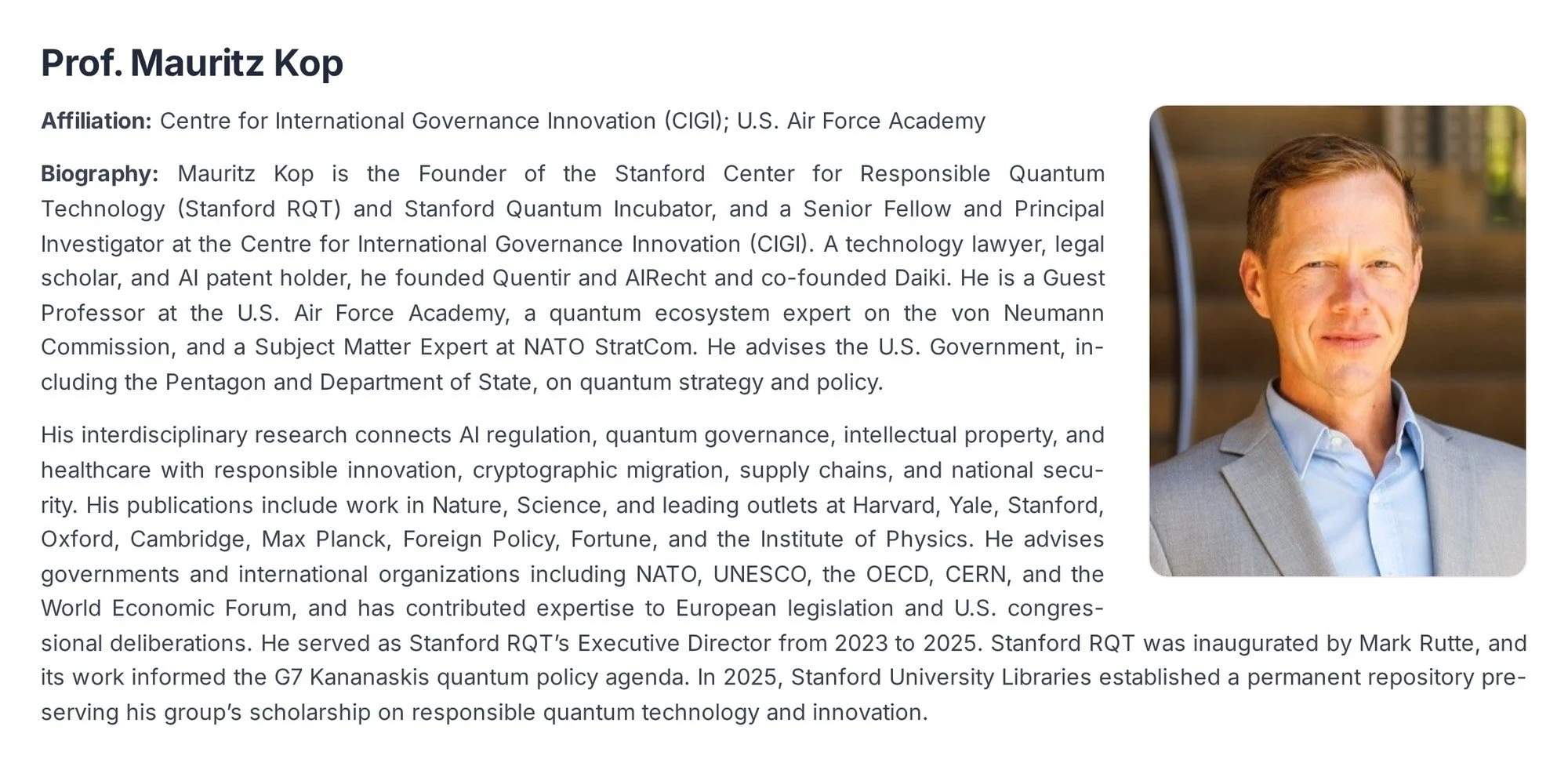
Kop will address responsible quantum innovation, standards, and the post-quantum migration, the subjects of his recent scholarship. The program lists Kop with Stanford, where he founded Stanford RQT and served as its Executive Director from 2023 to 2025.
Kop brings more than 100 scholarly articles, book chapters, and essays to this work, including publications in Nature Physics, Science, War on the Rocks, and Fortune and work published by Stanford, Harvard, Yale, Oxford, and Cambridge. He co-authored the Ten Principles for Responsible Quantum Innovation with Luciano Floridi, Mateo Aboy, Urs Gasser, I. Glenn Cohen, the late Raymond Laflamme, and colleagues, and the standards-first approach to quantum governance in Science with Aboy, Gasser, and Cohen. His sole-authored Nexus paper develops the LSI test for export controls and security measures, and his Quantum-ELSPI framework defines a field of research on the ethical, legal, social, and policy implications of quantum technology. He is also a Senior Fellow and Principal Investigator at the Centre for International Governance Innovation and a Guest Professor at the U.S. Air Force Academy.
Japan's Quantum Hardware: RIKEN, Fujitsu, Quantinuum, IBM, and Okazaki
Japan's hardware program includes systems developed with Fujitsu, Quantinuum, and IBM. RIKEN and Fujitsu announced a 256-qubit superconducting quantum computer in April 2025 at RIKEN's Wako campus. RIKEN also hosts Quantinuum's trapped-ion system Reimei, the company's first installation outside the United States, and in June 2025 IBM and RIKEN opened the first IBM Quantum System Two outside the United States in Kobe, connected to the Fugaku supercomputer. In Aichi Prefecture, the Institute for Molecular Science in Okazaki runs a neutral-atom quantum computer.
This combination of domestic hardware, American partners, and national supercomputing is the kind of allied industrial capacity that Kop's work describes as decisive. Quentir followed Japan's defense side of the same story in its analysis of the Ministry of Defense's FY2027 quantum budget request, and the semiconductor dimension in The Machine Behind the Machine.
Why Nagoya: Toyota, DENSO, and Japan's Manufacturing Base Meet Quantum Technology
The choice of Nagoya is significant. Aichi Prefecture is the home of Toyota and DENSO and one of the world's great manufacturing regions, and both companies support the symposium. Japan Quantum Week 2026, the nationwide program around the symposium, lists a Q-STAR Executive Seminar at the same venue on December 11 and a tentative Quantum Automotive Day on the same date. For industry, the message is that quantum computing, sensing, and secure communication are moving from the laboratory toward factories, vehicles, supply chains, and networks.
Japan Quantum Week also connects the symposium to international partners. On December 9 the Embassy of the Kingdom of the Netherlands in Japan hosts a Japan-Netherlands Quantum Matchmaking Workshop at WINC AICHI, and the week's program runs from protein-based quantum technology at the University of Tokyo to quantum networks, the certification of quantum key distribution devices, and a hackathon on quantum operations and programming. The breadth of the week shows how Japan builds its quantum economy through partnerships, with companies, universities, and allies working on shared standards and use cases.
A Busy Autumn: CIGI, Virginia, ACM, and Nagoya
Nagoya completes an autumn of invitations. On October 21 Kop leads the CIGI Quantum Nexus workshop and roundtable in Waterloo, on October 28 he speaks at the University of Virginia's Co-Opting AI: Quantum, and from November 2 to 4 at ACM PQQS 2026 in Silicon Valley. The scholarship behind these talks ranges from the Ten Principles for Responsible Quantum Innovation (IOP, 2024) and the standards-first approach in Science (2025) to the Nexus paper, indexed in the NASA Astrophysics Data System at the Center for Astrophysics | Harvard & Smithsonian, and the War on the Rocks essays A Bletchley Park for the Quantum Age and Before Q-Day: The Race to Quantum First. Kop advises the U.S. Government, including the Pentagon and the Department of State, as well as UNESCO, the OECD, the G7, CERN, and the World Economic Forum.
How Quentir Reads It
Japan matters to anyone who wants the democracies to reach quantum first. It combines a national program toward fault tolerance, major industrial companies that will turn quantum computing into products, and close partnerships with American firms such as IBM and Quantinuum. Its hub model links ministries, laboratories, universities, and companies in one network, and its standards and certification work, from quantum key distribution modules to post-quantum migration, will shape what allied buyers can trust. Cooperation on allied standards between Japan, the United States, Canada, and Europe is a recurring subject of Kop's published scholarship, from the Ten Principles to the standards-first approach in Science.
For executives, the practical message is to treat Japan as both a market and a partner in standards. For firms pursuing allied markets, certification and assurance requirements belong alongside export controls and procurement rules in product planning. Quentir's Insights follow these developments with the evidence behind every result. We congratulate the organizers of Quantum Innovation 2026 and look forward to the conversations in Nagoya.
Sources and Further Reading
- Quantum Innovation 2026 Nagoya
- QI2026 invited speakers, sessions and schedule (PDF)
- QI2026 keynote speakers
- QI2026 co-organizers
- Japan Quantum Week 2026
- RIKEN and Fujitsu, 256-qubit superconducting quantum computer (April 22, 2025)
- Quantinuum, Reimei fully operational at RIKEN
- Kop et al., Ten Principles for Responsible Quantum Innovation (2024)
- Aboy, Gasser, Cohen and Kop, Quantum technology governance: A standards-first approach, Science (2025)
- Kop, The Nexus of Quantum Technology, Intellectual Property, and National Security (NASA ADS)
Published intelligence, built to inform your own decisions. Published: October 8, 2026.