
Prof. Mauritz Kop Invited to the Inaugural ACM PQQS 2026 in Silicon Valley, With Dan Boneh, Bart Preneel, and Google Quantum AI's Ryan Babbush
From November 2 to 4, 2026, ACM's Special Interest Group on Security, Audit and Control (SIGSAC) holds the first ACM Conference on Post-Quantum and Quantum-based Security, PQQS 2026, in Silicon Valley near San Jose. Prof. Mauritz Kop, Founder of the Stanford Center for Responsible Quantum Technology (Stanford RQT) and of Quentir, has been invited to speak and is listed on the program with his affiliations at the Centre for International Governance Innovation (CIGI) and the U.S. Air Force Academy. His talk, The Race to Quantum First: Building a Secure and Responsible Quantum Future, sets out a strategy for the United States and its allies at a conference whose speakers include Stanford's Dan Boneh, KU Leuven's Bart Preneel, and Google Quantum AI's Ryan Babbush.
For executives, investors, and public leaders, the program maps who is building quantum-era security, which problems they consider urgent, and where post-quantum migration moves from research into procurement, compliance, and national strategy.
ACM PQQS 2026, November 2 to 4 in Silicon Valley: Organizers, Sponsors, and Program
ACM SIGSAC, the community behind the ACM Conference on Computer and Communications Security, created PQQS as a new annual forum for research at the intersection of cybersecurity and quantum technologies: post-quantum cryptography, information-theoretic and quantum cryptography, and the security of quantum computing systems and infrastructures. The first edition convenes at the Embassy Suites by Hilton Milpitas Silicon Valley, close to San Jose. Elisa Bertino of Purdue University is General Chair. Rei Safavi-Naini of the University of Calgary and Ashish Kundu of Cisco Research chair a program committee of about forty researchers that includes Chris Peikert, Douglas Stebila, and Steven Galbraith. Moti Yung of Google and Columbia University sits on the steering committee. The National Science Foundation and Cisco are sponsors.
The program's backbone is a double-blind, peer-reviewed call for papers that produced twenty-six accepted papers for the ACM proceedings. They cover lattice and isogeny cryptography, hash-based signatures and their formal verification in the open-source liboqs library, quantum key distribution networks, attacks on quantum cloud services, and post-quantum migration in central banking, finance, and stablecoins. One of the call's four topic areas covers deployment, policy, and ecosystem readiness, including certification, regulatory frameworks, and the economics of migration, and the final day is an industry-academia day on real deployments, standards, and compliance.
The speaker list also shows how much of quantum security now lives in industry laboratories. Cisco contributes a keynote, an invited talk, and a program chair; Google Quantum AI, IBM Research, and NTT Research each bring a senior scientist. Several accepted papers test real systems, from a live quantum key distribution pipeline to the hash-based signature code in the open-source liboqs library. For companies that will buy and integrate these technologies, the conference brings the researchers, the standard setters, and the engineers into one program. Early registration closes on October 12, 2026, and student travel grants are available through the conference website.
Keynotes From Stanford, Google Quantum AI, ETH Zurich, and Cisco, and a Panel With NIST's Post-Quantum Lead
Dan Boneh, Professor of Computer Science at Stanford University, heads the applied cryptography group, co-directs the computer security lab, received the 2014 ACM Prize, and is a member of the National Academy of Engineering. Ryan Babbush, Director of quantum algorithms and applications research at Google Quantum AI, speaks on The impending threat of quantum cryptanalysis, with new quantum algorithms against elliptic-curve cryptography and their consequences for blockchains and hardware roots of trust. Renato Renner of ETH Zurich is a leading theorist of quantum information and the security of quantum key distribution. Ramana Kompella, Cisco Fellow and Head of Cisco Research, leads research across AI, quantum technologies, networking, and cybersecurity.
The invited speakers widen the lens. Bart Preneel, who heads the COSIC group at KU Leuven, served as president of the International Association for Cryptologic Research, and received the 2014 RSA Award for Excellence in Mathematics, speaks on migration and policy, noting that governments are setting post-quantum deadlines around 2030 and 2031. Reza Nejabati, who leads quantum research at Cisco, presents a quantum-enhanced internet. Vipul Goyal of NTT Research and Carnegie Mellon University speaks on quantum uncloneability, Yevgeniy Dodis of New York University on secure messaging in the post-quantum world, including Signal's transition, and IBM Fellow J.R. Rao on securing quantum-centric supercomputing in the setting of the Department of Energy's Genesis Mission. A panel on the transition to quantum-safe security brings together Dustin Moody, who leads the NIST post-quantum cryptography project, and Michele Mosca of the University of Waterloo and evolutionQ, who helped create the Open Quantum Safe project behind liboqs.
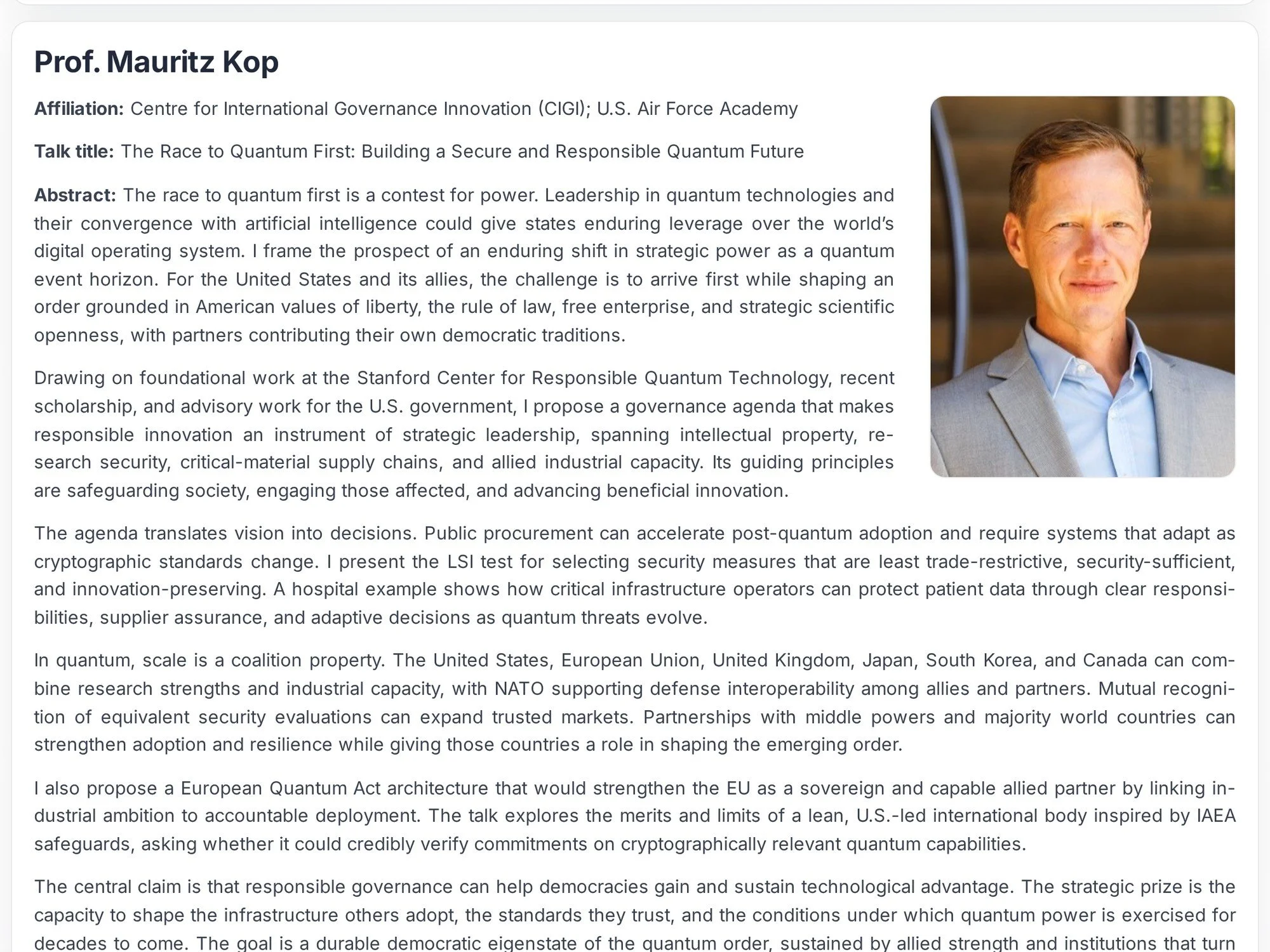
Kop's ACM Talk: Coalition Scale, Trusted Markets, and the Race to Quantum First
Kop's abstract opens with a thesis that speaks directly to boards: the race to quantum first is a contest for power, and leadership in quantum technologies and their convergence with AI could give states enduring leverage over the world's digital operating system. He calls the prospect of such a lasting shift a quantum event horizon, and he asks how the United States and its allies can arrive first while shaping an order grounded in liberty, the rule of law, free enterprise, and strategic scientific openness, with partners contributing their own democratic traditions.
For companies, the most consequential part of the agenda concerns market structure. In quantum, Kop writes, scale is a coalition property: the United States, the European Union, the United Kingdom, Japan, South Korea, and Canada can combine research strengths and industrial capacity, with NATO supporting defense interoperability. Mutual recognition of equivalent security evaluations would let a product evaluated in one allied country reach customers in the others, and partnerships with middle powers and majority-world countries can widen adoption and resilience. The strategic prize, in his words, is the capacity to shape the infrastructure others adopt and the standards they trust.
The instruments behind that vision are familiar to any procurement officer. Public procurement can speed post-quantum adoption and require systems that adapt as cryptographic standards change. A hospital example in the talk shows how operators of critical infrastructure can protect patient data through clear responsibilities and supplier assurance, a theme Quentir followed when Stony Brook aimed its quantum network at hospital patient data. The talk also proposes a European Quantum Act architecture and weighs a lean, U.S.-led verification body inspired by IAEA safeguards, toward what Kop calls a durable democratic eigenstate of the quantum order.
From War on the Rocks to the Pentagon: the Work Behind the Invitation
The talk draws on two essays that reached the U.S. national security community through War on the Rocks. Before Q-Day: The Race to Quantum First (July 20, 2026), written with Joseph Federici, argued that one accountable office in the White House, a senior director for quantum readiness at the National Security Council, should own the quantum agenda. It built on his November 2025 essay A Bletchley Park for the Quantum Age, which called for validated-only federal purchasing of post-quantum cryptography. Kop discussed the same race in his interview with The Prode in August 2026. He advises the U.S. Government, including the Pentagon and the Department of State, on quantum strategy and policy, teaches as a Guest Professor at the U.S. Air Force Academy, and serves as a Subject Matter Expert at NATO StratCom and a quantum ecosystem expert on the von Neumann Commission. Stanford RQT, which he led as Executive Director from 2023 to 2025, informed the G7 Kananaskis quantum policy agenda.
The scholarly foundation starts with the standards-first approach to quantum technology governance that Mateo Aboy, Urs Gasser, I. Glenn Cohen, and Kop proposed in Science in 2025, and with The Nexus of Quantum Technology, Intellectual Property, and National Security (2026), which introduced the LSI test and is indexed in the NASA Astrophysics Data System at the Center for Astrophysics | Harvard & Smithsonian. It reaches back to the Stanford RQT papers in the Yale Journal of Law and Technology (2021) and in Quantum Science and Technology, the Ten Principles for Responsible Quantum Innovation (2024). His conference appearances run from the Stanford Responsible Quantum Technology Conferences he chaired at Stanford Law School to the University of Oxford panel on quantum strategy in November 2025, the World Quantum Summit keynote in Washington, D.C., and the International Quantum Forum at TU Munich.
How Quentir Reads It
ACM's security community has now built a conference around post-quantum and quantum-based security. The keynote line-up shows where the pressure comes from: quantum algorithms that keep lowering the cost of attacking elliptic-curve cryptography, standards that NIST has finalized, and migration deadlines that governments have already set. The program's policy topic area and Kop's invitation show that much of the remaining work is organizational and legal. Quentir's analysis of the GAO audit of 24 federal agencies made the same point: inventories, funding, and testing decide how fast quantum readiness arrives.
For boards and procurement teams the message is practical. The decisions that matter in the next three years concern vendor assurance, crypto-agility requirements in contracts, and allied certification, and Quentir's Insights track them with the evidence behind every result. Quentir congratulates the organizers of the first PQQS and its sponsors, the National Science Foundation and Cisco, and we look forward to the conversations in Silicon Valley in November.
Sources and Further Reading
- ACM PQQS 2026, conference website
- ACM PQQS 2026, invited speakers
- ACM PQQS 2026, keynote speakers
- ACM PQQS 2026, panel
- ACM PQQS 2026, accepted papers
- ACM PQQS 2026, call for papers
- Kop, A Bletchley Park for the Quantum Age, War on the Rocks (November 6, 2025)
- Kop and Federici, Before Q-Day: The Race to Quantum First, War on the Rocks (July 20, 2026)
- Kop, Towards a European Quantum Act: A Two-Pillar Framework for Regulation and Innovation (arXiv; Columbia Journal of European Law)
- Kop, Quantum Needs a Smarter Legal Control Plane: the LSI Test, Vanderbilt JETLaw Blog (2026)
- Kop et al., Ten Principles for Responsible Quantum Innovation, Quantum Science and Technology (2024)
- Aboy, Gasser, Cohen and Kop, Quantum technology governance: A standards-first approach, Science (2025)
- Stanford RQT collection, Stanford Digital Repository
Published intelligence, built to inform your own decisions. Published: October 9, 2026.