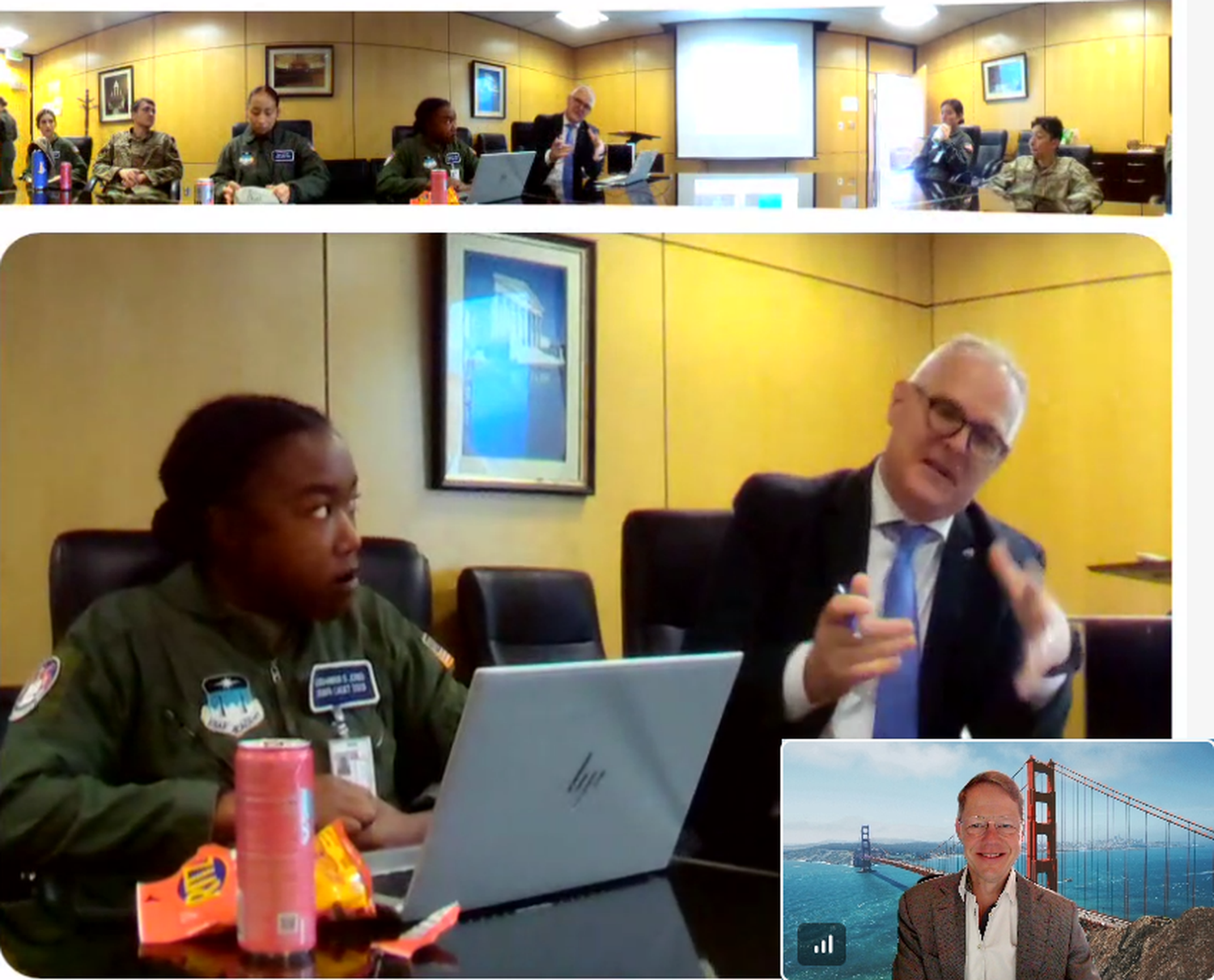
On November 19, 2026, Prof. Mauritz Kop taught the Law and Emerging Tech class at the United States Air Force Academy (USAFA). The course is led by Prof. Aubrey Davis, who spoke at the first Stanford Responsible Quantum Technology Conference in May 2023 and took part in the CIGI Quantum Nexus roundtable in Waterloo on October 21, 2026. Kop, founder of the Stanford Center for Responsible Quantum Technology and of Quentir, joined the cadets in their seminar room by video link for a lecture titled "Responsible Quantum Technology: A Legal-Ethical Framework for the Race to Quantum First." The cadets had read two of his publications in advance: the LSI test for export controls and "Before Q-Day: The Race to Quantum First," which he wrote with Joseph Federici for War on the Rocks. This post summarizes the part of the lecture that concerns people who plan migrations, write requirements and buy equipment.
The class is made up of future officers of the Air Force and the Space Force. Kop told them that they will operate the systems that migrate first, write the requirements that suppliers must meet, and that some of them will take part in decisions on export thresholds and alliance commitments.
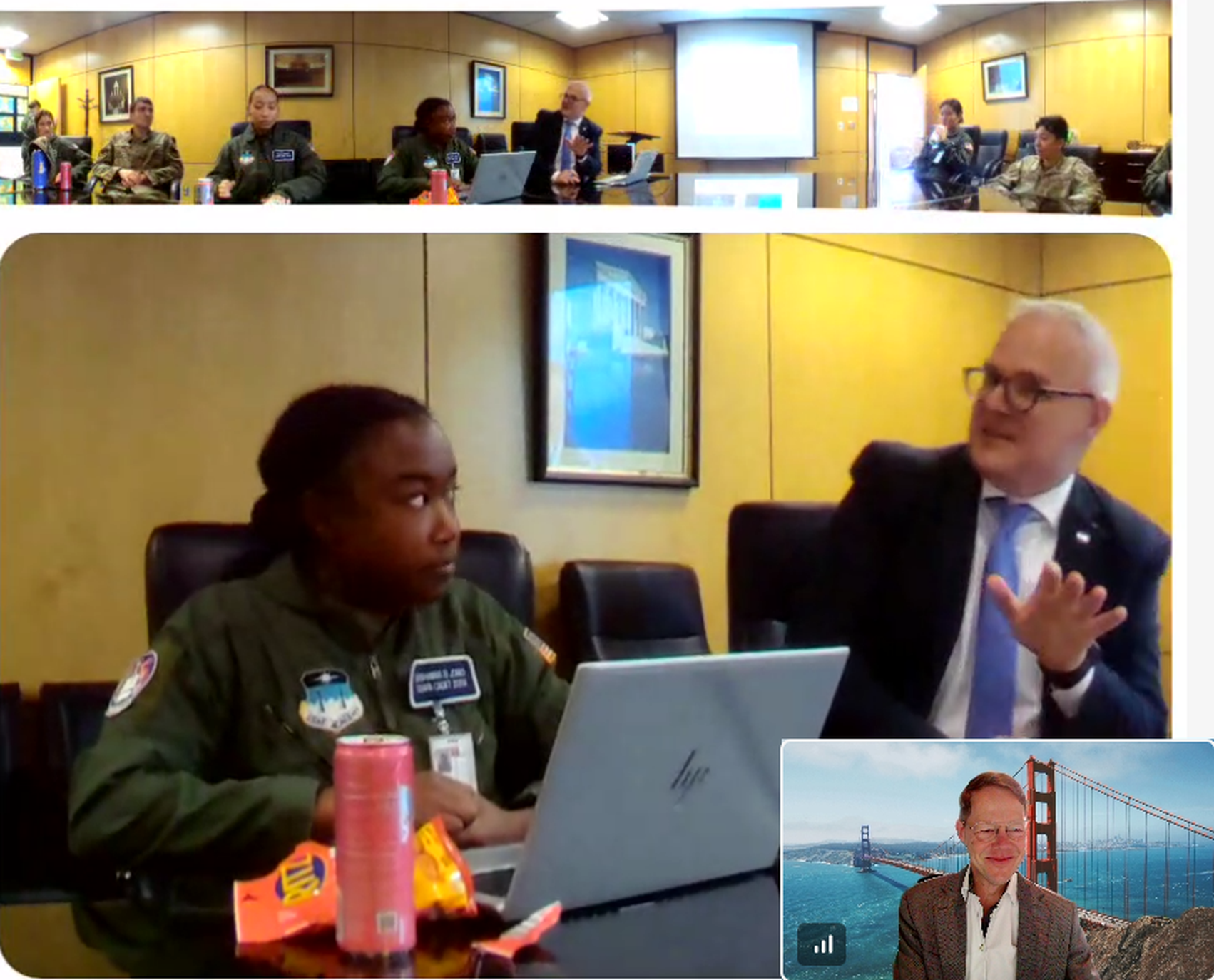
Cadets in the Law and Emerging Tech class at the United States Air Force Academy on November 19, 2026, with Prof. Mauritz Kop joining by video link (inset).
The Deadlines Kop Put Before the Cadets: 2030, 2031 and 2035
Peter Shor showed in 1994 that a sufficiently capable quantum computer could break the public-key cryptography that still protects most communications. Kop reminded the class that such a machine will probably be kept secret at first, so its victims will not know that their harvested data has been read. His advice was to plan the migration and to leave aside the debate over whether the date is 2028 or 2030. Q-Day, he said, will be a series of events, because systems become vulnerable at different times and some take years to replace.
The United States has set its deadlines. Executive Order 14412 and its implementing OMB memorandum, the subject of our analysis of the federal post-quantum mandate, require the government's high value assets and high impact systems to use post-quantum key establishment by the end of 2030 and post-quantum digital signatures by the end of 2031. The final version of NIST IR 8547 deprecates RSA and elliptic-curve cryptography after 2030 and disallows them under NIST standards after 2035. National security systems fall outside that memorandum. They follow the NSA's CNSA 2.0 suite, which new acquisitions are expected to support from January 2027 under NSA guidance, and National Security Memorandum 10 sets the wider goal of mitigating as much quantum risk as is feasible by 2035. Kop told the cadets that the Department of Defense has the hardest migration of all, and that he would migrate first the information that must stay secret longest and the systems that take longest to replace.
Post-Quantum Cryptography in Adversary Hands
Post-quantum cryptography is dual use: an adversary can use it to keep its own traffic secret. Kop's example was the campaign that Kaspersky reported in October and attributes to the Lazarus Group, in which malware used against at least three South Korean organizations hid its payloads behind ML-KEM, the standard NIST finalized in 2024. Quentir covered that campaign in Lazarus Fits Its Zero-Day With a Post-Quantum Key Exchange. Kop compared the group's use of ML-KEM to an Enigma machine and repeated the proposal from his 2025 War on the Rocks essay, "A Bletchley Park for the Quantum Age": a concerted allied effort to validate, standardize and deploy quantum-resistant algorithms, and to keep breaking what adversaries deploy.
A Qubit Threshold That Ages: From 34 Physical Qubits to the Logical Qubit
Export controls can fail in two directions. With too little security, algorithms, hardware designs and know-how leak to strategic competitors. With too much, research fragments and the ecosystems that give democracies their lead slow down. Kop developed the LSI test for this decision and published it this year in the Vanderbilt Journal of Entertainment and Technology Law. A measure must be least restrictive, security-sufficient and innovation-preserving. The regulator begins with a specific security objective, examines the measures capable of meeting it, chooses the most surgical one that still works, and then assesses the consequences for research, competition and the diffusion of knowledge. If those consequences are unacceptable, the measure is redesigned or the objective reconsidered. In legal terms it is a proportionality test with a built-in subsidiarity check.
He applied the test to the threshold of thirty-four physical qubits, paired with gate-error ceilings, that the United States and its allies adopted in 2024 and that the European Union made uniform in November 2025. Kop said he has not seen a published rationale for that number. A threshold written in physical qubits ages as error correction advances, so he proposed the logical qubit as the unit, with its error rate and circuit depth, and a number that follows from the stated security objective and published evidence and is revised every year. The Department of Energy's Science and Technology Risk Matrix, which the national laboratories update annually, shows that such a cycle can work. He called the aim security-sufficient openness, in which allied research, publication and standards work can continue.
One Accountable Office and Procurement as the Lever
For the Department of Defense, Kop listed where post-quantum cryptography must go now: command-and-control links, satellite links, telemetry authentication, software update pipelines and supply-chain provenance, all with cryptographic agility. A migration of that size needs one accountable office, and Kop would make a cabinet-level office responsible for the national transition, with each department responsible for its own systems and progress checked against milestones. A technical agency can advise on algorithms, he said, but it cannot decide how much risk a service should accept. His 2025 essay proposed a White House transition lead with a quarterly dashboard, procurement limited to validated cryptographic modules and annual crypto-agility drills. The July 2026 article with Federici added a senior director for quantum readiness at the National Security Council.
Procurement is the lever he asked the cadets to remember. A contract for equipment that will serve for fifteen years must say who updates its algorithms, how the owner audits the device over its life cycle, and whether it keeps working while vulnerable components are replaced.
Allies, a Quantum Acquis and Qubits for Peace
No single country has the scale that quantum technology requires. Kop proposed a harmonized quantum acquis among allied ecosystems: a common body of rights and obligations that countries incorporate into their own legal systems, supported by shared standards and by mutual recognition of each other's security evaluations under agreed scope, oversight and testing requirements. Beyond the allies he proposed Qubits for Peace, a global framework for quantum safety, benefit-sharing and non-proliferation in the tradition of Eisenhower's Atoms for Peace. He told the class where that proposal is hardest: an international body could test a declared machine, and establishing a state's total quantum capability is a much harder problem.
How Quentir Reads It
Kop ended by asking the cadets which system they would migrate first: the one with the longest-lived secrets, the one that takes longest to replace, or the one that is most critical. He also asked whether they would draw the export-control line at the first logical qubit. The first question belongs to every owner of a system that falls under the 2030 and 2031 deadlines or under CNSA 2.0, and the answer has to be written down before budgets are set. The second belongs to regulators, and it reaches laboratories and companies in allied countries, whose shared research depends on where the line is drawn. Between the two sits the procurement contract, the place where a buyer can still decide today who will update the algorithms in equipment that stays in service into the 2040s.
Quentir follows those decisions as they appear in public documents, and our overview Quantum First: One Race, Five Fronts, One 2030 Goal places them in the wider race. Prof. Kop's closing message to the cadets was that privacy, fairness, equal access and human dignity belong in the design of these systems from the start, because people trust and adopt technology that respects them.
Published intelligence, built to inform your own decisions. Published: November 19, 2026.