
Korea Funded a Quantum Drug Program That Plans to Make the Molecule
In Berlin in 1890, addressing the Tenth International Congress of Medicine, Robert Koch restated a short list of conditions that a claim about a microbe causing a disease was expected to meet. Find the organism in every case. Grow it away from the host. Reproduce the disease with it. The list was wrong at its edges almost immediately — healthy carriers, organisms nobody could culture — and it still changed medicine, because it changed what an argument had to contain. Before the postulates a physician could be persuasive. After them a physician could be checked. That is how rigor usually arrives: as a specification somebody wrote down.
A Korean research program announced on 19 August 2026 is interesting for a similar and similarly unglamorous reason. It published the order of operations it intends to follow, and the order ends in a laboratory.
The sector claim, and what it usually leaves out
“Quantum computing will transform drug discovery” is one of the most repeated sentences in technology finance, and as normally stated it is very hard to lose. No molecule is named. No comparator is named. No endpoint or date is nominated at which anyone would concede the point either way. A claim built that way can survive any number of quarters, because nothing in it can arrive and disappoint.
That is not the same as saying nothing has happened. The record already contains real wet-lab work: a 2025 Nature Biotechnology paper from Zapata Computing, Insilico Medicine, the University of Toronto and St. Jude Children's Research Hospital reported a quantum–classical generative model, partly run on a 16-qubit IBM device, whose proposals were filtered down to fifteen molecules that were actually synthesized and assayed against KRAS, two of which showed enough binding character to be worth pursuing. Compounds designed with quantum-enhanced methods have therefore been made and tested. What remains unestablished is reproducible advantage over the classical alternative, and any therapeutic translation at all — and those two gaps are where the sector's rhetoric usually parks itself.
What the Korean program says it will do
Korean industry press reported on 19 August that Baobab AiBIO had been selected as lead research and development institution for a Ministry of Science and ICT and National Research Foundation program on quantum-computing-based quantum advantage research in the new-drug and bio field, with LigaChem Biosciences, Yonsei University and the Institute of Molecular Design as co-institutions. The ministry's own call document was not retrievable for this post, so what follows is the program as its participants describe it, not as a contract anyone has read.
The chemistry is named rather than gestured at: targeted protein degradation, where a designer must optimize a target protein, an E3 ligase and the linker joining them as one ternary object instead of three separate ones. That is a genuinely awkward combinatorial surface, and a fair place to look for a quantum method to earn its keep. The computational side is a large quantitative model in a GPU–QPU hybrid arrangement, with quantum routines exercised in Yonsei's IBM QPU environment and technical cooperation named from NVIDIA, Quantinuum and D-Wave.
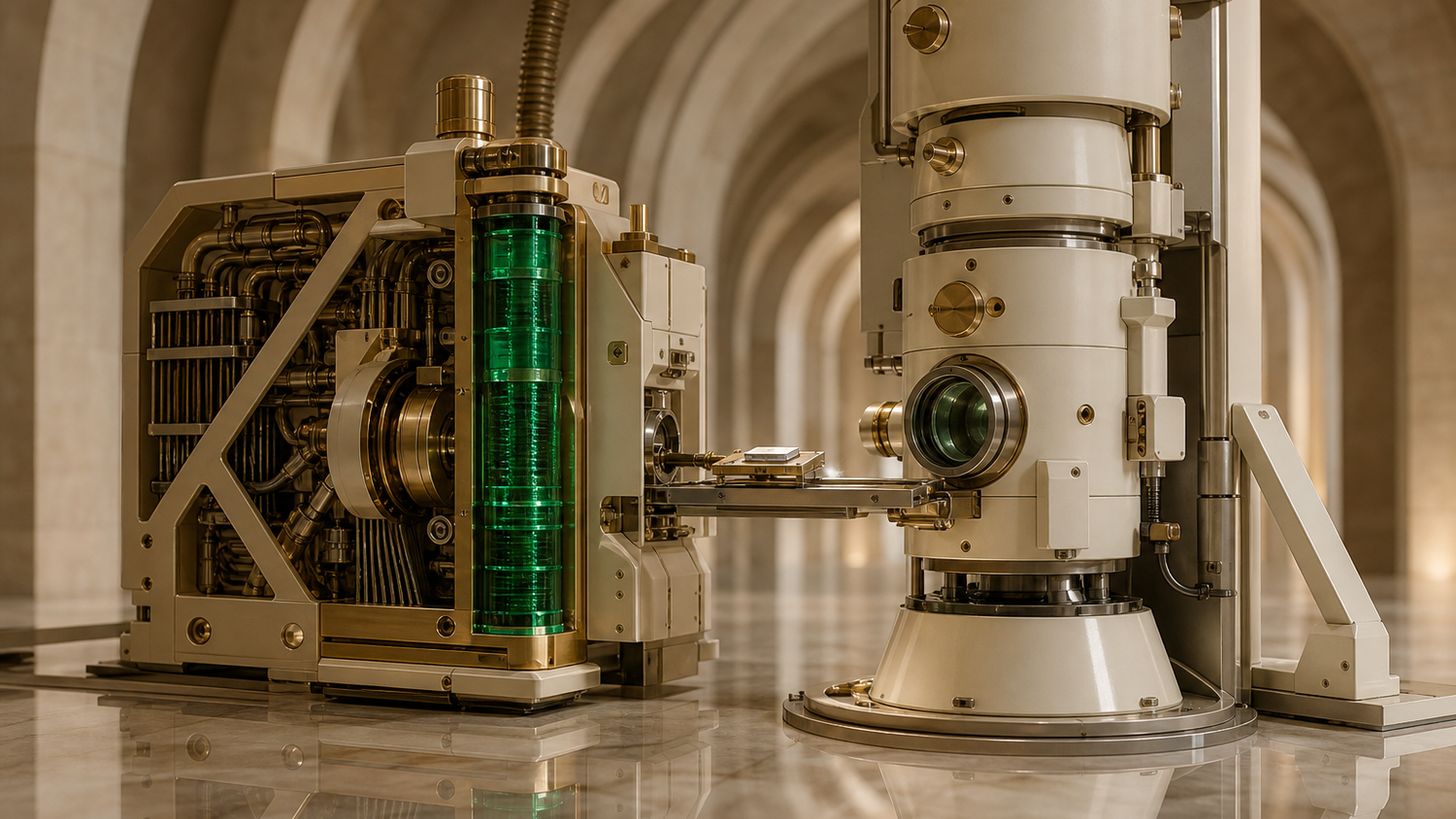
The part that distinguishes it is the workflow rather than the hardware. Candidates are to be designed, then synthesized and evaluated at LigaChem, then structurally examined by Cryo-EM, then redesigned on what the structural data shows. Cryo-EM does not photograph a single predicted complex; it reconstructs a three-dimensional density from very many particle images, and the resolution it yields depends on the sample and the data. It is still an independent physical check on whether the predicted arrangement is the one that exists, and an independent physical check is what this field has most consistently lacked.
It is worth being precise about what that would and would not prove. A synthesized compound with a matching structure tests the model. It does not on its own demonstrate quantum computational advantage, which additionally requires a declared classical comparator, a stated endpoint and a resource or performance comparison against it. None of those three is public yet. The honest description today is a funded program with a published verification step, which is a lower and much more useful claim than the one the vocabulary invites.
Practical takeaway. The useful question about a quantum-medicine claim is not which hardware it ran on. It is whether anyone has named the observation that would settle it, and whether that observation has been scheduled.
Where this sits against what we have already written
This is the third time in recent months that the same seam has opened. When we looked at quantum drug discovery entering its workflow phase, the argument was that the interesting movement had shifted from algorithm papers to where the quantum step sits inside an otherwise classical pipeline. The Korean program is a clean instance of that: the quantum routines are one stage of a loop whose other stages are chemistry, assay and microscopy. In the peptide-space piece the constraint was that generative breadth outruns anyone's capacity to make and test what is generated — which is exactly the bottleneck a named synthesis partner is meant to relieve. Today's addition to both is narrower: a public funder has attached money to the testing half, and the participants have said so on the record.
The infrastructure running alongside
On the same day, IBM joined and cooled its first two modular cryogenic units into a single environment at Poughkeepsie. The units stand over eight feet in each dimension, reached 4 kelvin together in under five days and fell below 15 millikelvin shortly after; the architecture note explains that the boxes exist to make room for the L-coupler links that join separate chips, with at least a thousand programmable qubits planned for 2027 and the fault-tolerant Starling system for 2029.
Nothing in that announcement is tied to the Korean program, which names Yonsei's existing IBM QPU environment. The two belong in the same week's reading for a different reason. One is an infrastructure milestone announced plainly as a cooldown, with its own dates attached. The other is a chemistry program announced with its verification step attached. In a sector where most statements carry neither, two in one day is worth noticing.
How Quentir Reads It
The change worth marking is procedural. A public funder is paying for the half of the work that can produce a disappointing result, and the participants have described that half in public before the results exist. Private capital rarely does this, because a stated test is a stated way to lose. Public research money can absorb that cost, and when it does it produces something more durable than a headline: a dated, checkable account of what someone is trying to establish. That capability is administrative more than scientific, and it transfers — to sensing procurement, to migration timetables, to any purchase where a supplier's claim currently arrives with no stated way of being wrong.
For readers deciding where to put attention, the filter is small enough to carry around. Does the claim name a physical or measurable object? Does somebody other than the claimant get to observe it? Is there a date? Most of what shares this vocabulary answers none of the three. We track the instruments that do — who funded them, what they described as success, when the first data is due — edition by edition in the Signature Brief, where dated program entries and their review triggers sit in one fixed scope instead of scattered across a year of posts.
This program will most likely not produce a quantum-designed drug, and it does not need to in order to have been worth funding. Its value is that it has said in advance what it is trying to show and roughly how anyone would know, and the first published compound data is when that gets tested. Between now and then, the question worth putting to every quantum-medicine announcement is the one Koch's contemporaries eventually had to answer: what would you accept as showing that you are wrong?
Sources: 몰니테이, “바오밥에이바이오, 과기부 ‘양자이득 도전연구’ 주관기관 선정”, 19 August 2026, for the selection of the lead research institution, the co-institutions and the design–synthesis–Cryo-EM–redesign workflow. The Ministry of Science and ICT / National Research Foundation call document itself was not retrieved for this post; the program is described here as its participants describe it. Mohammad Ghazi Vakili and colleagues, “Quantum-computing-enhanced algorithm unveils potential KRAS inhibitors”, Nature Biotechnology, published online January 2025 (PubMed 39843581), for the quantum–classical generative model, the 16-qubit device, the fifteen synthesized and assayed molecules and the two KRAS candidates. IBM, “IBM Connects Its First Modular Cryogenic Systems in Milestone Toward Fault-Tolerant Quantum Computing”, 19 August 2026, with the IBM Quantum modular cryogenics architecture note, for the joined modules, the temperatures, the L-coupler and the 2027 and 2029 roadmap dates. On Koch’s postulates and their 1890 restatement, see Steve M. Blevins and Michael S. Bronze, “Robert Koch and the ‘golden age’ of bacteriology”, International Journal of Infectious Diseases, 2010. Public sources checked 19 August 2026.
Published intelligence, built to inform your own decisions. Published: August 19, 2026.