Peptide Space Has a Population Problem
Every nucleated cell carries a small display window. HLA molecules hold short peptide fragments at the cell surface, where T cells can inspect them for signs of infection or disease. That molecular display is one of immunology’s essential acts of translation: chemistry inside a cell becomes a signal the immune system can read.
The display system is also intensely diverse. HLA genes are among the most polymorphic in the human genome, and allele frequencies differ between populations. Biomedical models inherit the unevenness of the data collected around those alleles. A model may be excellent for common, well-studied variants and much less dependable where examples are scarce.
A DTU-led team has now placed a photonic quantum processor inside that problem. Its July 2026 bioRxiv preprint describes a generative model seeded with boson-sampling output from ORCA Computing’s 32-mode PT-2 system. The model produced higher predicted yields of strong peptide binders across many HLA alleles, with the largest gains concentrated where the classical baseline struggled. The researchers carried candidates for three understudied alleles into a wet-lab assay.
Practical takeaway. The study gives quantum-biomedical governance a concrete object: a hardware-generated distribution that changes which peptide candidates a model explores. Its value depends on population coverage, classical comparators and laboratory validation, while therapeutic benefit remains untested.
The bottleneck sits before the model
Generative models begin with a latent prior, a distribution of values that supplies the starting points from which the model learns to generate outputs. Gaussian noise is a common choice because it is easy to sample. Easy sampling does not guarantee that the prior matches the structure of a biological search space, especially where some positions in a peptide are tightly constrained and others permit broad variation.
The researchers assembled 105,970 experimentally observed peptide-HLA pairs, representing about 77,000 unique nine-amino-acid sequences across 126 HLA class I molecules. They used the curated ligand dataset behind NetMHCpan-4.1, then trained conditional generative adversarial networks in which the HLA allele served as a label. The model architecture stayed fixed while the prior changed. That design makes the prior, and the search behavior it induces, the central variable.
Data abundance was uneven. Common alleles gave the classical model many examples. Rare alleles exposed its weak spots. That unevenness matters beyond model accuracy: HLA variation is tied to ancestry and population history, so sparse training coverage can become sparse therapeutic discovery coverage.
What the photonic sampler changed
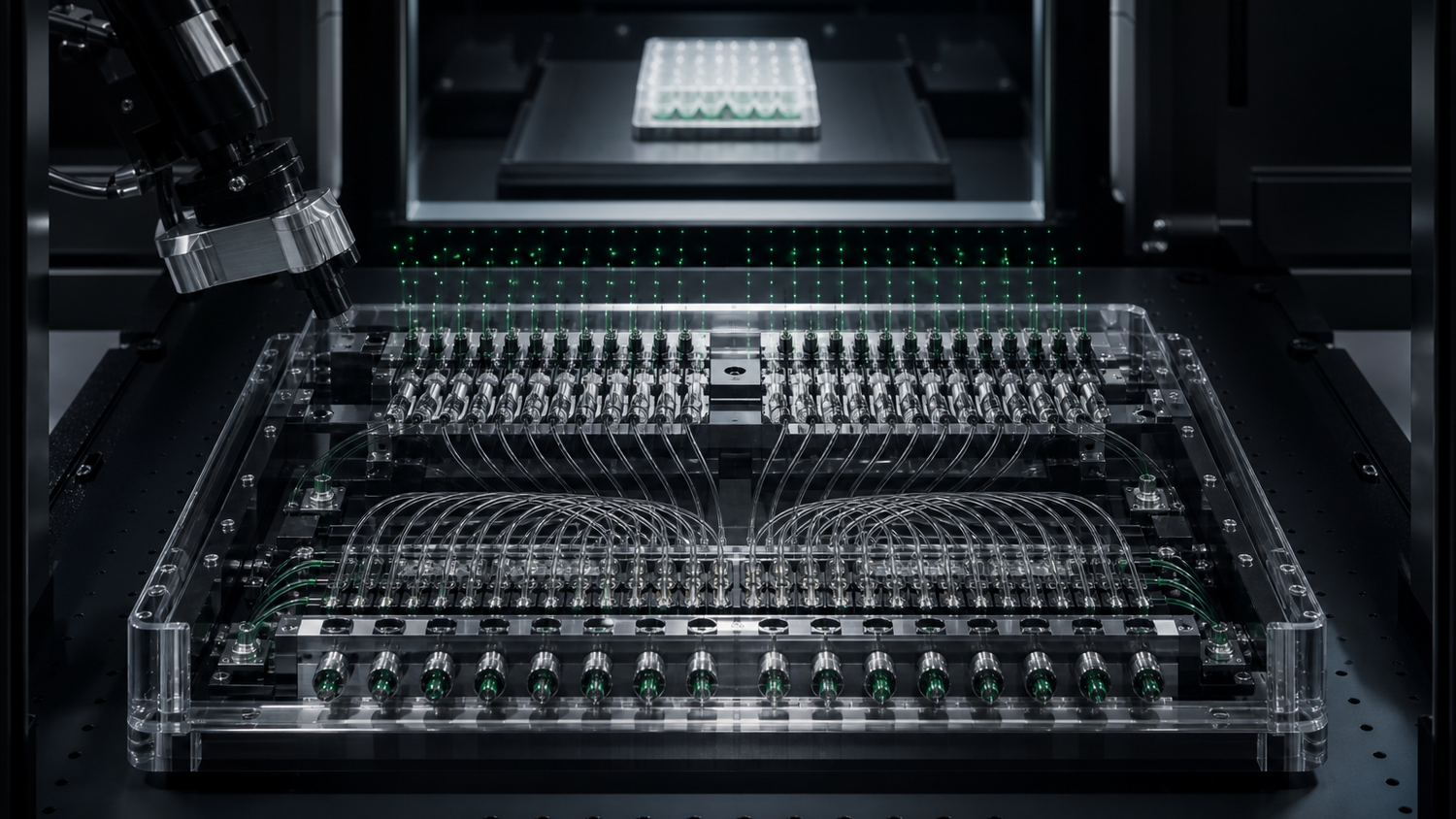
The quantum route used boson sampling on ORCA Computing’s PT-2 system at the UK National Quantum Computing Centre. Photons moved through a configurable time-bin interferometer and were measured by superconducting nanowire detectors. The resulting 32-dimensional samples replaced the Gaussian latent vectors that usually seed the generator. In physical terms, the apparatus supplied a correlated distribution shaped by quantum interference.
The team generated 1,000 peptide candidates for each of 131 HLA alleles, including five absent from the training set, and evaluated predicted binding with NetMHCpan-4.2. Each configuration ran across 30 training seeds. The simulated quantum prior outperformed the Gaussian prior on 63 percent of alleles. A mixed model estimated 10.6 additional predicted strong binders per 1,000 for the simulated quantum prior and 6.3 for the physical processor’s samples. The reported p-values were 0.001 and 0.049.
The average gain was modest and unevenly distributed. Its concentration is the interesting feature. Gains were larger among alleles where the Gaussian baseline produced poor or medium results. The prior appears to have broadened exploration at non-anchor positions while preserving the motifs needed for binding.
The wet lab narrows the claim
Predictions alone would have left the study inside the familiar circle of one model grading another. The team selected 20 high-ranked peptides for each of three understudied alleles: HLA-A*31:01, HLA-A*68:01 and HLA-B*37:01. A peptide-MHC stability ELISA tested whether those designs could stabilize MHC class I complexes after UV-mediated ligand exchange.
All tested predicted binders for A*31:01 and A*68:01 crossed the positivity threshold. B*37:01 produced many strong binders and several failures. Its unusual acidic anchor is sparsely represented in the training data, and the authors treat the wider result range as a reason for continued laboratory validation. The assay converts a computational lead into a measured molecular interaction. It does not establish immune activation, clinical utility or a treatment effect.
The paper is unusually clear about that boundary. Peptide-MHC binding is a prerequisite for T-cell recognition, yet immune response also depends on processing, T-cell receptor availability, biological context and molecular dynamics. The work is a preprint and has not completed peer review. Its authors also disclose employment links to ORCA Computing, Sparrow Quantum and HERVolution Therapeutics.
A fairness claim can migrate into hardware procurement
Population coverage in biomedical AI is usually framed as a data-governance problem. The study adds a second layer. If a structured prior consistently improves exploration for data-sparse alleles, the choice of sampler becomes part of the model’s distributional behavior. A future developer could cite a photonic processor as one element in a representativeness or bias-mitigation argument.
That possibility creates a demanding chain of attribution. The underlying ligand dataset, the generator, NetMHCpan’s scoring, the quantum samples and the wet-lab assay all contribute distinct information. No single component carries the whole result. A supplier’s claim about the sampler could still migrate into procurement language and, eventually, into a regulated product’s technical documentation.
The EU AI Act requires training, validation and test datasets for high-risk systems to meet data-governance and representativeness requirements. This research pipeline is not itself proof of a high-risk medical product. It shows how a later medical use could connect dataset coverage to a hardware dependency that conformity assessors and purchasers may need to understand. Fairness can become partly an infrastructure claim.
How Quentir Reads It
Quentir’s earlier analysis, “Quantum Drug Discovery Is Entering the Workflow Phase,” argued that each quantum-biomedical claim belongs to a particular stage of discovery and validation. This paper supplies a precise example. The quantum contribution sits at the prior-distribution stage. Classical training and scoring remain central. Wet-lab testing confirms molecular stability for selected candidates. Clinical translation lies further downstream.
The original connection is institutional as much as technical. A latent prior looks like a small modeling choice, yet it can alter who is well represented in the generated candidate pool. Once a commercial hardware vendor supplies that prior, population coverage becomes entangled with supplier governance, IP terms, reproducibility and access to the device.
Quentir’s Signature Report format adds fixed scope, an executive summary, a dated source spine, refresh triggers and an internal-use license for cross-domain questions of this kind. This public post stays with one preprint and its central institutional implication.
The next comparison will decide how durable the result is
The authors state that the 32-mode system remains classically simulable and that their findings do not demonstrate quantum advantage. They also acknowledge that other structured classical distributions may produce similar improvements. Those caveats preserve the study’s value. They define the experiment closely enough for later work to test its mechanism.
A stronger sequel would compare the physical sampler against well-chosen classical structured priors, repeat the result on independent datasets and examine whether gains persist beyond binding toward immunogenicity. The outcome could narrow the role of quantum hardware or deepen it. Either way, peptide space has exposed a governance issue that will survive the benchmark: when a technical component changes the populations a model serves, that component enters the responsibility chain.
Sources: Emilie Sofie Engdal et al., “Hybrid quantum-classical de novo design of MHC-binding peptides”, bioRxiv preprint, posted July 10, 2026; European Union, Regulation (EU) 2024/1689 (Artificial Intelligence Act), Official Journal publication July 12, 2024. Public-source snapshot: July 20, 2026.
Published intelligence, built to inform your own decisions. Published: July 20, 2026.