Quantum Navigation Leaves the Laboratory Bench
In November 1761 John Harrison's fourth marine timekeeper went to Jamaica aboard HMS Deptford, because no argument about escapements settled what a voyage could settle. The instrument had to take the motion and the damp, then be read against a known position on arrival. That is the test an instrument faces when it stops being a laboratory result.
Practical takeaway. Quantum position, navigation and timing has reached ruggedization work on real platforms: a sensor being built for helicopter testing, a gravimeter run from an unconditioned ship's cabin, an inertial sensor flown in orbit, a clock taken down on an uncrewed submarine. That transition is visible in public awards and program descriptions. Operational replacement of satellite navigation is not among the published results.
What Everitt and colleagues measured over 83 kilometers at sea, posted 26 August 2026
The paper is GNSS-free quantum gravity-aided navigation and fine-scale marine surveying with a strapdown quantum gravimeter, submitted to arXiv on 26 August 2026 by Patrick J. Everitt, Donald H. White, Todd Lyon, Murat Muradoglu, Alessandro D'Ortenzio, Aaron J. Canciani and colleagues. Its opening admission is the reason it matters: field demonstrations of satellite-free quantum gravimetric navigation had not been reported before.
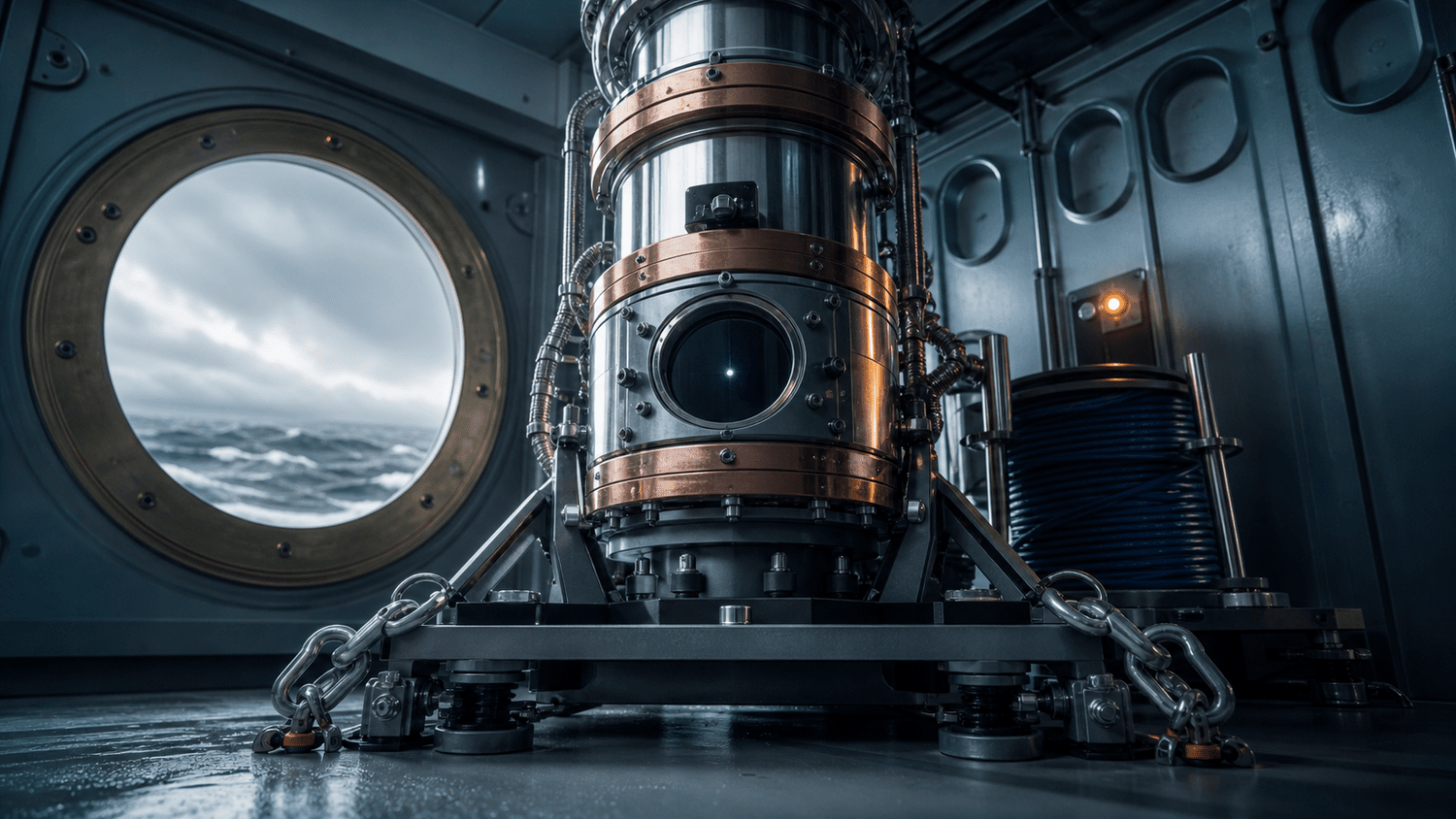
A mobile quantum gravimeter went aboard a 29-meter surface vessel, hybridized with a classical accelerometer for bias stabilization, alongside an independently mechanized navigation-grade inertial measurement unit. All of it sat in an uncontrolled cabin with no environmental stabilization and no calibration. It corrected the inertial solution across an 83-kilometer maritime trajectory by gravity map matching, referencing locally measured gravity against a satellite-derived anomaly map, with satellite navigation excluded from the measurement chain throughout. The claimed result is bounded positioning at nautical-mile-level accuracy. In a separate, satellite-referenced survey mode the same instrument covered coastal routes up to Sea State 4 at milligal-level agreement with sub-milligal repeatability.
Two words carry most of the weight. Strapdown means the sensor was bolted to the hull with no stabilized platform holding it level, which is the configuration a real installation gets. Bounded means the gravity aiding constrained inertial drift; it did not deliver a fix. This is a preprint and has not been through peer review. Q-CTRL, which describes the underlying product as Ironstone Opal, reports the Coral Sea run in its own maritime field-trial announcement and states there that the accuracy is better than ten times what navigation-grade GNSS backup systems deliver. That comparison belongs to the company.
Which programs pay for the transition: DARPA's RoQS, DIU's Transition of Quantum Sensing, NASA's gradiometer
DARPA's Robust Quantum Sensors program states its purpose plainly: take quantum sensors off the laboratory bench and onto moving military platforms, addressing the sensitivity to electromagnetic interference and vibration that keeps them there. Q-CTRL received two awards under it in August 2025, reported at A$38 million, with Lockheed Martin. Safran Federal Systems received a first-phase award reported on 3 October 2025 to build a ruggedized quantum sensor for testing on a military helicopter. That helicopter testing is the planned first phase of the work, not a completed result.
The Defense Innovation Unit runs the adjacent program. Its Transition of Quantum Sensing effort spans five areas — inertial sensors, gravimeters, magnetic anomaly detection, magnetic navigation and component development — and anticipates more than ten field experiments in its first twelve-month phase. Its named prototype is QuINS, a quantum-enabled inertial navigation system contracted to Lockheed Martin with Q-CTRL and AOSense. Neither program's existence proves that a prototype has passed its trials. Reading an award as a verdict would misstate what a first-phase contract is.
Infleqtion announced on 27 August 2026 that NASA had awarded it a USD 20 million follow-on for the Quantum Gravity Gradiometer Pathfinder, a mission led by the Jet Propulsion Laboratory. The company puts NASA's investment in the program at USD 40 million, with instrument hardware work running through 2027 and a low-Earth-orbit launch planned for 2030. The same cold-atom physics that constrains a ship's inertial drift is being built to map groundwater, ice and subsurface resources from orbit, which is worth noticing when this sensor class gets called a purely military asset.
What the Space Force, the Royal Navy and the Irish Aviation Authority did, August 2025 to June 2026
Three records show the same movement from bench to platform. The X-37B spaceplane launched on 21 August 2025 from Kennedy Space Center on the USSF-36 mission carrying what the Space Force describes as the highest-performing quantum inertial sensor tested in space, a joint Defense Innovation Unit and Air Force Rapid Capabilities Office experiment with an atom interferometer from Honeywell and Vector Atomic.
On 28 October 2025 Infleqtion, the Royal Navy and MSubs reported a quantum optical clock, Tiqker, running on Excalibur, an extra-large uncrewed underwater vehicle. The claim was narrow and the announcement said so: the clock operated reliably across multiple dives, and benchmarking against high-grade time standards would follow.
The third record is civil, and it explains the money. The Irish Times reported on 29 June 2026 that the Irish Aviation Authority has slowed its program to replace ground-based radio beacons with satellite-based navigation, keeping ageing beacons because they are far less vulnerable to deliberate interference. A national aviation regulator is paying to keep old infrastructure alive because the new infrastructure can be jammed. That is the GPS-denied problem expressed as a maintenance budget, and it is where the consequences reach passengers, crews and shipping.
Quantum sensing at the ruggedization stage: what drift, vibration and supply chains decide
The quantum pillar here is quantum sensing, and the honest readiness statement is prototypes demonstrated in a relevant environment. Nothing above exceeds that. Quantum inertial units are drift-limited, and the question that decides whether any of this becomes equipment is how much drift accumulates over how many hours, under what vibration, at what temperature. No published result answers it for an operational mission profile.
The pace is also set by inputs that have nothing to do with physics. A cold-atom gravimeter rests on ultra-high-vacuum hardware, narrow-linewidth lasers and their optics, magnetic coils and shielding, photodiodes and cameras, precision electronics, and vibration-control components. Several of these are narrow supply chains with few qualified suppliers, and that constraint holds however many field experiments a program funds. The Stanford Center for Responsible Quantum Technology and CIGI, the Centre for International Governance Innovation, supply the standard this article applies: judge a fielded system on its measured performance, and govern a broad enabling technology with rules that adapt to the use in front of them.
How Quentir Reads It
Alternative position, navigation and timing is now the quantum application with the shortest distance between a laboratory result and a purchase order. Quantum computing timelines remain contested. Quantum sensing has an 83-kilometer track, a funded helicopter test phase, an orbital experiment and a funded 2030 launch, each checkable against a public document.
The same measured-performance standard turned up in our reading of the GSA post-quantum procurement work, where the useful question was also what had been tested and what had only been announced. It applies more sharply here: a crew that trusts a drifting solution is worse off than a crew that knows it has none.
The near-term milestones are already dated and already public: instrument hardware completion for the gradiometer through 2027, the low-Earth-orbit launch in 2030, and whatever the RoQS and Transition of Quantum Sensing phases publish as they close. This is a program that can be followed by its awards, its test platforms and its published results, on a clock set by engineering milestones.
The Quentir Defense Monitor is free and open, and it tracks programs like these as they develop. Readers who need the underlying entries with their sources and technology-readiness assessments can find them in the Quantum Defense Evidence Register, our paid defense layer at USD 1,490 per year.
Sources: Patrick J. Everitt, Donald H. White, Todd Lyon, Murat Muradoglu, Alessandro D'Ortenzio, Aaron J. Canciani et al., "GNSS-free quantum gravity-aided navigation and fine-scale marine surveying with a strapdown quantum gravimeter", arXiv:2608.25563, submitted 26 August 2026 (preprint, not peer reviewed). Q-CTRL, maritime field-trial announcement, August 2026 (company claim). DARPA, Robust Quantum Sensors program record, and Q-CTRL, "DARPA Selects Q-CTRL to Develop Next-Generation Quantum Sensors for Navigation on Advanced Defense Platforms", August 2025. The Quantum Insider, "DARPA Selects Safran Federal Systems For Quantum Sensor Development", 3 October 2025. Defense Innovation Unit, Transition of Quantum Sensing field-testing record, and Lockheed Martin, "Unlocking the Power of Quantum Navigation", March 2025 (QuINS). US Space Force, "U.S. Space Force Successfully Launches X-37B Orbital Test Vehicle", August 2025, with DefenseScoop, 28 July 2025, and Spaceflight Now, 22 August 2025. Infleqtion, "Infleqtion and Royal Navy Demonstrate World's First Quantum Optical Clock on Underwater Autonomous Submarine", 28 October 2025. Infleqtion, "NASA Awards Infleqtion $20 Million as World's First Quantum Gravity Mission Advances Toward Flight", 27 August 2026 (company announcement), carried by The Quantum Insider, 27 August 2026. The Irish Times, "Ireland retains out-of-date air navigation systems in response to Russian jamming", 29 June 2026. Public sources checked 27 August 2026.
Published intelligence, built to inform your own decisions. Published: 27 August 2026.
Published intelligence, built to inform your own decisions. Published: August 27, 2026.