
Quantum Navigation Leaves the Laboratory Bench
What a quantum gravimeter measured over 83 kilometers at sea in August 2026
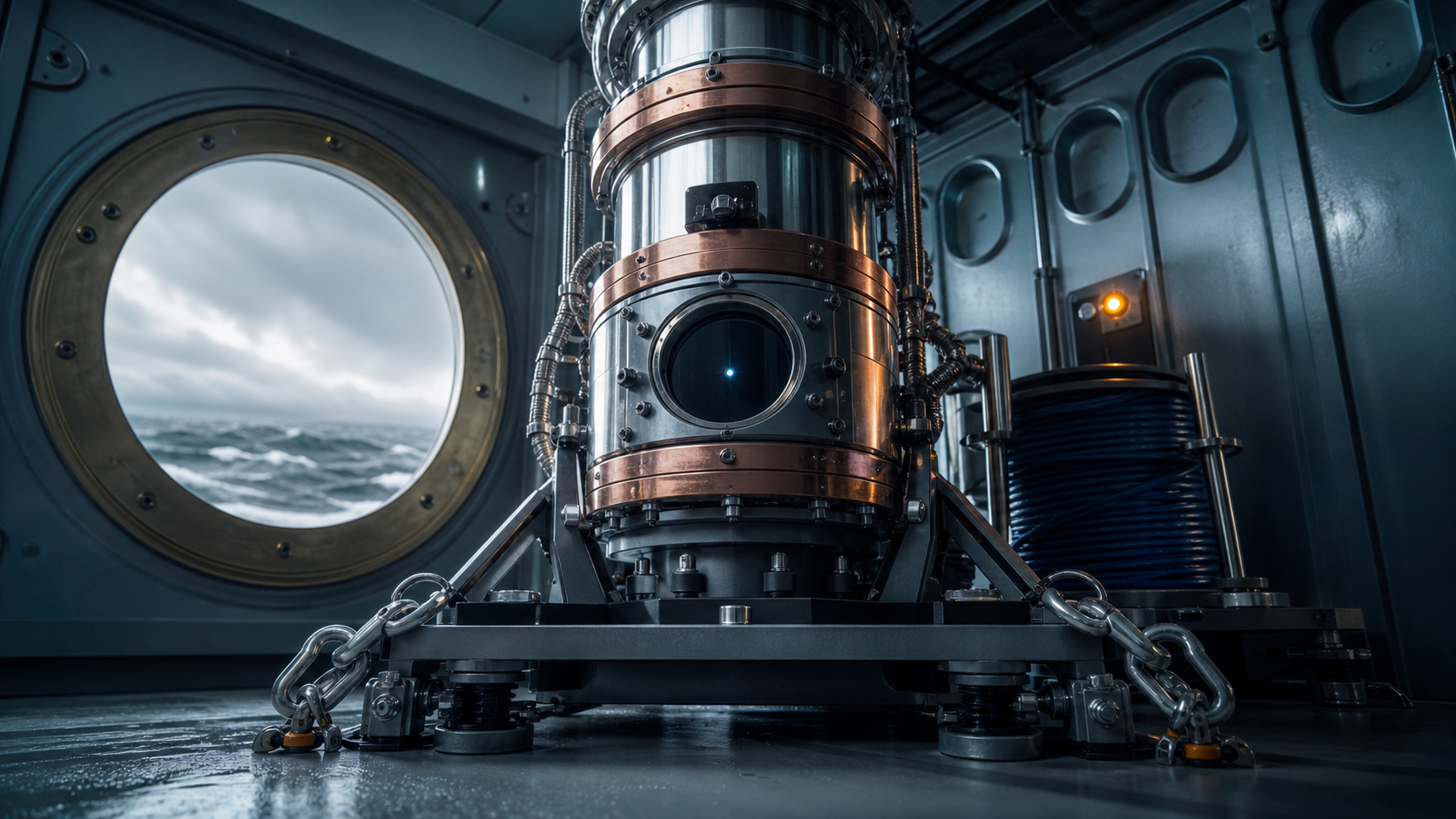
A preprint posted on 26 August 2026 (arXiv:2608.25563) reports gravity map matching aboard a 29-meter surface vessel: a mobile quantum gravimeter, hybridized with a classical accelerometer and installed in an uncontrolled cabin with no environmental stabilization and no calibration, corrected an inertial solution over an 83-kilometer maritime trajectory by referencing locally measured gravity to a satellite-derived anomaly map. The authors report bounded positioning at nautical-mile-level accuracy with satellite navigation excluded throughout. In a separate referenced survey mode the same system worked coastal routes up to Sea State 4 with mGal-level agreement and sub-mGal repeatability.
Which programs pay for it: DARPA's Robust Quantum Sensors, the Defense Innovation Unit and NASA
DARPA's Robust Quantum Sensors program exists to move quantum sensors off the bench onto moving platforms, and it has funded ruggedization work at Q-CTRL with Lockheed Martin and at Safran Federal Systems, whose planned first phase tests a quantum sensor on a military helicopter against electromagnetic interference and vibration. The Defense Innovation Unit's Transition of Quantum Sensing program covers inertial sensors, gravimeters, magnetic anomaly detection, magnetic navigation and components, and holds a prototype contract for a quantum-enabled inertial navigation system. Infleqtion announced on 27 August 2026 that NASA had awarded it a USD 20 million follow-on for a space-based gravity gradiometer.
What the published record does not show about replacing satellite positioning
No public result shows quantum inertial navigation replacing satellite positioning in operational use. These instruments are drift-limited, and the honest question is how much drift accumulates over how many hours under what vibration. These remain field experiments, and the published record stops there.
The Quantum Laboratory Has an Overnight Shift
An agent is taking the overnight shift
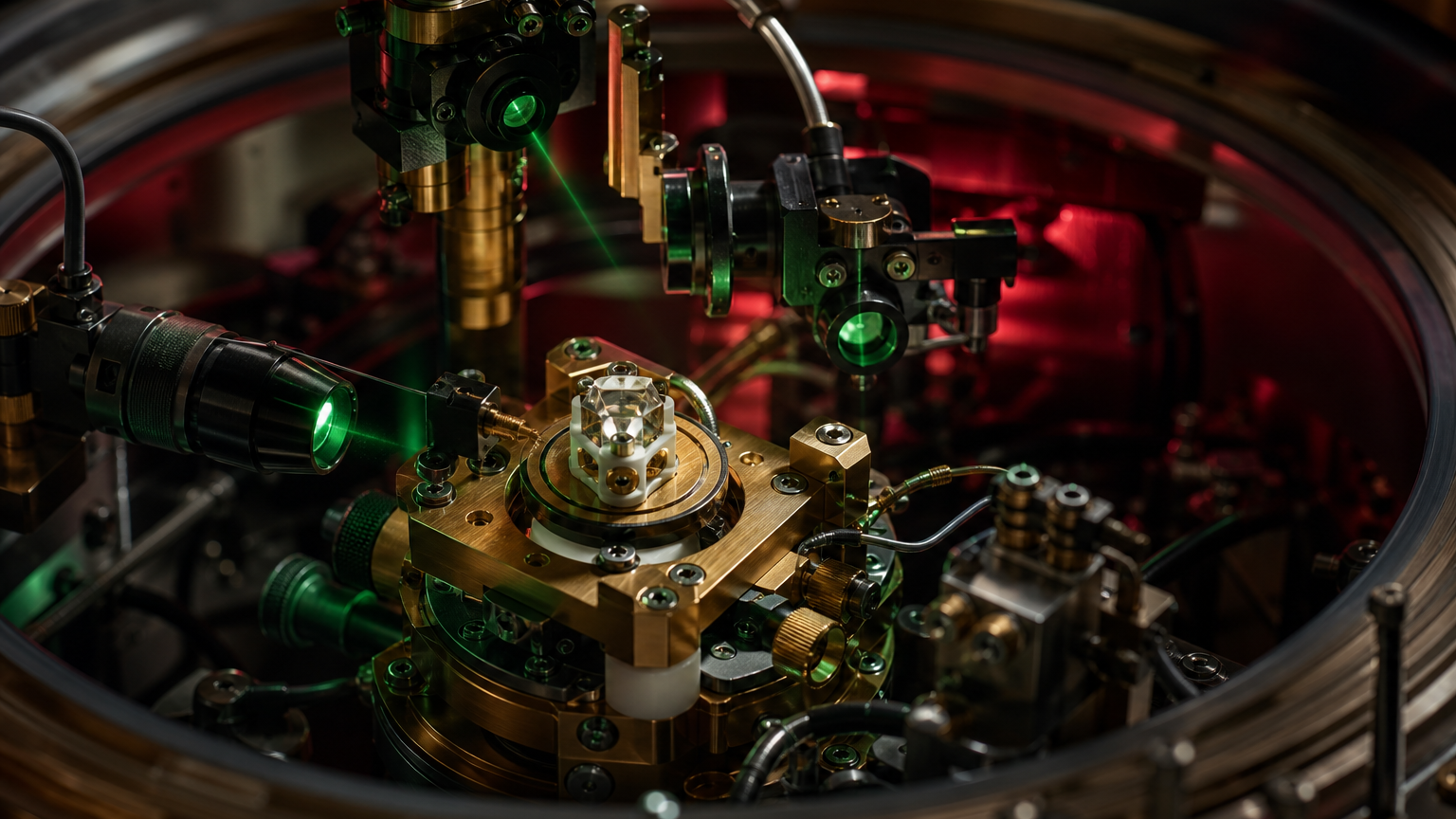
Four preprints posted within two days put AI agents inside quantum sensing, neutral-atom experiments, error-correcting-code discovery and hardware design. In one diamond-sensing run, software selected a nitrogen-vacancy center, calibrated its resonant frequency, measured coherence and added a pulse sequence to investigate a weak feature. A separate workflow moved from a paper or patent to an overnight campaign on two cloud-accessible neutral-atom processors. These are early research reports, yet they show autonomous quantum experiments becoming concrete enough to govern.
The failures are part of the finding
The neutral-atom authors also describe an inadequate observable and a plausible but wrong hardware diagnosis, both caught by domain experts. Another paper, ContractHIL-HLS, translates natural-language requirements into interfaces, constraints, validation checks and rollback rules, then feeds hardware results back into revision. The emerging issue is the chain of delegated judgment: who set the goal, which actions software selected, what the instrument measured and which person accepted the interpretation.
The handoff becomes an institutional object
Quentir reads the cluster as a move toward instrument delegation. Scientific credit, product assurance, intellectual property and procurement meet at the handoff between machine-selected action and an accepted result. Laboratories may gain speed and preserve more failed branches than ordinary notebooks capture. Trust will depend on visible permission, independent validation and named human acceptance, especially when these methods later shape sensors, chips, diagnostics or security systems.

Quantum Sensing Is Entering the Acquisition File
Why the sensing signal matters
Project Farseer, reported on 1 July 2026, moves quantum sensing and timing from capability talk into a procurement-shaped record. The reported $200 million Defense Innovation Unit solicitation asks for dual-use hardware under an OTA path, with prototype evaluation in three to nine months. That makes quantum sensing procurement a near-term governance object rather than a distant research theme.
What buyers should notice
The sharper detail is not the headline budget. It is the mix of SOSA requirements, performance testing, and foreign-component and investor disclosure tied to 15 C.F.R. § 791.4 countries. Quantum devices are starting to carry the same questions that already follow chips, cryptography, cloud infrastructure and advanced sensors: who built the component, who funded the company, where the data flows, and how a promising prototype becomes supportable hardware.
Quentir’s reading
The useful frame is dual-use supply-chain assurance. A quantum timing or sensing device can be brilliant in the lab and still weak as an acquisition asset if its component chain, ownership structure, maintenance path, export-control exposure or test conditions cannot be explained. That is where quantum governance becomes physical: not a principle on a slide, but a file that can survive procurement review.