
Doe v. GitHub, Decided 16 September 2026: Why the Ninth Circuit Held That Copilot Creates New Works Under DMCA Section 1202(b), and How the Training-Data Theory Was Forfeited Before It Was Argued
What the Ninth Circuit decided on 16 September 2026
In Doe v. GitHub, No. 24-7700, a unanimous panel affirmed Judge Jon Tigar's dismissal of the programmers' claim under 17 U.S.C. § 1202(b), the Digital Millennium Copyright Act provision that forbids removing or altering copyright management information. Judge Eric Miller wrote that the complaint itself describes an AI tool that does not look up and reproduce stored work but creates new work; a new work that never carried an author's notice cannot have had that notice removed. Standing was found, on memorization research, GitHub's own 150-character duplicate filter and verbatim examples; the claim failed on the statute's text.
Why the training-stage theory never reached the court
A second theory, that stripping licenses and notices from code before feeding it into the model was itself a violation, was held forfeited. At the first motion-to-dismiss hearing, counsel had answered "Perhaps it doesn't" when asked whether copying training data breached attribution terms, and the district court said the complaint "is not about training." Nobody corrected that reading afterwards.
What is still open for AI coding tools
This complaint's output theory failed; the panel kept the door open for nonidentical copies where removal is shown, expressed no view on ordinary copyright infringement for substantially similar output, and left two contract claims before Judge Tigar. This post reconstructs the case and reads it beside the EU AI Act's training-side obligations.
FIPS 203 and FIPS 204 Do Not Specify the Silicon: the 9 September 2026 NTT Patent Screening, and the Two Portfolios NIST's Royalty-Free Licenses Cover
What the 9 September screening says
The Suzhou Institute of Information Security Law published a patent-landscape screening of number-theoretic transform polynomial multiplication on 9 September 2026. Its argument runs through the layer where post-quantum cryptography meets silicon. FIPS 203 and FIPS 204 fix the algorithms, their parameters and the transform itself, and say nothing about circuit-level butterfly architecture, modular-reduction circuitry or hardware organization, so the authors judge that patents on those things would be hard to declare standard-essential and are not bound by a FRAND undertaking. The document is explicit that it is a preliminary screening of public information rather than an infringement opinion.
What this read covers
The five areas where the screening finds the filings clustered, the surge it dates to 2024, and the per-chip royalty stacking it calls a tollbooth. Set against it: what NIST's two royalty-free patent licenses actually cover. Those agreements reach any apparatus implementing CRYSTALS-KYBER, which is to say hardware is inside the grant — and they reach exactly two patent portfolios and one algorithm. A National Law Review analysis of 9 September 2026 states that this is not blanket freedom to operate for every ML-KEM product.
Why the timing matters
OpenSSL published 4.1.0-alpha1 on 9 September 2026, a pre-release carrying optimized ML-DSA and ML-KEM transform operations on ppc64le and AVX-512 SHAKE work on x86_64. A library can change a variant in a point release. A frozen chip architecture cannot, and supervisors are already setting migration dates against estates that will run on parts bought this year.
€1.05 Billion, and the IP Has to Stay in Romania
A member state acts while the union schedules
On 20 August 2026 the Romanian Government approved TechUp România, a state-aid scheme with a maximum budget of 5.313 billion lei — about 1.05 billion euro — created under the economic-relaunch package in Emergency Ordinance 8/2026. The eligible-technology list is unusually explicit for an ordinary industrial instrument: alongside artificial intelligence, ASIC and FPGA chip design, integrated photonics and 5G/6G, it names quantum computing and post-quantum cryptography outright. Financing agreements may be issued between 2026 and 2032; the payments run through to 2041.
The condition attached to the money
The scheme will not pay for research standing on its own. A qualifying project carries between 5 and 50 million lei of eligible costs, of which at least 2 million must be research and at least 3 million must be a follow-on investment in production or service-provision capacity. Beneficiaries provide at least 25 percent from non-public sources, their own or private external finance. The capacity has to keep operating in its region for five years, the aided jobs have to last as long, and the intellectual property has to be held through the investment period. The reason given is blunt: Romanian firms currently buy research services in Germany, France and Israel at high cost, and risk the know-how, trade secrets and rights that result staying captive abroad.
Where the top rates point
Under the current regional-aid map, intensity reaches up to 70 percent in four counties — Galați, Prahova, Dolj and Gorj. Those are the steel, oil-refining, car-making and lignite counties, rather than Romania's leading research hubs. Arad and Timiș, the west's industrial success story, get up to 30. The rates are horizontal, applying to any eligible project rather than to cryptography specifically, and the hierarchy is not fixed for the scheme's whole life: intensities for 2028 to 2032 fall to be set under new Commission-approved maps. Read as a map rather than a table, though, they mean a qualifying post-quantum or photonics project would draw its strongest support in the places with the most to lose when the old industrial base closes.
The A-Share Market's First Quantum Measurement Stock Is a Scientific-Instruments Business
A listing that does not match its label
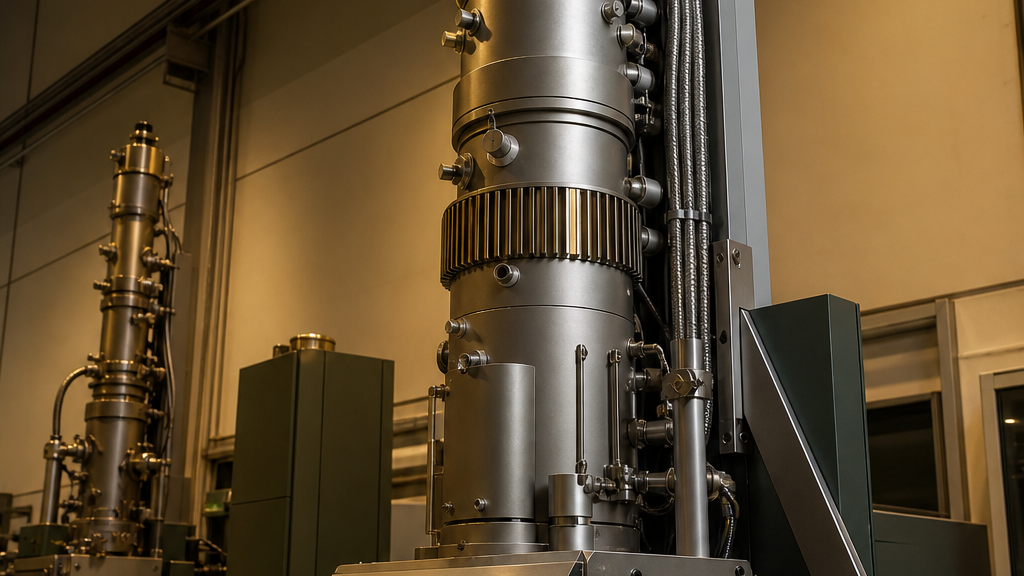
On 11 August 2026 CIQTEK closed its first session on Shanghai's STAR Market at RMB 110.23 against an offer price of RMB 21.22, a gain of 419.46 percent and a market capitalization near RMB 44.1 billion. Chinese financial coverage called it the A-share market's first quantum precision measurement stock. The catalog underneath that label is electron microscopes, nuclear magnetic resonance and electron paramagnetic resonance spectrometers, scanning nitrogen-vacancy microscopes and gas adsorption analyzers, sold to universities, national academies and manufacturers.
Why measurement ships before computation
Part of the catalog is not quantum technology at all — electron microscopes and gas adsorption analyzers are conventional laboratory instruments. The spin-resonance line is where the physics matters. A quantum computer has to protect coherence across an entire algorithm, which is why error correction dominates its cost. Many present-day spin sensors hold a state only for a single short interrogation, read out a field-induced phase or resonance shift, and recover precision by repeating and averaging, which is why the products shipping today carry no fault-tolerance layer.
Where the public instruments reach, and where they thin out
Most of what governments issued this year points at computation or at defence timing: the US Commerce letters of intent in May, DARPA's optical clock award in August, the Royal Navy's cold-atom timing trial. Brussels and London have funded quantum sensing and metrology tooling too. What stays thin is the ordinary laboratory instrument park — the spectrometers, microscopes and adsorption analyzers that qualify materials for every industry, still classified under scientific-equipment rules that predate the quantum label. This post reads the listing closely and asks what concentration in that supply would mean for anyone who has to verify a battery, a wafer or a drug.
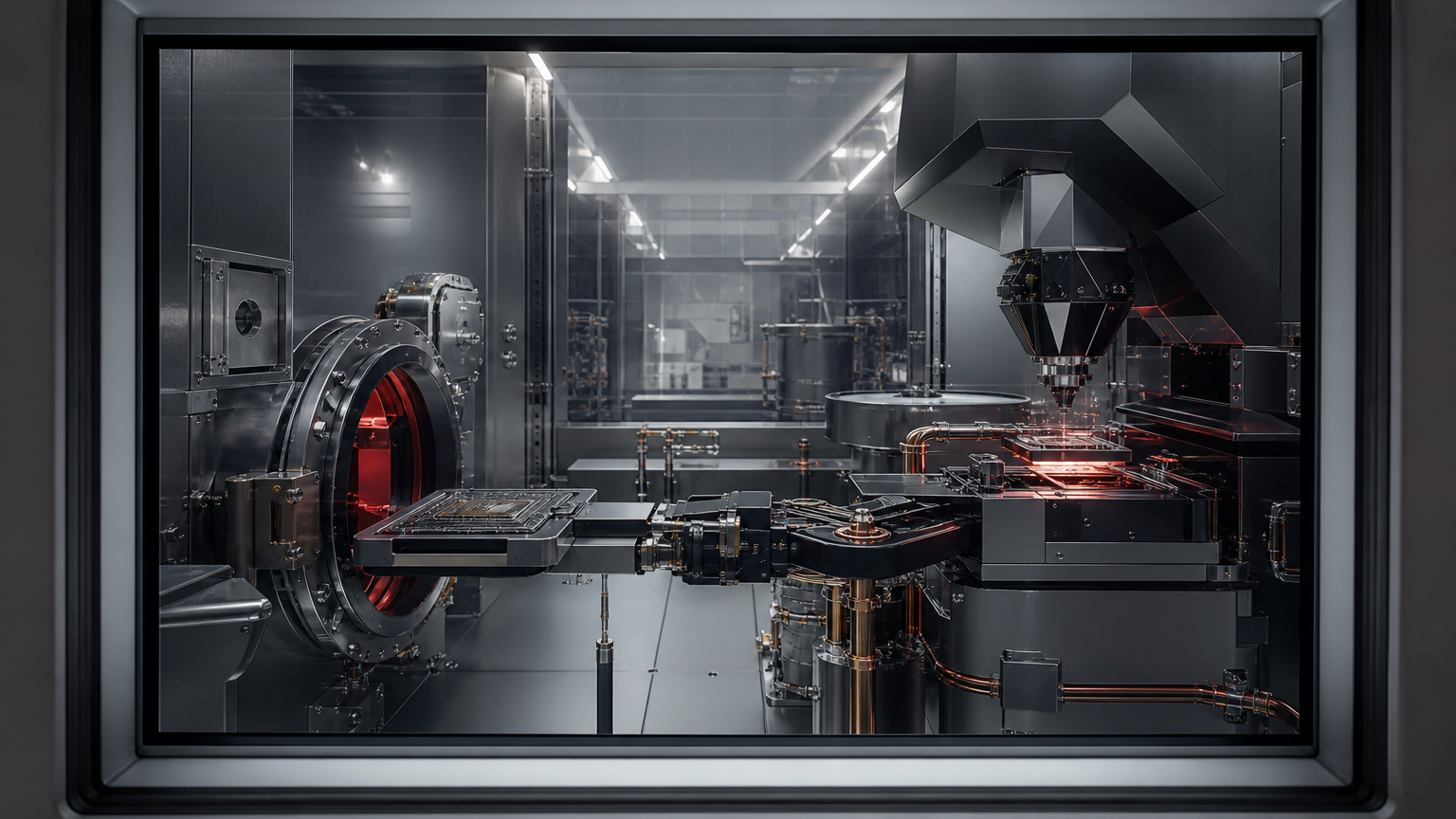
The Quantum Foundry Deal That Cleared Without Its Safeguards
A foundry changes hands
IonQ completed its acquisition of SkyWater Technology on July 31, 2026, bringing a major US semiconductor foundry inside a quantum-computing company. The transaction promises tighter coordination between design, fabrication and testing. It also places a supplier used by several quantum developers under the ownership of one of their competitors. That tension turned an industrial transaction into a live test of quantum supply-chain competition.
Two commissioners, two market theories
The Federal Trade Commission ended its review after Chairman Andrew Ferguson and Commissioner Mark Meador reached different conclusions. Ferguson said the deal could create short-term foreclosure and confidentiality risks. He favored an order covering equal access, information firewalls, switching assistance, arbitration and independent monitoring. Meador found the available record too weak to show likely competitive harm, pointing to other fabrication routes, low foreclosure shares and new public investment in domestic capacity.
The unresolved access question
The acquisition closed without those conditions. IonQ says SkyWater will retain its merchant-foundry model and continue serving customers. The public record therefore leaves a precise trusted foundry access question: whether commercial promises and ordinary contracts will preserve neutral treatment during the years before alternative US capacity becomes fully available. Quentir reads the split as an early signal that quantum industrial policy and antitrust are now operating on the same physical bottleneck.