
The A-Share Market's First Quantum Measurement Stock Is a Scientific-Instruments Business
In 1873 Ernst Abbe published the theory explaining why an optical microscope cannot resolve detail much finer than half the wavelength of the light it uses. The consequence landed in a workshop rather than a lecture hall. The Jena shop that had paid for Abbe's time — Carl Zeiss's — could now compute a lens instead of grinding its way toward one, and the Zeiss works became one of the leading suppliers of research microscopes to laboratories that wanted to see a bacterium, a metal grain or a crystal boundary. The theory was published for everyone. The instrument was sold.
Something with that shape happened on the Shanghai Stock Exchange on 11 August 2026, and it was reported almost everywhere as a quantum computing story.
Practical takeaway. The quantum company that just cleared a large public listing sells electron microscopes, spectrometers and gas adsorption analyzers. Its revenue is real and modest, its customers are laboratories and factories that will never run a quantum algorithm, and none of the 2026 quantum-specific instruments cited below is addressed to that business.
What the exchange actually listed
CIQTEK Co., Ltd. — 国仪量子 — was founded in Hefei in December 2016 by He Yu, then twenty-four, and Rong Xing, a faculty member at the University of Science and Technology of China, out of USTC's Key Laboratory of Microscopic Magnetic Resonance. It priced its STAR Market offering at RMB 21.22 per share, closed its first session at RMB 110.23 — a gain of 419.46 percent — and finished the day valued near RMB 44.1 billion, roughly USD 6.5 billion, on market coverage of the debut; the Shanghai statutory disclosure record carries the share count and issue price but leaves the first-day performance fields blank. The offering itself was smaller than most of the coverage suggested: 40.01 million shares at RMB 21.22 is gross proceeds of about RMB 849 million, and the RMB 1.17 billion figure repeated widely is the funding requirement stated in the prospectus, not the money raised. Chinese financial coverage described it as the A-share market's first quantum precision measurement listing, and as the second Hefei quantum company to go public after QuantumCTek's 2020 debut.
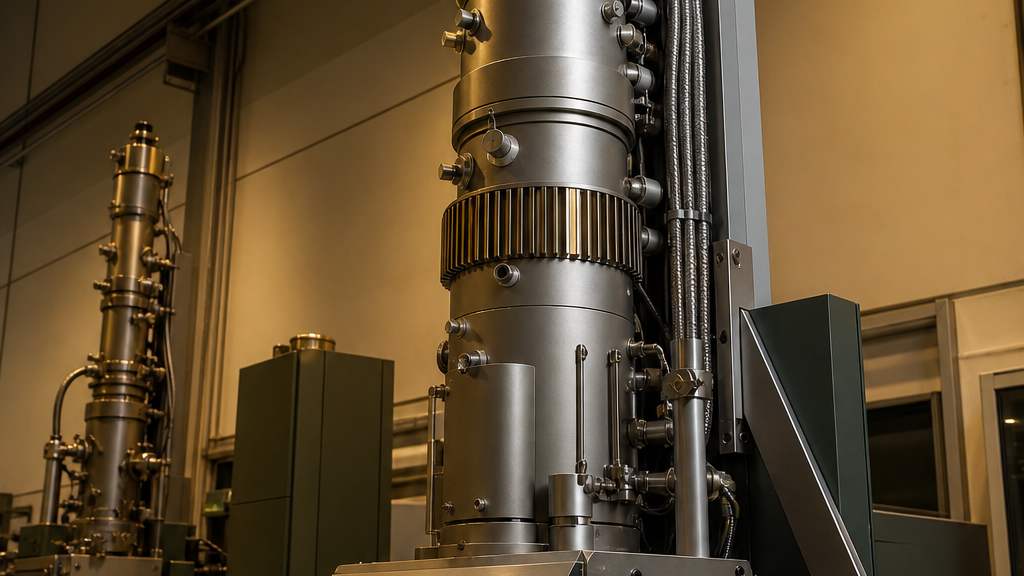
The product catalog behind that description is worth reading slowly. CIQTEK's own materials list focused-ion-beam and scanning electron microscopes, transmission electron microscopes, nuclear magnetic resonance spectrometers, electron paramagnetic resonance spectrometers, scanning nitrogen-vacancy microscopes, gas adsorption analyzers, and a measurement-while-drilling line for oil and gas exploration. The company reports more than 700 staff with about 40 percent in research and development, twelve research centers, more than 760 patents and software copyrights granted or pending, and more than 2,000 customers. Coverage of the listing named Tsinghua University, Peking University, the Chinese Academy of Sciences and Oxford among the research buyers, and the manufacturers BOE, BYD and CATL among the industrial ones. Those names, the first-day close, the capitalization and the 2025 revenue and loss all come from Chinese market coverage of the debut rather than from an exchange filing we have read; the statutory disclosure record supports the share count and the issue price. Treat the second set as reported, not as filed.
The financial shape is a manufacturer's. Revenue for 2025 was RMB 666 million against an adjusted net loss of roughly RMB 19 million, with the company telling investors it expects break-even as early as 2026. The proceeds are earmarked for industrialization of high-end scientific instruments, a research institute, and a network of application centers — the capital expenditure profile of a company that intends to build and service equipment at volume.
Why measurement is the part of the field that ships
Two things are being sold here, and they should not be run together. Electron microscopes, transmission microscopes and gas adsorption analyzers are conventional high-end laboratory instruments; their commercial maturity has nothing to do with quantum technology. The magnetic-resonance line — electron paramagnetic resonance, nuclear magnetic resonance and the scanning nitrogen-vacancy microscope — is where quantum behavior is the working principle, and there the physics explains something about the order in which products arrive.
Both a quantum computer and a spin sensor need coherence, and in both the environment destroys it. The difference is how long each one has to hold it. A useful computation must keep a fragile superposition intact across an entire algorithm — deep enough that error correction, and not qubit count, dominates the cost of the machine. Many of today's spin sensors hold their state for one short interrogation, read out the phase accumulated in the field or the shift in a resonance, and recover precision by repeating the measurement and averaging. Decoherence sets the ceiling on that precision; it is not the signal. Error-corrected and entanglement-enhanced sensing are active research subjects, and some quantum sensors need cryogenics or vacuum, so this is a statement about the instruments on a commercial price list rather than about quantum sensing in general.
A nitrogen-vacancy center in diamond works as a magnetometer on that basis, electron paramagnetic resonance reads unpaired electron spins in the same spirit, and nuclear magnetic resonance reads nuclear ones. The underlying theory is the body of quantum mechanics that also underwrites qubits. The engineering budget for a benchtop instrument, though, is a different order of problem, and one a manufacturer can meet today.
That difference in coherence budget, more than policy or capital, is part of why the measurement side of this company has paying customers now. The position is also durable in a way a roadmap is not. An instrument that works does not become obsolete when someone announces a better qubit.
Who actually buys these machines
Read the instrument list as a list of industrial questions and the customer base stops looking academic. Electron paramagnetic resonance detects unpaired electrons, which in practice means free radicals: electrolyte decomposition inside a lithium cell, polymer ageing, catalyst behavior, radiation dose in a sterilized product. Nitrogen-vacancy magnetometry maps magnetic fields at micron scale, which means current paths across a chip and defects inside a battery electrode. Electron microscopy and gas adsorption analysis sit inside essentially every materials qualification workflow that exists. CIQTEK names environmental science, biochemistry, semiconductor technology and materials science as its application fields, and those are how industry proves that what it built is what it intended to build.
This is the part with a public stake attached. Measurement equipment is the machinery by which a claim becomes checkable. Whether a battery cell degrades safely, whether a wafer carries the defect density the supplier certified, whether a drug substance has the polymorph on the label, whether a soil sample carries what the permit allows — each of those is a question that some laboratory answers with an instrument it bought from someone. A regulator, a hospital procurement office and a competitor auditing a rival's claim all depend on the same tools. Supply of those tools is therefore a quiet form of infrastructure, and it behaves like infrastructure: unremarkable until it concentrates.
Where the public instruments do and do not reach
Set the listing against what Western governments actually issued this year and the picture is uneven rather than empty.
On 21 May 2026 the US Department of Commerce announced non-binding letters of intent covering roughly USD 2.013 billion in proposed CHIPS incentives across nine companies, with the department to take a minority, non-controlling equity stake in each recipient as a condition of any award finalised: USD 1 billion proposed for IBM's Anderson, a 300mm quantum wafer facility in Albany that IBM would match dollar-for-dollar; USD 375 million for GlobalFoundries; USD 100 million each for Atom Computing, D-Wave, Infleqtion, PsiQuantum, Quantinuum and Rigetti; and USD 38 million for Diraq. We read the equity mechanics of that program against one recipient's own prospectus earlier this month. Nine intended recipients, and all nine are computing companies or their foundry.
Where measurement draws state money directly, it arrives through defence timing. DARPA selected IonQ on 6 August 2026 under its It's About Time program, and the numbers repay care: the award is USD 28 million covering manufacturing development and 25 Evergreen-05 optical atomic clocks, with a separate unexercised option worth USD 30 million for a further hundred. The widely repeated "125 clocks, USD 58 million" is the ceiling of an option, not the contract signed — a distinction we drew when we looked at what that program is really purchasing. On 14 August the Royal Navy published its own account of a trial in which Aquark cold-atom clocks timed a radar network through simulated jamming and spoofing.
Sensing is not, however, a policy blind spot as such. In June the European Commission approved EUR 76 million in support for manufacturing quantum-sensing semiconductor metrology and inspection systems, and Innovate UK has run a competition aimed squarely at the quantum-sensing and positioning-navigation-timing supply chain. We covered the acquisition side of that market ourselves in July, when sensing hardware changed hands under a named program. Governments are buying quantum sensing, and in some cases funding the tools that make chips.
The gap is narrower and more specific than "sensing is ignored". General-purpose laboratory instrumentation — the spectrometers, microscopes and adsorption analyzers that qualify materials for every industry — remains far less visible in these instruments than either computing or dedicated quantum-sensing programs. Spectrometers and electron microscopes are traded under the general scientific-instrument headings that long predate the quantum label, and they are rarely the named object of a quantum strategy, a subsidy line or a standards work item. The category the money and the rules recognize most readily is the quantum computer. The category with a shipping product, an industrial customer and a public listing is harder to find on the form.
How Quentir Reads It
The market has just paid roughly sixty-six times trailing revenue for a company whose own description of itself is a maker of high-end scientific instruments. Two readings are available. Either that multiple is a quantum-computing option premium that has landed on the wrong balance sheet, in which case it will compress. Or the buyers have priced something the policy documents have not: that in a field where the computers are still years from general usefulness, the durable position is supplying the equipment everyone else needs in order to check anything.
The Jena precedent argues for the second reading. CIQTEK's own account of itself is a domestic alternative in high-end scientific instruments, a segment long dominated by German, American and Japanese suppliers, and its use of proceeds — industrialization, a research institute, an application-center network — is written for that purpose. A listed, capitalized domestic manufacturer of electron microscopy, magnetic resonance and nitrogen-vacancy instruments is that objective arriving in the capital markets with a balance sheet to fund application centers and volume production. That is a slower and less visible form of leverage than a qubit record, and a considerably harder one to reverse.
For European and American institutions the exposure sits well away from the qubit race. It is concentration: the characterization equipment underneath battery, semiconductor and pharmaceutical qualification could consolidate into few enough hands to matter. Brussels and London have both funded quantum sensing and metrology tooling this year, so the sensing side is on someone's desk. The general-purpose instrument park in ordinary industrial laboratories is the part that still reads as procurement rather than as strategy. Our own running coverage of this field has spent most of the summer on computation, cryptography and procurement, and this listing is a reminder that the industrial base under all three is instrumentation. Every post we have published on the quantum industrial base, the equity programs, the standards calendars and the migration deadlines is available together under the All-access membership; the argument only works as an archive, because the pattern is only visible across months.
CIQTEK's share price will now do what a 419 percent debut normally does, and it will tell us very little. Two other numbers will: whether the instrument business reaches the break-even the company promised for 2026, and what share of that business is exported. And the question worth asking of the next national quantum strategy, whichever government publishes it: alongside its computing chapter and its sensing chapter, does it have a paragraph about who manufactures the ordinary laboratory instruments on which every other chapter's claims are checked?
Published intelligence, built to inform your own decisions. Published: August 16, 2026.
Sources. CIQTEK listing record, share count and issue price: Shanghai statutory disclosure for stock code 688828 (cnstock.com). First-day close, capitalization and 2025 financials: BigGo Finance market report, 11 August 2026 (finance.biggo.com). Gross proceeds of about RMB 849 million are computed from the issued share count at the issue price; the RMB 1.17 billion figure in circulation is the prospectus funding requirement. Product lines, staffing, research centers, patent count and customer count: CIQTEK company materials (ciqtekglobal.com, product catalog). US Department of Commerce letters of intent with nine quantum companies, 21 May 2026: NIST/Department of Commerce announcement (nist.gov) and Manufacturing Dive, 22 May 2026 (manufacturingdive.com). European Commission approval of EUR 76 million for quantum-sensing semiconductor metrology and inspection manufacturing, June 2026 (european commission, PDF); Innovate UK quantum-sensing and PNT supply-chain competition (innovate uk). DARPA It's About Time selection of IonQ, 6 August 2026, including the USD 28 million contracted scope and the unexercised USD 30 million option: IonQ company announcement (ionq.com). Royal Navy cold-atom clock and radar-network trial, published 14 August 2026 (royalnavy.mod.uk). Coherence and phase-accumulation behavior in quantum sensing: Degen, Reinhard and Cappellaro, Quantum sensing, Reviews of Modern Physics 89, 035002 (aps.org). Abbe's 1873 diffraction theory and his role at the Carl Zeiss works: Encyclopaedia Britannica, Ernst Abbe (britannica.com). Second Chinese financial account of the offering and its RMB 1.169 billion funding requirement: Phoenix Finance (ifeng.com). Public sources checked 16 August 2026.
Published intelligence, built to inform your own decisions. Published: August 16, 2026.