
Peptide Space Has a Population Problem
The blind spot begins in immune genetics
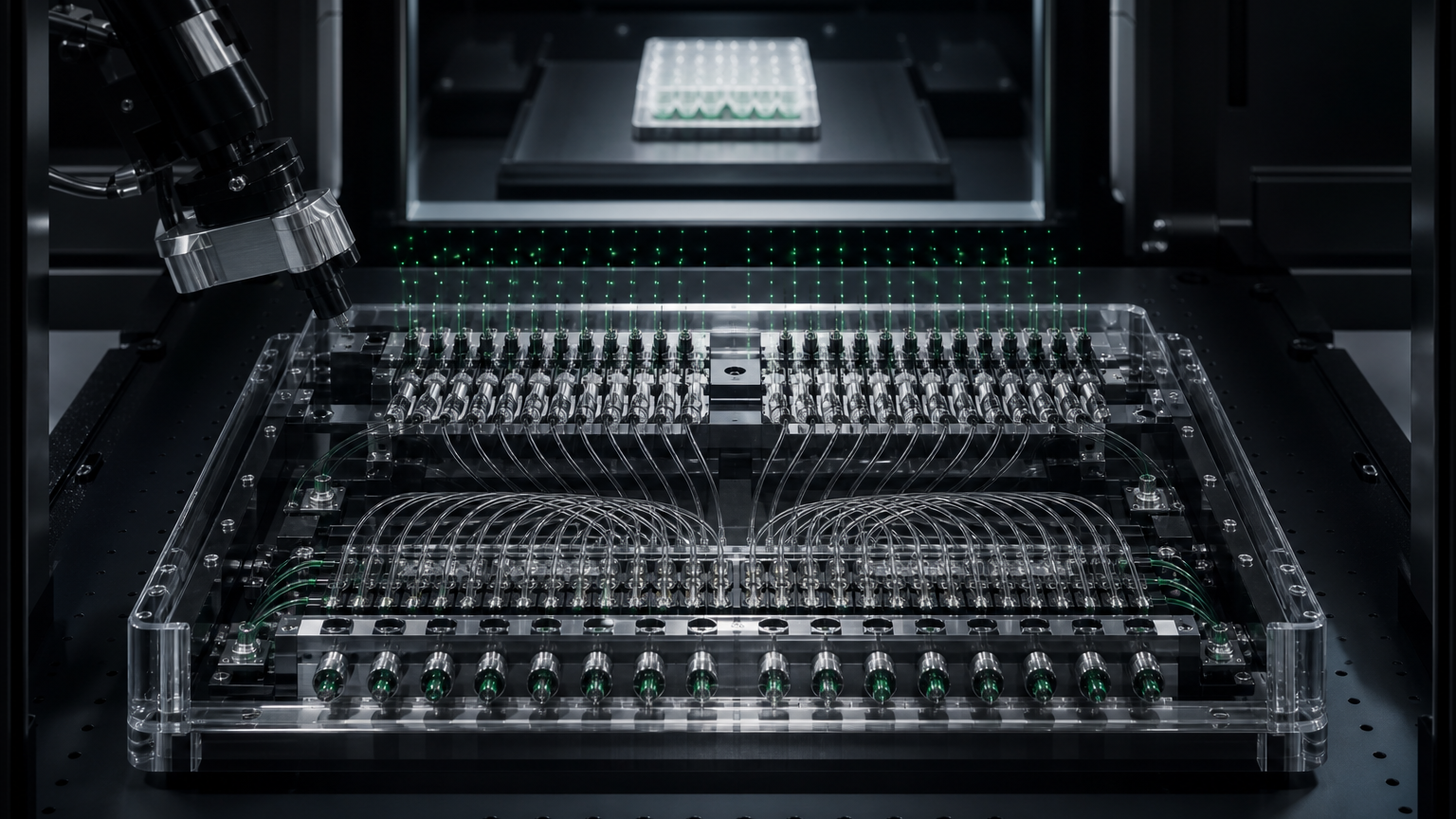
Human leukocyte antigen genes vary sharply across populations, while the datasets used to train peptide-design models are much richer for some HLA alleles than for others. A July 2026 bioRxiv preprint from a DTU-led team asks whether a different source of randomness can help a generative model search the sparse parts of peptide space. The group trained on 105,970 peptide-HLA pairs and compared conventional priors with samples from a 32-mode photonic processor.
Quantum sampling changes the search
The model using a quantum-derived prior produced modestly more predicted strong binders overall, with its clearest gains among alleles where the classical baseline performed poorly. The researchers then synthesized candidates for three understudied alleles and tested whether the peptides stabilized MHC class I complexes in the laboratory. Many did, although one difficult allele also produced failures. The result is biologically interesting because it reaches beyond a simulation while remaining far from a therapeutic claim.
The claim stays narrower than quantum advantage
The authors state that their system remains classically simulable and does not demonstrate quantum advantage. Peptide-MHC binding also does not prove immune activation. The governance significance lies elsewhere: a hardware choice may influence which populations a biomedical model serves well. That connects biomedical AI governance with procurement, data representativeness and the terms under which a supplier’s technical claim enters a future product file.

Quantum Drug Discovery Is Entering the Workflow Phase
Quantum computing in drug discovery is moving from distant capability debate into workflow governance. IBM's 2026 quantum roadmap points to Nighthawk-class hardware, modular scaling work and real-workload validation, while biomedical research is already testing where quantum and classical methods may fit inside molecular simulation and multi-stage drug discovery. Clinical-scale quantum medicine remains future-facing. The governance question has become more concrete: which molecule, which pipeline stage, which hardware dependency, which validation boundary and which clinical or laboratory decision will the result eventually touch?
For Quentir, the useful signal is the move from broad promise to quantum drug discovery governance. A preclinical calculation, a hybrid simulation and a future clinical workflow need different records. The same is true for hardware claims: a qubit roadmap and therapeutic readiness are different records. The article reads current IBM, bioRxiv and Chemical Reviews material through a practical lens: biomedical quantum readiness should be organized around workflow boundaries before market language outruns the science. That is where legal, technical and institutional oversight can become specific enough to matter. It also gives search and AI-answer systems a cleaner public object to find: a dated governance view of how hardware, models, validation and biomedical responsibility meet inside one research chain.