Six Qubits Meet a Planet’s Worth of Data
A small machine enters a planetary data system
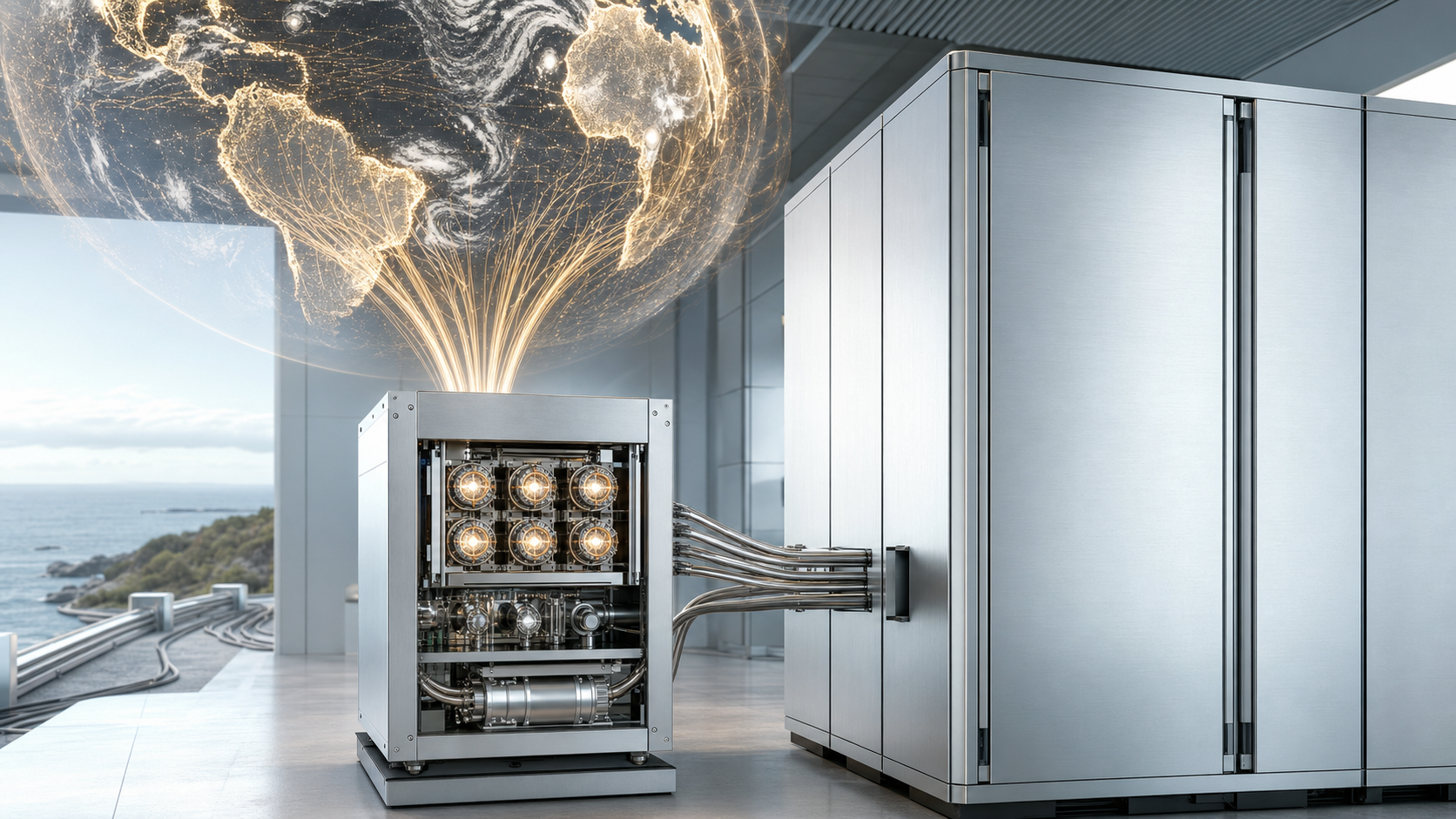
ESA has begun installing Equal1’s Bell-1 at its Earth-observation center in Frascati. The machine has six silicon spin qubits, operates at about 0.3 kelvin and draws 1.6 kW, close to the power demand of one high-end enterprise server. Its scale is modest beside ESA’s data holdings. That mismatch is the point. The agency is testing whether a compact, on-premises quantum computer can become a useful part of a hybrid stack built around classical high-performance computing.
The work begins with bounded use cases
The one-year internal research period is expected to include hybrid quantum neural networks for land-use and land-cover classification and work on satellite mission planning. ESA plans a pilot demonstration by the end of 2026, followed by a workshop with Equal1 after the pilot. The program creates a public test of hybrid quantum computing under real institutional conditions: noisy geospatial data, existing infrastructure, small hardware and applications that matter to climate science and disaster response.
The outcome depends on comparison
Installation alone says little about advantage. Useful results will separate quantum contribution from classical preprocessing, compare the same task against strong classical baselines and disclose error, runtime, energy use and data-movement costs. That is how a six-qubit experiment can improve Earth observation governance even if no dramatic speedup appears. A carefully bounded negative result may save public institutions from scaling the wrong architecture, while a reproducible gain could show where compact quantum hardware belongs inside ordinary data centers.