Six Qubits Meet a Planet’s Worth of Data
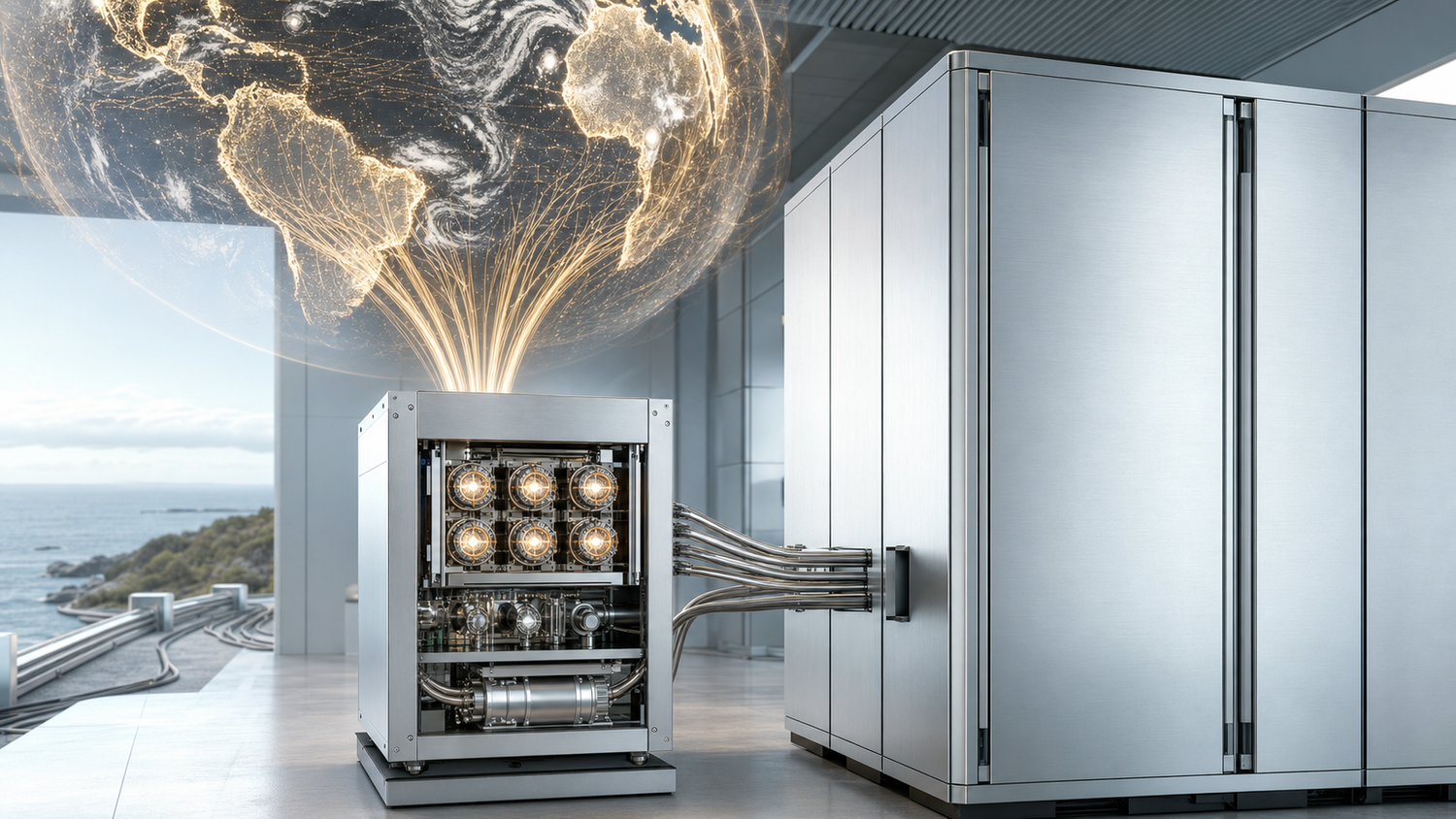
Six qubits have arrived to face a planet’s worth of data. The imbalance is almost comic. At ESA’s Earth-observation center in Frascati, satellites feed an institutional system built to watch coastlines, forests, weather, ice and the aftermath of disaster. Into that world comes Bell-1, a compact quantum computer with fewer qubits than a child has fingers.
Scale can mislead in both directions. Six qubits cannot carry the weight of Europe’s Earth-observation workload. They can still answer a useful institutional question: whether a quantum processor can earn a defined place inside a working classical data center. ESA’s July 15, 2026 account of the installation describes a one-year research period after commissioning, direct on-premises access and a pilot demonstration planned by the end of 2026. The proposed uses include land-use and land-cover classification and satellite mission planning.
Practical takeaway. ESA’s installation matters as a bounded public experiment. Its value will come from transparent comparisons, measured resource costs and a clear account of which part of a hybrid workflow the six-qubit processor actually improves.
A quantum computer moves into the data center
The project began with an agreement signed in November 2025. Equal1’s Bell-1 is now being installed at ESA-ESRIN, the agency’s center for Earth observation, inside the data center in Frascati. The arrangement is unusually concrete for a field still rich in remote-access demonstrations. ESA researchers will have the machine on premises, alongside the high-performance computing infrastructure that already supports their work.
The hardware choice makes that proximity possible. Bell-1 uses silicon spin qubits made through a complementary metal-oxide-semiconductor process, the manufacturing family behind ordinary computer chips. ESA says the processor operates at about 0.3 kelvin. That remains extraordinarily cold, yet it is warm enough to reduce some of the cooling burden associated with other quantum systems. A closed-cycle cooler fits inside a rack-mounted chassis. Reported power draw is 1.6 kW, roughly comparable to a high-end enterprise server.
Those details move the story away from a remote scientific instrument and toward infrastructure. Rack space, power, cooling, access control, maintenance and integration become part of the experiment. Procurement meets physics in the machine room. A compact footprint does not establish performance, but it changes the cost and organizational setting in which performance can be tested.
The pilot starts where the classical stack is strongest
ESA’s stated plan joins Bell-1 to classical high-performance computing. That matters because Earth-observation data arrive with the qualities that make current quantum computing difficult: the datasets are large, noisy and heterogeneous, while today’s devices are small and error-prone. Loading classical information into a quantum circuit can consume much of the hoped-for gain. Preprocessing, feature selection, circuit execution and postprocessing may each dominate the result.
Hybrid quantum computing is therefore an allocation problem. The pilot must decide which narrow operation belongs on the quantum processor and which work remains with CPUs or accelerators. A land-cover classifier, for example, may rely on classical systems to prepare satellite imagery and extract features before a small quantum circuit handles a bounded part of the model. Mission planning may isolate a compact optimization subproblem while classical software manages constraints, schedules and operational checks.
ESA’s program is valuable because these divisions can be observed inside one institution. The quantum machine does not need to replace the data center. It needs to improve a task after the full cost of moving data and coordinating systems is counted.
One year can expose the hidden cost of a result
The announced research period gives the program a clock. ESA plans a pilot demonstration by the end of 2026, and the machine is expected to remain available for internal research for one year after commissioning. The agency and Equal1 intend to share practical findings with the scientific community in a joint workshop after the pilot.
A credible benchmark has to follow the whole workflow. Accuracy and runtime are the obvious measures. Energy use, repeated-run stability, classical preprocessing, queue time, calibration burden and failed jobs also belong in the account. The relevant comparator is a well-tuned classical method running on infrastructure available to the same research team. If the quantum step appears faster while data preparation grows slower, the application may have moved cost without reducing it.
Quentir made a related point in its analysis of a trapped-ion Gibbs-state experiment: a result becomes meaningful when the machine is compared with the state or task it was asked to reproduce. ESA adds an institutional layer. A public pilot should make clear which result would justify continuation, which result would trigger redesign and which result would close the experiment.
Earth observation gives the experiment a civic edge
Satellite computation can sound remote until its outputs reach ordinary life. Land-cover maps inform agriculture and conservation. Weather models shape warnings. Disaster-response imagery can influence where rescuers look first and which roads appear passable. Climate records become part of public planning and scientific argument.
That civic role raises the standard for novelty claims. A small improvement in a research benchmark may be scientifically interesting without being operationally safe. Classification errors can have geographic and social patterns. Faster mission planning can still conflict with safety constraints or public priorities. Data provenance, reproducibility and human review remain necessary when an experimental component enters a chain that serves public decisions.
The humane stake is quiet but substantial. Better Earth intelligence can help communities prepare for floods, fires and crop stress. Poorly understood automation can create misplaced confidence at exactly the moment when people depend on an institution’s map or forecast. The pilot’s governance quality will be visible in how carefully ESA separates research promise from deployable capability.
How Quentir Reads It
The six-qubit count is the least interesting number in the announcement. The stronger signal is institutional: a European public agency is placing quantum hardware beside classical compute, giving it a time-bounded assignment and naming applications before scale-up. This turns “quantum readiness” into a test of integration, comparison and exit criteria.
The program also connects industrial policy with scientific restraint. Equal1 is an Irish quantum-hardware company building silicon devices designed for conventional racks. ESA supplies an application environment, public mission and path to shared findings. If the combination works, Europe gains knowledge about where compact domestic hardware can fit into critical data infrastructure. If it fails cleanly, the failure can still narrow future procurement and research choices.
Quentir’s All-access membership connects this post with the archive on quantum hardware, public pilots and institutional governance. The paid edition adds fixed scope, an executive summary, refresh triggers, a dated source spine and an internal-use license; this public analysis stays with the ESA experiment and one concrete integration question.
The machine is small enough to make discipline unavoidable
Grand claims often survive by remaining distant from the systems they are supposed to improve. Bell-1 is moving in the opposite direction: into a named data center, beside established computers, for a limited period and against applications that already matter. Its size leaves little room for theatrical substitution. The useful work will have to be narrow, measured and repeatable.
By the end of the pilot, the most important outcome may be a boundary. ESA could identify one operation where a compact quantum processor adds value, several where classical computing remains superior, and a set of engineering costs that future machines must reduce. That would be a serious result. Public technology programs mature when they can say where a machine belongs, where it does not, and what would have to change before the answer moves.
Sources: European Space Agency Φ-lab, “ESA’s first quantum computer will shift computing frontiers in space”, published July 15, 2026; European Space Agency, “Observing the Earth”, live applications index; Equal1, rack-mounted quantum-computing product and technology overview, accessed July 19, 2026. Public-source snapshot: July 19, 2026.
Published intelligence, built to inform your own decisions. Published: July 19, 2026.