A Cold-Atom Comagnetometer Reaches a Fitted 60-Second Spin-Coherence Time
Quentir Defense Monitor
Evidence-based insights for quantum defense and security. Published by Quentir Systems LLC · August 17, 2026.
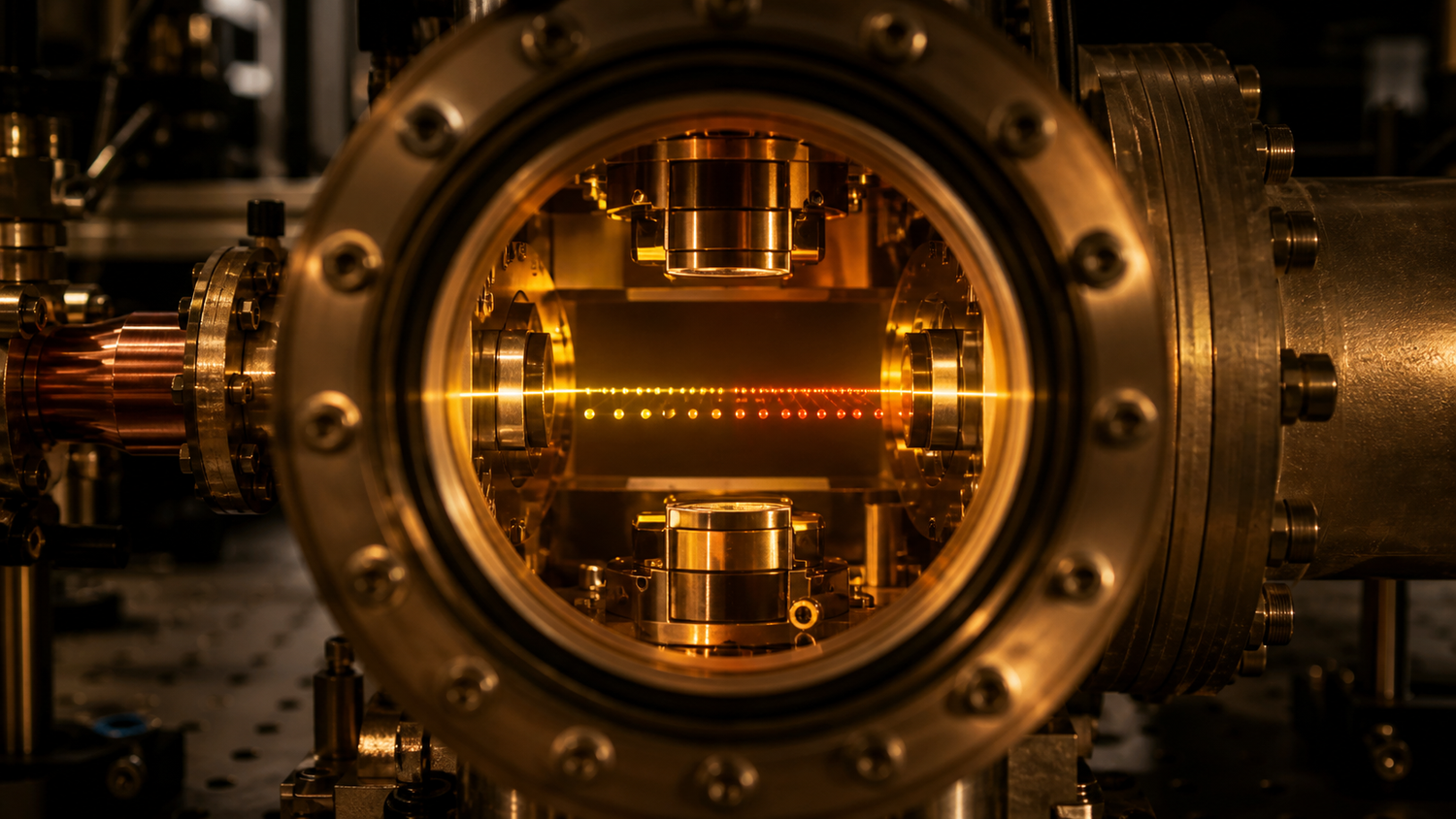
A new experiment holds the nuclear spins of two ytterbium isotopes in the same optical trap and reports a fitted spin-coherence time of sixty seconds, canceling magnetic noise by a factor of more than thirty thousand. That combination of a shared trapping region, quantum-controlled spin states and fitted minute-scale coherence moves a sensor architecture with a long navigation pedigree onto a fundamentally cleaner platform.
The result, posted to arXiv on August 14 by J.-L. Zhang, W.-T. Luo, Y. A. Yang, Y.-Q. Wang, T. Xia and Z.-T. Lu, is a cold-atom comagnetometer. The word matters. A magnetometer measures a magnetic field. A comagnetometer runs two different spin species in the same place at the same time so their shared magnetic environment can be subtracted away. In the combined signal, what is specifically magnetic in origin is strongly suppressed, leaving the couplings that act differently on the two species. Rotation of the apparatus is the practically important member of that family, which is why comagnetometers sit at the root of nuclear-spin gyroscope programs for navigation without satellites.
This paper does no navigating. It is a laboratory physics demonstration, aimed in its own framing at precision measurement and searches for physics beyond the Standard Model. The defense reading comes from the architecture it validates and the numbers it posts, which bear directly on a capability every force planner tracks: positioning without GPS when satellite signals are jammed, spoofed or gone.
What a comagnetometer cancels, and why that is hard
Spin-based magnetic sensing is one of the oldest quantum technologies in service. Devices that read atomic spins to sense magnetic fields date to the 1950s, as the U.S. National Institute of Standards and Technology notes in its overview of quantum sensing. The comagnetometer variant solves a different problem. For an inertial instrument, the magnetic field is noise. A nuclear spin precesses in response to the field, to platform rotation and to any exotic coupling all at once, and the field term is enormously larger than the others. Two co-located species with different magnetic moments let the instrument solve for the field and remove it, because the genuinely magnetic response scales with each species' moment while rotation shifts both precession frequencies equally.
The established way to build one is a glass cell of polarized gas, typically helium-3 with xenon-129 or a potassium-rubidium-neon system. Gas-cell comagnetometers work and have been engineered into compact nuclear magnetic resonance gyroscopes. They also carry structural systematics. The two gases occupy centimeter-scale volumes whose spatial distributions differ, so field gradients across the cell survive the subtraction. Wall collisions and collisional shifts limit coherence and drift. Those effects set the floor that decades of engineering have been sanding down.
The cold-atom version attacks the floor's origin. Trap both species in one optical lattice and they sample the same region, an architecture expected to reduce the differential-volume systematic. Cold atoms in vacuum touch no walls. And laser-controlled atoms offer expanded access to optical quantum control techniques. The cost has always been coherence: the trapping light itself shifts the spin states through vector and tensor light shifts, and those shifts kill exactly the long, quiet precession a comagnetometer needs. That is the specific obstacle this experiment clears.
What the ytterbium demonstration posts on the board
The team traps ytterbium-171, whose nucleus carries spin one-half, together with ytterbium-173, spin five-halves, in one optical lattice. Ytterbium is diamagnetic in its ground state, so the nuclear spins are naturally isolated from electronic magnetism. The paper reports that vector light shifts are suppressed by enforcing strictly linear polarization of the lattice light, while the tensor shift in ytterbium-173, which cannot be polarized away, is suppressed by preparing that isotope in a Schrödinger cat state, a quantum superposition engineered so the tensor term averages out.
With both shift channels controlled, the experiment runs Ramsey interferometry on the two isotopes simultaneously and reports a fitted spin coherence time of sixty seconds. The comagnetometer subtraction then delivers a magnetic noise suppression factor exceeding three times ten to the fourth, and as a metrological dividend the team determines the ratio of the two nuclear magnetic moments to a precision of four parts per million. Each number carries operational meaning for the sensor family. Coherence time sets how long a single measurement can integrate, and fitted minute-scale coherence is what turns a noisy spin into a precision instrument. The suppression factor is the depth of the magnetic cancellation, the quantity that decides how well a rotation signal could be separated from field noise. The moment ratio is the calibration constant any future instrument of this type would lean on.
Quantum pillar: sensing (inertial navigation and PNT). Use posture: dual-use. Technology readiness: TRL 4 of 9. The comagnetometer exists as a bench-assembled laboratory apparatus tested under controlled conditions, while rotation sensing, dynamic environments and any fieldable packaging remain undemonstrated for this platform.
The navigation lineage runs through exactly this architecture
The reason a defense reader should file this result under navigation rather than under laboratory curiosities is the direct line from comagnetometry to inertial sensing. DARPA's public account of its quantum sensing portfolio describes positioning, navigation and timing in GPS-denied environments as a foundational goal of its atomic-sensor investments, from chip-scale atomic clocks through the miniaturized gyroscopes and integrated timing-and-inertial devices of its micro-PNT efforts. That navigation goal is precisely why a spin system that suppresses magnetic fields while remaining sensitive to rotation is relevant to an inertial navigator that needs no external signal.
The use posture is honestly dual-use. An inertial instrument is guidance-neutral: the same rotation reading serves a submarine keeping its position under ice, an airliner crossing a jammed corridor, and a missile that has lost its satellite fix. Public disclosure changes nothing about that symmetry, and the paper itself makes no defense claims of any kind. What the demonstration shifts is the credibility of the cold-atom branch of the family tree. Before this work, the objection to cold-atom comagnetometry was concrete: light shifts would cap coherence far below the gas-cell state of the art. A fitted sixty-second joint-coherence time with the shifts engineered away demonstrates substantial mitigation of that specific problem on the bench, though it neither matches gas-cell state of the art nor establishes that light shifts no longer limit relevant operating regimes.
The same result also feeds the science mission it was built for. A comagnetometer with this noise floor is a search instrument for exotic spin couplings, the hypothesized feeble interactions that would signal physics beyond the Standard Model. Defense planners have seen this pattern before. The gravimeters and clocks now entering field trials spent their first decades as fundamental-physics instruments, and the migration from precision measurement to platform hardware is a well-trodden, slow road.
What stands between the bench and a platform
The distance from this apparatus to anything a program office could buy is long, and it is worth stating in parts. The experiment is a room of lasers, optics and vacuum hardware; nothing about it is packaged, ruggedized or power-budgeted. It measures no rotation: demonstrating an actual gyroscopic readout with a competitive drift figure on this platform is unclaimed and unproven. Operation on a moving vehicle, with vibration, temperature swings and platform dynamics, is a separate engineering campaign that gas-cell instruments have already survived and cold atoms largely have not. And the comparison that matters for procurement, drift per hour against fielded ring-laser and NMR gyroscopes at equal size, weight and power, cannot even be written down yet for this device.
None of that diminishes what is now on the public record. A sensing architecture central to satellite-free navigation has been shown to work on a platform that may reduce specific wall- and spatial-overlap systematics and offers greater quantum-control headroom, with a fitted minute-scale coherence time and a four-orders-of-magnitude magnetic rejection posted as measured facts. Buyers should treat the cold-atom comagnetometer as a validated laboratory instrument and an early entrant on the inertial-sensing readiness ladder, several rungs below anything deployable. Watchers of the field should note which laboratories and funding agencies pick the thread up, because a demonstrated rotation measurement would provide important readiness evidence and is the natural next paper.
Sources
Primary source: J.-L. Zhang, W.-T. Luo, Y. A. Yang, Y.-Q. Wang, T. Xia and Z.-T. Lu, "Cold-atom comagnetometry via optical control of spin states," arXiv preprint, August 14, 2026. Context: DARPA quantum sensing feature and NIST Quantum Sensing Explained.