A Quantum Fluid Solver Gets an Exascale Reality Check
Quentir Defense Monitor
Evidence-based insights for quantum defense and security. Published by Quentir Systems LLC · August 11, 2026.
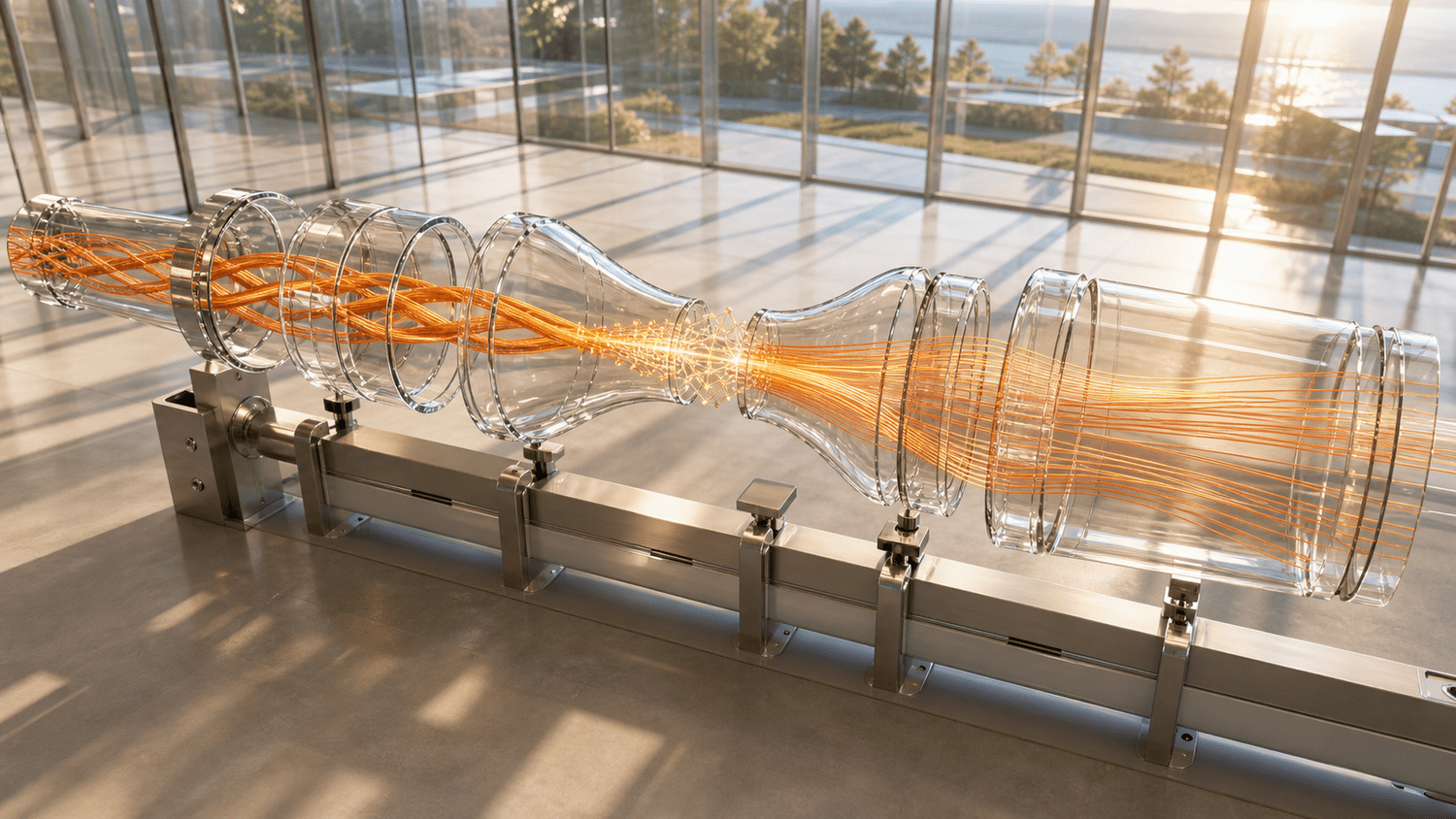
On August 10 a team at Oak Ridge National Laboratory posted a paper that reads less like a pitch and more like an audit. In Memory-, Circuit-, and Ansatz-Efficient VQLS for CFD on Hybrid Quantum-HPC Systems, Chao Lu and four colleagues take the leading near-term quantum algorithm for solving linear systems, wire it into an end-to-end pipeline for computational fluid dynamics, and run the whole thing on Frontier, the exascale machine that currently does this work the classical way. Then they publish the bill: which encoding step eats memory, which circuit choices matter, what actually converges, and where the pipeline stalls.
A defense reader should care about this accounting for one plain reason. Fluid dynamics is the workhorse discipline behind every airframe that flies fast, and its computational appetite has been an acknowledged wall for a decade. NASA's CFD Vision 2030 study, written by authors from Boeing, Stanford, MIT and Pratt & Whitney, set out exactly this problem: physics-based prediction of turbulent, transitional and reacting flows "across a broad Mach number regime" demands computing that outruns what even the largest machines routinely deliver. High-Mach design work leans on that prediction hardest, because wind tunnels that reproduce sustained hypersonic heating are scarce and flight tests are counted in single digits per year. Any technology that could someday move that wall gets read as a defense technology, whatever its authors intend. This paper is a sober measurement of how far one candidate actually is from doing so.
What the Oak Ridge team actually built
The algorithm at the center of the study is the variational quantum linear solver, published in 2023 by Carlos Bravo-Prieto and colleagues in the journal Quantum. VQLS is a hybrid method for the oldest problem in scientific computing, solving a linear system Ax = b, and it exists because the textbook quantum approach demands circuit depths far beyond present hardware. VQLS instead trains a shallow parameterized circuit, with a classical optimizer in the loop, until the circuit prepares a state proportional to the solution. Since discretized fluid equations reduce to exactly such linear solves, repeated thousands of times per simulation, a solver of this kind is the natural doorway through which quantum computing would enter aerodynamics.
The Oak Ridge study names three obstacles that have kept that doorway theoretical, and works each one with engineering patience. The first is memory. Before a matrix can meet a quantum circuit it must be decomposed into a weighted sum of unitary operations, and the standard Pauli-basis route explodes in cost as the grid grows. The team benchmarks four encoding strategies and reports that a fast Walsh-Hadamard transform approach cuts peak memory by a factor of up to 1,298 on an 11 by 11 flow grid, while a two-term decomposition built on the singular value decomposition delivers a per-iteration speedup beyond 10,000-fold over the standard route at eight qubits. The second obstacle is circuit design guesswork. They train eleven ansatz families, the candidate circuit shapes a variational method must choose among, and find that the metrics the field usually reaches for, expressibility and entanglement, "correlate only weakly with VQLS convergence." The rules of thumb, in other words, do not predict which circuits solve flow problems well. The third obstacle is the absence of end-to-end demonstrations on production machines, which is the gap the Frontier supercomputer fills here: the full workflow ran on the same exascale system, first on the TOP500 list in 2022, that carries flagship classical simulation workloads today.
The numbers, and what they are numbers about
The concrete results deserve to be stated with their qualifiers attached, because the qualifiers are the story. The pipeline solved a Hele-Shaw flow problem, a canonical configuration in which the Navier-Stokes equations simplify to coupled linear partial differential equations, on a 4 by 4 grid, reaching a solution fidelity of 0.999438. It handled structured tridiagonal test systems at sizes up to 2 to the 15th power, a 15-qubit problem, on a single Frontier node. In a separate eight-qubit fidelity validation, fidelity exceeded 0.9999 once the circuit carried four or more layers. The top-performing circuit families converged in under 40 optimization steps. And every one of those quantum circuits was emulated on Frontier's classical AMD hardware, with no quantum processor anywhere in the loop. The authors are direct about this, listing "real quantum-hardware execution alongside the HPC simulator" as future work, and equally direct that no single encoding strategy won across problem sizes.
Read together, the numbers say something specific: the classical scaffolding around a quantum flow solver, which was quietly the binding constraint, can be engineered down by orders of magnitude, and the remaining costs can now be measured rather than argued about. What the numbers do not say is that a quantum computer has solved a flow problem of engineering interest. A 4 by 4 grid stands to a design-grade simulation roughly as a paper airplane stands to an airframe.
Quantum pillar: simulation (hypersonics and aerodynamics). Use posture: dual-use. Technology readiness: TRL 3 of 9. The full solver pipeline ran end to end as working software on small model flow problems, with every quantum circuit emulated on Frontier's classical processors rather than executed on quantum hardware.
What a force would eventually do with this
The capability question is worth walking through concretely, because a linear solver benchmark does not announce its military meaning the way a radar or a warhead does. Design authority over high-speed flight runs through simulation. A vehicle that sustains Mach 5 and above lives inside a regime of shock layers, boundary-layer transition and surface heating where small prediction errors become structural failures, and where ground-test facilities cannot hold the full flight condition for more than seconds. Programs on every side of that competition, and their counterparts designing interceptors against such vehicles, buy their margins with hypersonic flow simulation on machines like Frontier. A solver family that eventually cut the cost or raised the fidelity of those linear solves would compress design cycles, widen the space of shapes a program can afford to explore, and sharpen the aerothermal models that decide how much thermal protection a vehicle must carry. The same mathematics prices the radar cross-section of a duct, the mixing in a scramjet combustor and the plume a sensor hunts for.
The honest posture reading is dual-use, and the provenance of this work argues the point on its own. The paper comes from a civilian science laboratory operated by UT-Battelle for the Department of Energy, and the identical solver serves an airliner wing, a wind farm wake study, a reentry capsule and a glide vehicle without changing a line. Nothing in the method points at an adversary's systems; nothing in it is restricted to protecting one's own. What a reader has to weigh is who gains from cheaper aerodynamic truth, and the answer is every design bureau at once, civil and military, on whatever timeline quantum hardware permits. That symmetry is exactly what the dual-use label is for.
Between a benchmark and a wind tunnel
The distance between this result and anything a program office would rely on is long, and the paper itself marks most of the road. The demonstrated problems are linear by construction: Hele-Shaw flow is the special case in which the hard nonlinear terms of real aerodynamics vanish, and a tridiagonal Toeplitz matrix is a mathematician's idealization. Genuine high-Mach flow is turbulent, reacting and coupled to structural heating, and mapping it onto quantum linear algebra multiplies overheads this study does not yet touch. The quantum processor in the loop was classical emulation, which caps honest readiness at experimental proof of concept, working software exercised on stand-in data. The input and output problem stands untouched here as well: loading a full flow field into quantum amplitudes, and reading a full field back out, carries costs that can consume the advantage a solver earns in between. And the finding that standard circuit-design metrics fail to predict convergence cuts both ways, removing a bad compass without yet supplying a good one; the authors point toward physics-informed circuit construction as the next step.
None of that makes the work small. Twelve years passed between the CFD Vision 2030 study's diagnosis and this paper, which provides an honest inventory of what a quantum-HPC fluid pipeline costs on Frontier. A reader tracking the field should watch three things next. Whether the Oak Ridge group's stated follow-on, execution on real quantum hardware beside the Frontier simulator, materializes and at what qubit count. Whether the memory-efficient encodings transfer from structured model matrices to the irregular systems real meshes produce. And whether anyone demonstrates a nonlinear flow problem, however tiny, end to end. Those are the checkable milestones between a promising audit and a technology a design bureau would schedule around, and until they land, the classical exascale machine remains the only place aerodynamic truth gets manufactured.
Sources
Primary source: Chao Lu, Muralikrishnan Gopalakrishnan Meena, Eduardo Antonio Coello Perez, Kalyana Chakravarthi Gottiparthi and Seongmin Kim (Oak Ridge National Laboratory), "Memory-, Circuit-, and Ansatz-Efficient VQLS for CFD on Hybrid Quantum-HPC Systems," arXiv:2608.09661, August 10, 2026; context from the Oak Ridge Leadership Computing Facility's Frontier documentation, the founding VQLS paper in Quantum, and NASA's CFD Vision 2030 study.