A Quantum Lidar Reads Multiple Directions at Once
Quentir Defense Monitor
Evidence-based insights for quantum defense and security. Published by Quentir Systems LLC · August 15, 2026.
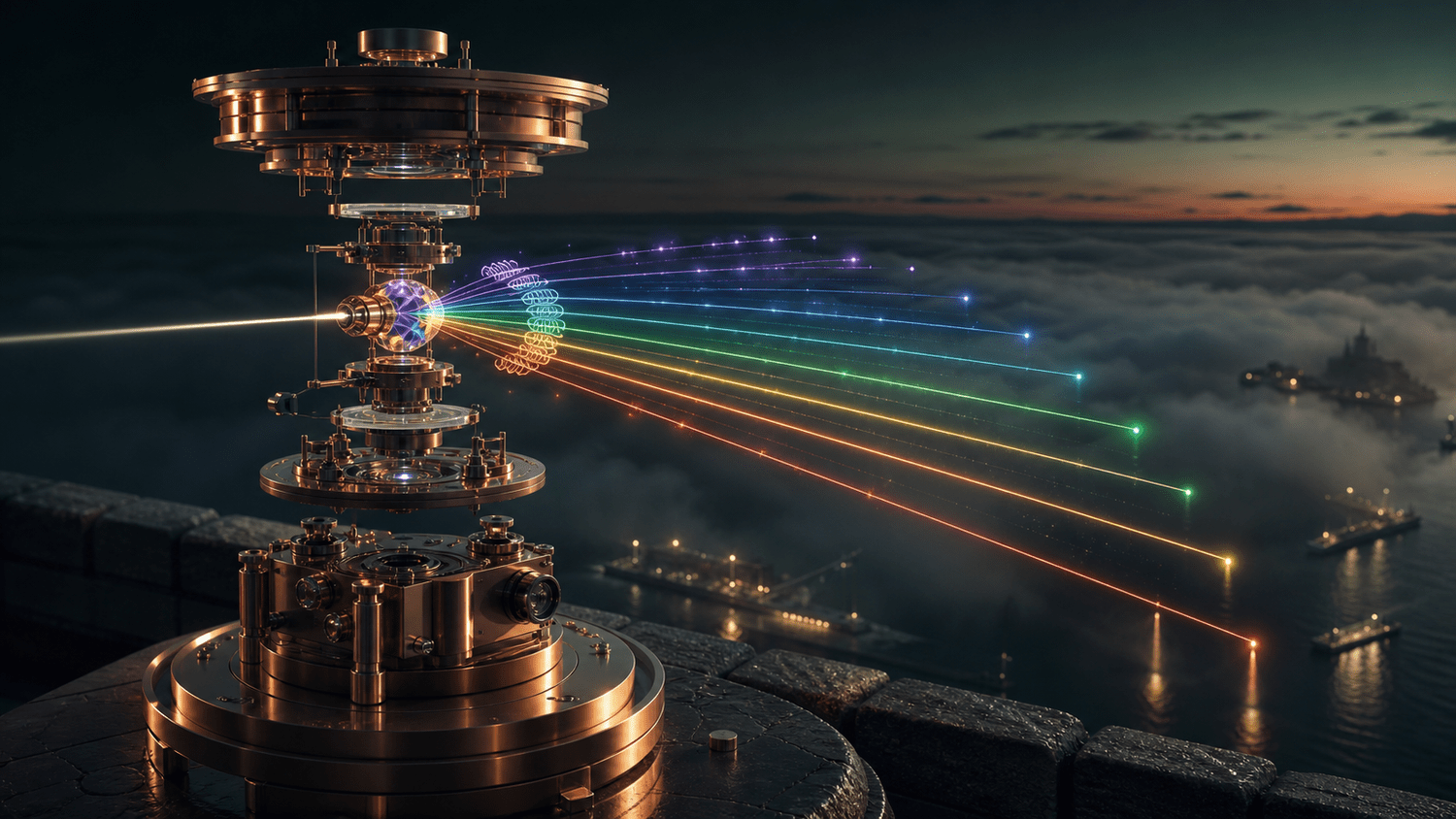
A physics team at POSTECH in South Korea has demonstrated a lidar that reads the range and bearing of several targets in a single measurement, in conditions where the surrounding background light runs a thousand times stronger than the echoes it is trying to catch. The coverage is a finite fan of multiple directions, not omnidirectional or "every-direction" coverage. The work was funded in part by the Agency for Defense Development, South Korea's military research agency, which is reason enough for a defense reader to slow down and ask what was actually shown.
Conceptual illustration, not a field trial: the experiment did not test operation in fog.
The result appeared in July in the journal Laser & Photonics Reviews under the plain title "Parallel Multi-Target Detection for Quantum LiDAR," from the group of Heedeuk Shin, with Junyeop Kim as first author. The claim is specific and checkable. Using pairs of correlated photons, the instrument located multiple reflectors in range and direction at the same time, with a signal-to-background advantage over a comparable classical receiver that grows as conditions get noisier, reaching roughly a thousandfold in the reported measurements. Coverage in the Korean trade daily etnews adds the provenance detail that matters for this readership: the project ran under the Agency for Defense Development's future-challenge defense technology effort, alongside a university ICT research grant.
Lidar itself needs no introduction in a defense context. It ranges obstacles for autonomous vehicles, maps terrain from aircraft, and increasingly hunts small drones that radar struggles to separate from clutter. Every one of those jobs gets harder when the sensor must stay quiet, because a beam bright enough to overpower daylight is also bright enough to reveal the platform carrying it. The interesting part of this paper is that it attacks exactly that corner of the problem, and does so with a genuinely new architecture rather than an incremental gain.
Twin photons carry their own receipt
The design rests on a quantum light source that emits correlated photon pairs, with a nonzero chance of producing more than one pair. Inside a nonlinear medium, pump photons occasionally convert into two daughter photons through a process called spontaneous four-wave mixing, and each pair is born sharing tightly linked properties. The two frequencies add up in a fixed way, and the two photons leave the source at the same instant. One photon of each pair, the probe, flies out toward the scene. Its twin, the herald, stays inside the instrument.
Two pieces of ordinary optics turn that correlation into a direction reader. The outgoing probe passes through a diffraction grating, which bends light by wavelength, so a probe born at one wavelength departs along one bearing while a probe born at a slightly different wavelength departs along another. The herald meanwhile travels through a long dispersive fiber that delays it by an amount set by its wavelength. Reading the herald's arrival time therefore reveals the pair's wavelength, and the wavelength names the direction its twin flew. Every photon that returns from the scene carries, through its twin, a receipt saying where it went and when it left.
The same pairing does the noise filtering. Background light arrives at random moments and has no partner inside the instrument, so it almost never lines up with a herald detection inside the tight coincidence window the electronics apply. Echoes from real targets do line up. Counting only the coincidences strongly suppresses uncorrelated light, and that is how the team pulled clean range and bearing readings for several reflectors out of a background a thousand times brighter than the signal. The photon pairs are doing double duty, steering the survey and vouching for every return.
From a scanning flashlight to a standing stare
Many lidar systems in service work like a flashlight in a dark room, pointing at one bearing at a time and sweeping. That serial habit costs time, and against several moving objects it costs track continuity, because the beam is always somewhere else when one of the targets does something interesting. The POSTECH instrument holds many directions open at once. Each probe photon picks its bearing at random through its wavelength, so the fan of directions is interrogated in parallel and the returns are sorted afterward by their heralds, with no active or mechanically scanned beam-steering stage; the diffraction grating passively maps wavelength to bearing. In a single acquisition the experiment resolved the range and the direction of multiple reflectors together, something a sequential scanner can only assemble over several passes.
The second property worth noticing is how little light the method needs. A sensor that must stay unnoticed while it measures cannot afford a bright beam, and at very low photon numbers a classical receiver drowns in ambient light. Correlation filtering moves that floor, and the paper's measurements show the advantage growing precisely as the background gets worse. That is a regime relevant to possible future covert ranging applications: weak deliberate illumination, strong ambient light or deliberate optical clutter, and a requirement to still resolve several objects at once. Whether the method can operate below an opponent's detection threshold would require validation against an adversarial receiver at operational range and in a realistic propagation environment. The lead professor keeps the frame modest, telling Korean press the system stands at the principle-verification stage, and the honest reading of the paper supports both the novelty and the modesty.
Quantum pillar: sensing (quantum radar and lidar). Use posture: dual-use. Technology readiness: TRL 3 of 9. The team ran a benchtop experiment on real hardware that verified the working principle, several steps short of a validated laboratory instrument and far from anything a force could field.
What a force could do with a parallel stare
Read as capability, the published result points toward a possible future sensor that could range and resolve several small objects at once using weak illumination in daylight or other noisy-background conditions. Whether it could watch without announcing itself, operate below an opponent's detection threshold, or function under active optical interference requires further validation. The coincidence method suppresses statistically uncorrelated background light, but the reported experiment does not establish general resistance to blinding or spoofing: sufficiently bright illumination can produce accidental coincidences, saturation or detector dead time, while synchronized or correlated signals fall outside the stated reasoning. A counter-drone picket, a periscope search, or a debris-tracking space sensor could fit that shape if those capabilities are validated. Who gains runs honestly down both sides of the ledger. The physics serves an observer trying to find platforms another force intends to keep concealed, and it equally serves a defender who needs perimeter awareness or navigation in settings where emitting a bright beam invites a strike. That is a dual-use posture in the plain sense of the term, and the funding line from a military research agency shows at least one defense establishment reads it the same way.
History supplies the caution. Quantum illumination, the theory behind a decade of quantum radar headlines, promises a real advantage that turns out to be modest, and Jeffrey Shapiro's widely read account of that story concludes that the practical value of the microwave version is severely limited once realistic hardware enters the picture. A 2023 assessment in the JAPCC journal, written for NATO air power planners, lands on the same posture: microwave quantum radar presently looks unfeasible, while space-based quantum lidar in the optical regime remains viable only in the medium-to-long term. The POSTECH work lives on the plausible side of that line. It operates at optical wavelengths, where correlated pairs are comparatively easy to generate and detect, and compared with quantum-illumination experiments built around scanning architectures, it adds coverage of many directions at once instead of paying the quantum advantage back through slow scanning.
The distance between this bench and a program office
The limits are stated in the paper rather than hidden, and they are substantial. The signal-to-background improvement is real and large, yet the absolute signal-to-noise ratio of the demonstration remains below one, because the source brightness and the heralding efficiency, meaning the fraction of probe photons whose twin is actually caught, are still low. In plain terms, the instrument distinguishes true echoes from noise very well, and it still needs long integration times to gather enough of them to act on. A bench experiment with laboratory reflectors also says nothing yet about kilometer-scale range, about turbulence, fog or rain along a real optical path, or about the size, weight and power budget a mast-mounted or airborne sensor would have to meet. Those are the gaps between an elegant proof of concept and an instrument a test squadron could bolt to anything.
For a program office the readiness picture is early and clean. What exists today is a verified working principle on real hardware, with laboratory validation of an integrated instrument still ahead, then realistic-environment trials, then anything a procurement decision could lean on. The signals worth watching over the next few years are brighter pair sources, heralding efficiencies climbing toward useful absolute sensitivity, an outdoor demonstration at tactically relevant range, and whether the Agency for Defense Development carries the work from a university grant into a named development effort. Low-light sensing is a sub-branch where public, checkable results are rare, and this one is both public and checkable, which is precisely why it earns a briefing. The sources establish a clever and genuine capability step. They establish nothing yet about a deployable sensor, and a buyer should hold both statements at once.
Sources
Primary source: Junyeop Kim, Dongjin Lee, Woncheol Shin, Yeoulheon Seong and Heedeuk Shin, 'Parallel Multi-Target Detection for Quantum LiDAR,' Laser & Photonics Reviews, July 2026 (DOI 10.1002/lpor.71592); supporting material from the Korean trade daily etnews, Jeffrey Shapiro's 'The Quantum Illumination Story' (arXiv:1910.12277), and the JAPCC journal's 2023 assessment of quantum technology for the air and space domains.