
Kaspersky's Operation FlashHole Report, 21 October 2026: Lazarus Wraps LPEClient Payload Delivery in Four ML-KEM-1024 Key Exchanges Against South Korean Firms, TRL 9
Kaspersky's Securelist report of 21 October 2026 on Operation FlashHole shows the Lazarus Group's LPEClient tool receiving four ML-KEM-1024 public keys, deriving four shared secrets and decrypting its next payload with a 128-byte Threefish key, in a campaign against at least three South Korean software, construction and telecom-equipment firms since July 2025; the company's press release traces the group's use of the mechanism to September 2024. This post reads the development as an offensive post-quantum cryptography capability on the harvest-now-decrypt-later branch: what an intrusion unit gains when captured command-and-control traffic stays closed to future decryption, how the same four-key construction appeared in Check Point's August 2026 Dream Job report, and what the ML-KEM-1024 malware finding leaves unproven for a program office, at TRL 9.
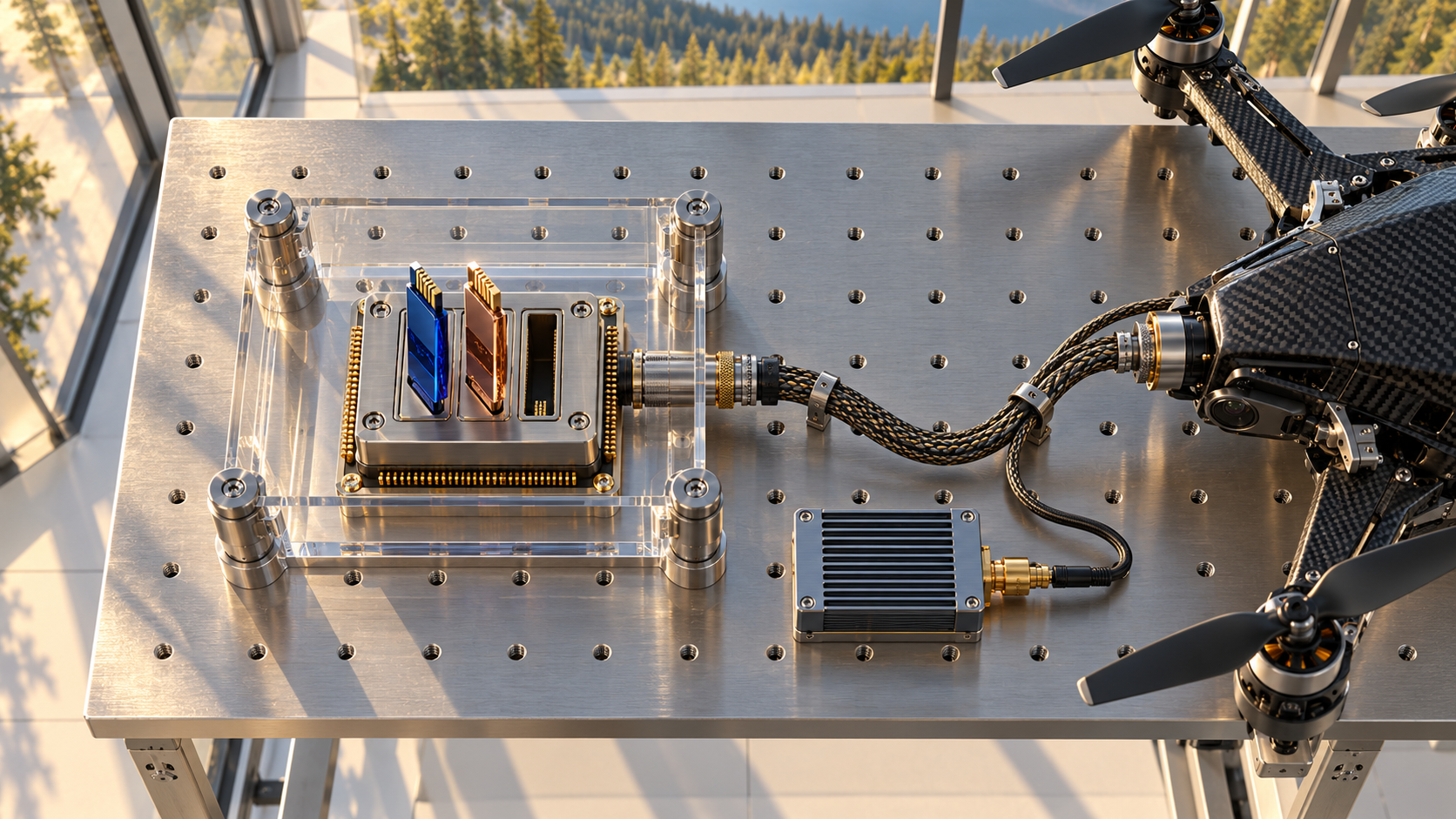
IDEMIA and KT Put NIST and KpqC Post-Quantum Algorithms on One SIM for South Korea's Defense Pilot, 26 October 2026: What a Secure-Element Root of Trust Changes for Tactical Endpoints
IDEMIA Secure Transactions said on 26 October 2026 that it is implementing both the NIST algorithms and South Korea's KpqC algorithms on a quantum-resistant SIM for KT's post-quantum pilot for the Ministry of National Defense and the Army Information and Communication School, covering drones and ground control stations, CCTV and video storage, user PCs and 5G segments. This post reads the announcement as a defensive post-quantum cryptography capability: what a secure-element hardware root of trust would let a force do with tactical endpoints it already owns, why two algorithm families on one chip is the point, and what validation, conformance and performance evidence still separates a vendor release from a program office.

South Korea's Science Ministry Expands the Open Quantum Testbed Into a Nationwide QKD Network by 2028, 21 October 2026: KT and SK Broadband, Overseas Hubs in Singapore, Poland and Bulgaria
South Korea's Ministry of Science and ICT opened its Open Quantum Testbed Advancement and Expansion Project on 21 October 2026: a nationwide quantum key distribution test network reaching Daegu, Gwangju, Busan and Gangwon by 2028, run by KT and SK Broadband consortia on 7.4 billion won in 2026, with overseas hubs linking Singapore, Poland and Bulgaria. The release pairs QKD on short sections with post-quantum cryptography on the long international haul, and KT adds a wireless QKD target of 15 kilometers. This post reads the program as a defensive networking capability: what it would let a Korean agency do, who gains, and which milestones a buyer should ask for before 2028.
South Korea's DAPA Orders a Concept Study on Quantum Computing for Battlefield Prediction and Asset Optimization, 8 October 2026: What It Will Benchmark and Why It Has No TRL Yet
On October 8, 2026 South Korea's Defense Acquisition Program Administration ordered a concept study on quantum computing for battlefield prediction and asset optimization. It will type the computational problems of defense, compare classical methods, quantum simulators and hybrid environments on the same representative problems, and design a defense quantum computing benchmark with a non-sensitive standard problem family and synthetic data. The agency names the two obstacles itself, data input and output and the cost of transforming the problem, and the post lays out the classical baseline questions a program office should hold until the comparison is run. Technology readiness: not assessed, the announcement concerns a study, with insufficient evidence to assess a specific system.

A Quantum Lidar Reads Multiple Directions at Once
A POSTECH team funded by South Korea's Agency for Defense Development demonstrated a quantum lidar that resolves multiple targets across a finite fan of directions in one measurement—not omnidirectional coverage—through background light a thousand times stronger than the signal. An early-stage low-light sensing result that establishes no field or fog performance.