A Zero-Shift Strontium Clock Clarifies the Timing Path
Quentir Defense Monitor
Evidence-based insights for quantum defense and security. Published by Quentir Systems LLC · August 4, 2026.
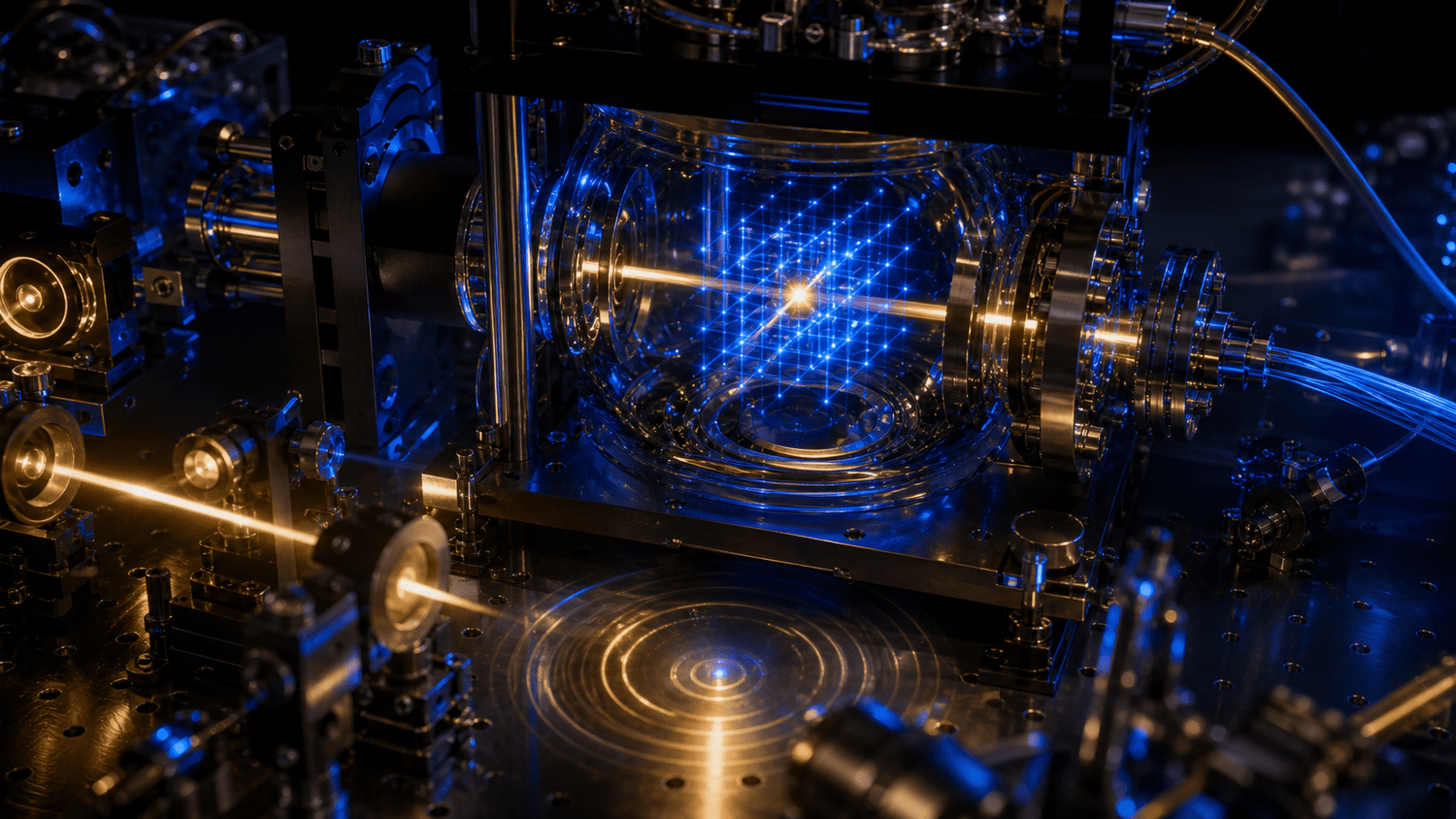
An Italian metrology team has measured how collisions among strontium atoms pull an optical clock away from its reference frequency, then found operating points where that shift cancels. The result gives clock builders a better-controlled laboratory instrument, while the hard work of turning that control into resilient field timing remains ahead.
Researchers at Italy's Istituto Nazionale di Ricerca Metrologica used bosonic strontium-88 atoms in one-dimensional and two-dimensional optical lattices. Their primary paper by J. P. Salvatierra and colleagues reports a nonlinear dependence between atom density and clock frequency. In the two-dimensional lattice, the team canceled the interaction-induced shift close to the clock's optimal sensitivity point by choosing the interrogation detuning and atomic density together.
That is a checkable optical lattice clock result. It is also a narrow one. The apparatus stayed in a metrology laboratory, the paper studied one systematic frequency shift, and its intended scientific applications include isotope-shift measurements and many-body physics. The defense relevance comes from the larger timing problem: forces need precise local time when satellite signals are unavailable or untrusted, and every uncontrolled clock shift consumes part of the error budget.
Atom collisions can move a clock's tick
An atomic clock takes a stable transition between two energy states as its reference. A laser interrogates the atoms, and the measured response tells the control system how closely the laser frequency follows that transition. Counting cycles of the disciplined light produces time. NIST's explanation of atomic clocks connects that physics to navigation and synchronized networks, where a frequency error accumulates into a timing error.
Optical lattice clocks confine ultracold atoms in a standing wave of laser light. The lattice reduces motion-related disturbances and lets the clock interrogate many atoms together. More atoms can improve measurement statistics, yet they can also collide. Those interactions slightly change the energy levels that define the clock transition, shifting the reported frequency as the population or excitation condition changes.
Bosonic strontium has a relatively simple atomic structure and potentially long coherence times. Its strong s-wave interactions have also made density-dependent shifts and loss of coherence difficult to suppress. Clock builders can reduce multiple occupancy, spread atoms through a three-dimensional lattice, or operate at lower density. Each choice brings a cost in signal strength, apparatus complexity, or exposure to other systematic effects.
The new experiment makes the collision behavior visible across a much wider operating range. The team varied total atom population from roughly one thousand to one hundred thousand atoms. It compared a one-dimensional lattice with a two-dimensional lattice that confined the atoms more tightly. In the two-dimensional geometry, multiply occupied lattice tubes produced an asymmetric Rabi line shape and a measurable interaction sideband, a spectral fingerprint of collective many-body behavior.
The researchers then changed the point on the Rabi resonance used to lock the clock. In the two-dimensional lattice, the measured interaction shift crossed zero at a lock detuning of 32(1) hertz, close to the region of strongest clock sensitivity. The result matters because cancellation at an impractical operating point would solve one error while damaging the clock's ability to read its transition. Here, the useful operating region and the cancellation point were close.
The one-dimensional lattice behaved differently. Density-induced dephasing modified the shift and moved its zero crossing to a less attractive interrogation setting. A dissipative mean-field model fit those observations better than a unitary spin model. This comparison is valuable engineering evidence: lattice geometry and collisional dynamics determine whether a correction remains useful under the clock's real operating conditions.
The defense capability is a local time reference that holds
Precision timing is infrastructure for PNT. A receiver normally draws time from satellite signals and uses it to calculate range. Networks use a common time base to align data and sensing. A force that loses the external reference needs local clocks whose error grows slowly enough to sustain the mission until another trusted update becomes available.
DARPA's Robust Optical Clock Network program states the defense requirement directly. Its portable-clock track seeks timing for distributed coherent sensing on airborne or spaceborne platforms. Its transportable-clock track seeks month-long holdover of GPS-quality time for land or seaborne use. Both tracks also impose size, weight, power, autonomous-operation, and environmental-sensitivity constraints.
The strontium result addresses one small source of drift inside that larger stack. If atom number changes between cycles, an uncontrolled density shift can move the clock frequency. A measured nonlinear model and an experimentally demonstrated zero crossing give designers another way to reduce that sensitivity. The method could also permit a useful atom population without accepting the corresponding collisional bias.
For defensive use, the benefit is resilient timing for one's own platforms and networks when an adversary disrupts or deceives satellite navigation. The published method does not create a navigation solution and does not show jam resistance. It improves control of a laboratory frequency reference that could eventually sit inside such a solution.
The posture is dual-use because the same clock physics serves national timekeeping and telecommunications. Geodesy, fundamental science, and defense PNT also benefit. The paper contains no platform trial and no military integration, so the defensible claim is that a relevant error mechanism became measurable and controllable in the laboratory.
The U.S. Government Accountability Office's quantum-sensor assessment places this result in a broader transition picture. GAO identifies atomic clocks as an established quantum-sensor application and navigation without GPS as a future opportunity. It also identifies reliability and cost as obstacles, alongside technology transfer and workforce limits. A laboratory correction method answers only part of that list.
Quantum pillar: sensing (clocks and timing). Use posture: dual-use. Technology readiness: TRL 4 of 9. The assembled strontium clock produced repeatable laboratory measurements, while no realistic platform or environmental trial was reported.
The clock still has to survive outside metrology
TRL 4 is meaningful because real atoms were measured through assembled hardware and interleaved frequency comparisons. The researchers report about 3 times 10^-16 statistical uncertainty after one thousand seconds of integration. They estimate interaction parameters in both lattice geometries and compare the measurements with explicit models. Those are laboratory results rather than a resource estimate or a simulation of hardware that does not exist.
Readiness does not transfer automatically from the clock's physics to a fieldable timing unit. The experiment's relative frequency instability was limited mainly by local-oscillator phase noise and a duty cycle of roughly four percent. The system also depends on ultracold atom preparation and controlled optical lattices. Stable interrogation lasers add demands. So do vacuum hardware and diagnostics. A deployable package must preserve enough performance through motion and shock under thermal change and constrained power.
The paper's zero-shift point also needs robustness evidence. A buyer would want to know how cancellation moves with changes in atom loading and temperature. Lattice depth and laser alignment also vary over long periods, along with excitation fraction. The reported two-dimensional result is promising because cancellation occurs near a sensitive operating point. Long-duration repeatability and recovery after disturbance would show whether an automated controller can stay there.
System architecture matters just as much. A platform clock needs a local oscillator and optical frequency conversion. Control electronics must connect its self-diagnostics to the navigation or network timing system. It also needs a startup sequence and a credible holdover specification. The clock may improve a reference while the surrounding electronics or distribution link dominates the final error.
Supply and service burdens will shape defense value. Specialized lasers and optical coatings can limit availability even when the underlying measurement performs well. Vacuum components and trained operators add constraints. A compact package also has less room for vibration isolation and thermal management. Program offices therefore need evidence at the subsystem boundary, where frequency performance meets maintainability and platform constraints.
What a buyer should ask to see next
The next useful artifact is a long-duration automated run that varies atom population and environmental conditions while tracking the residual frequency shift. It should report how often the controller reacquires the operating point, how uncertainty grows during interruptions, and which calibration steps still require an expert. Repeated runs across more than one apparatus would expose unit-to-unit variation.
A later milestone should place an integrated clock package in a realistic timing experiment. The comparison needs an independent reference and a stated holdover interval. Results should separate the atomic reference from the local oscillator and electronics. Time-distribution contributions also need their own accounting so a buyer can see which subsystem sets the limit. Environmental conditions and power consumption belong beside the frequency data.
For a defense program, the decisive measure will be mission-level timing error under representative platform conditions. That could support local navigation continuity, network synchronization, or a distributed sensor architecture, depending on the system. The public sources justify those capability directions without establishing that this strontium apparatus is ready for any of them.
Salvatierra and colleagues have shown that a troublesome collision-driven shift in a bosonic strontium clock is nonlinear and geometry-dependent, yet controllable. Their two-dimensional lattice reaches zero shift close to a useful interrogation point. That narrows a real technical uncertainty for GPS-independent timing. Packaging and autonomy remain open, as do holdover and realistic-environment performance.
Sources
Primary source: J. P. Salvatierra, M. Barbiero, G. Bertaina, D. Calonico, F. Levi, and M. G. Tarallo; other material from the U.S. National Institute of Standards and Technology, DARPA, and the U.S. Government Accountability Office.