Chicago Shows Quantum Links Can Share Busy Fiber
Quentir Defense Monitor
Evidence-based insights for quantum defense and security. Published by Quentir Systems LLC · August 2, 2026.
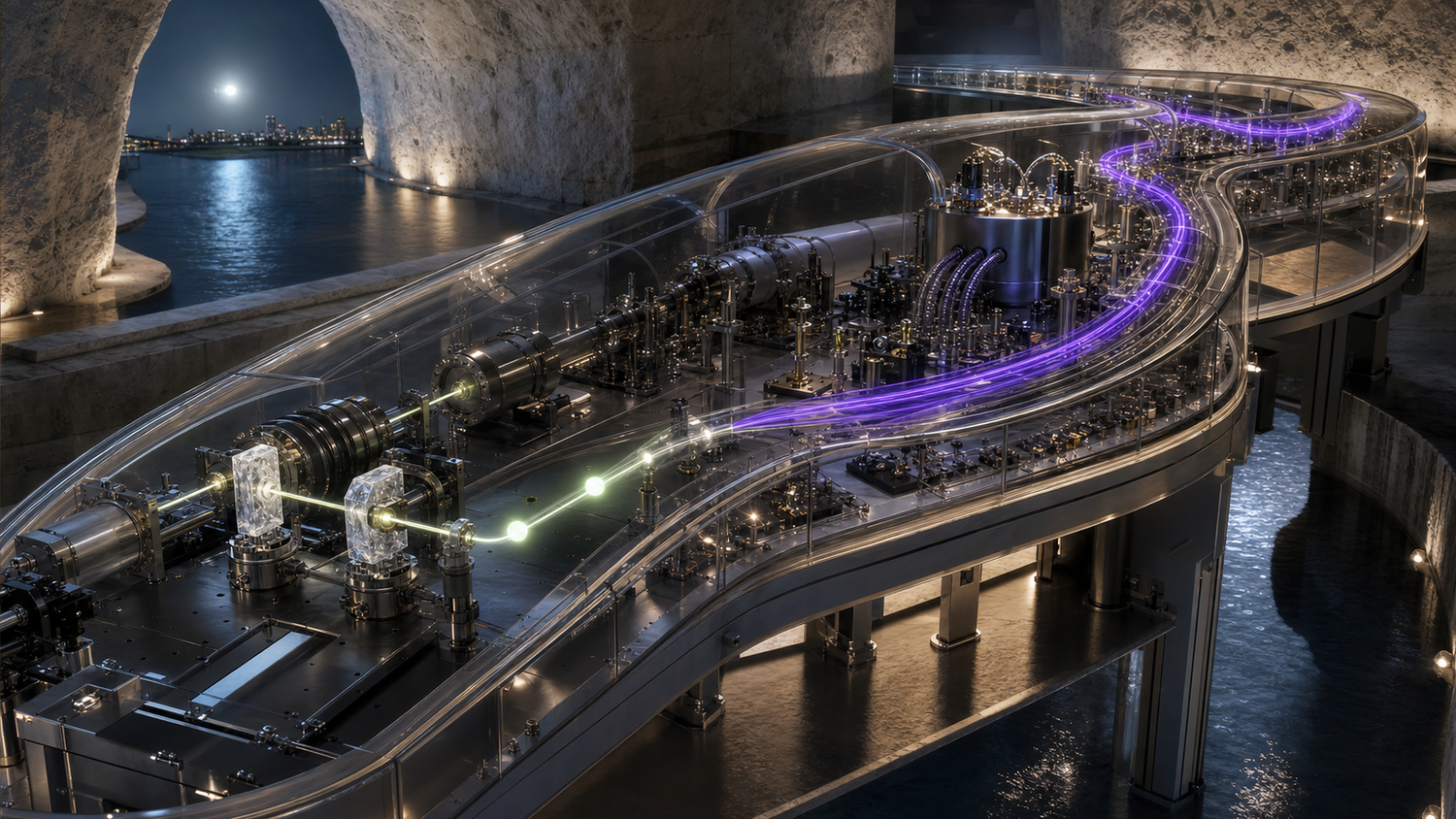
A quantum network will rarely receive an empty cable and a forgiving environment. It will have to coexist with the ordinary traffic and timing systems already inside a communications estate, along with its maintenance practices and ownership boundaries. A new metropolitan experiment gives program offices unusually concrete evidence about one part of that transition.
Researchers led by Gina M. Talcott at Northwestern University distributed polarization-entangled photons over 24.4 kilometers of installed fiber between Evanston and Chicago. The same fiber carried two 800-gigabit-per-second classical data channels, additional optical power representing a fully loaded C-band system, and a separate optical synchronization signal. The primary paper by Talcott and colleagues reports Bell-state fidelity above 94 percent under that load.
This is a meaningful quantum networking result because the test joined physically separated, synchronized nodes over deployed infrastructure. The authors measured the optical noise created by the classical channels, selected a quieter wavelength for the quantum signal, and filtered the received light. They then compared quantum performance with and without the heavy classical load. The experiment establishes coexistence on one metropolitan link. It does not establish a routed network, quantum repeater, key-distribution service, or operational communications system.
One fiber carried three very different jobs
The engineering problem begins with scale. A classical optical channel uses many photons. An entanglement-based link must recover correlations between individual photons against noise produced inside the glass. Powerful C-band traffic creates spontaneous Raman scattering across other wavelengths, and those stray photons can reach the quantum detector as false events.
The Northwestern team separated the functions by wavelength. The entangled photon traveled at 1290 nanometers in the O-band. The conventional traffic occupied the C-band, with an aggregate launch power of 21.4 dBm across a 4.9-terahertz span. A bidirectional signal in the L-band carried timing. Narrow filters and wavelength-division components isolated the quantum channel at the receiver.
That choice came from measurement rather than a clean-room assumption. The researchers mapped Raman noise across the O-band and found that shifting the quantum channel from 1310 to 1290 nanometers cut the measured noise by about a factor of six. The trade is slightly greater transmission loss at the shorter wavelength. For an integrator, the result is a real design relationship: wavelength allocation and filter width must be budgeted together with link loss and launch power, plus detector background.
The timing layer matters just as much. The two endpoints used White Rabbit synchronization with roughly five-picosecond root-mean-square jitter, allowing matching photon detections to be identified across the separated sites. Picosecond synchronization is therefore part of the demonstrated assembly, rather than an invisible laboratory convenience. Any future network that connects sites owned by different organizations will need to preserve that timing performance through routine configuration changes and faults.
The researchers also made a useful distinction in the classical load. Two channels carried 1.6 terabits per second of actual data, while amplified spontaneous emission filled the rest of the C-band to reproduce the optical power and noise profile of a commercial system capable of supporting much more traffic. The paper supports coexistence under the tested optical load. It does not show 36 terabits per second of live user data moving beside the quantum channel.
The capability is shared quantum infrastructure
The Northwestern account of the experiment confirms the physical route, the StarLight communications exchange endpoint, and fidelity above 94 percent. It also identifies the next planned step as quantum teleportation between remote nodes. That sequence helps a buyer read the current result accurately: entanglement distribution has crossed a realistic infrastructure test, while transfer of an unknown quantum state across this metropolitan arrangement remains future work.
For a defense estate, the immediate capability is architectural. Quantum-classical coexistence could let protected facilities and laboratories explore entanglement services alongside data centers and test ranges, without procuring a separate fiber path for every link. Reusing installed infrastructure can reduce civil works and give experiments access to existing ducts and exchanges, plus their monitoring and repair processes. It also creates dependencies on classical-network configuration and on organizations that control those assets.
The use posture is dual-use. Civil research networks and telecommunications operators gain a route toward shared quantum infrastructure. Defense users could apply the same foundation to entanglement-based key establishment, interconnection of quantum processors, clock-linked instruments, or distributed sensing. A force protecting its own communications and sensing estate could gain resilience or stronger tamper evidence. The identical transport layer could also support measurements and processing that improve intelligence collection. The paper demonstrates transport physics, leaving each application and its advantage to later systems.
Quantum pillar: networking (entanglement distribution and repeaters). Use posture: dual-use. Technology readiness: TRL 5 of 9. The assembled link handled installed metropolitan fiber and realistic telecom traffic, while routing, repeaters, and an end service remain untested.
A working link is still far from a network
The Department of Energy's explanation of quantum networks and their building blocks sets out the next scale problem. Photons cannot be copied and amplified like classical signals. DOE therefore identifies entanglement-based repeaters, multi-hop routing, and error correction as priorities for extending range. None of those functions appeared in the Chicago demonstration.
Loss is the first constraint. The paper reports a 24.4-kilometer point-to-point fiber and two endpoints. A wider estate would add connectors and patch panels; optical switches; longer spans; and variable loss. Each element reduces successful photon detections or adds background. Repeaters will eventually need quantum memories and entanglement swapping coordinated by control logic across multiple links. A low-noise single span is necessary evidence, yet it cannot predict the rate or availability of a multi-hop service.
Operations create a second constraint. The experiment used carefully selected filters and superconducting nanowire single-photon detectors, together with precision timing equipment and a characterized optical line system. A deployable service must tolerate maintenance and fiber rerouting; channel additions and amplifier changes; temperature shifts; and outages. Its monitoring system must distinguish an attack or component fault from an ordinary network reconfiguration without overwhelming operators with alarms.
Security evaluation must include the complete implementation. Quantum protocols can reveal certain disturbances in the quantum state. Sources and detectors remain ordinary attack surfaces. The same applies to timing and control software, plus management interfaces and classical authentication. The coexistence result says the entangled photons survived the tested optical environment. It supplies no security evaluation of a service built from those components.
The U.S. Government Accountability Office's technology assessment of quantum computing and communications identifies collaboration and workforce, together with investment and supply chains, as factors governing transition. Those issues are visible here. A shared link crosses photonics and carrier networking; cryogenic detection and timing; security engineering; and facilities operations. It may also cross contractual boundaries between a mission owner and network operator, with component vendors adding another layer.
What a program office should ask to see next
The next evidence package should begin with repeatability. The test team should report entanglement fidelity and successful-pair rate, plus detector background and uptime across days of changing classical traffic. Planned channel additions and amplifier adjustments would show how much optical reconfiguration the quantum lane can absorb. Recovery behavior after a loss of synchronization should be measured alongside best-case performance.
A second test should introduce a switch or intermediate node. That would reveal insertion-loss and control-plane costs before a full repeater is available. A later experiment should perform entanglement swapping between independently generated pairs, then quantify end-to-end rate and fidelity. These steps would move the evidence from one compatible link toward entanglement distribution as a network service.
An acquisition team will also need the full resource envelope: detector cooling and rack space; power and fiber types; filter tolerances and timing interfaces; calibration intervals and spares; plus specialist labor. The current apparatus occupied research sites with expert support. Availability measured during unattended operation would be more informative than a short successful run for any program considering persistent service.
The Chicago result deserves attention because it retires a practical question with measured evidence. Entangled photons can remain usable across installed metropolitan fiber while that fiber carries a heavy, broadband classical optical load and its own precision timing signal. The result narrows one infrastructure risk. The harder network questions remain visible and testable: multiple hops and switching; repeaters; application performance; security assurance; and sustained operation under real maintenance conditions.
Sources
Primary source: Gina M. Talcott, Ahnnika I. Hess, Laura d'Avossa, Scott J. Kohlert, Fei I. Yeh, Jim Hao Chen, Joe J. Mambretti, Tim M. Rambo, Gregory S. Kanter, Jordan M. Thomas, and Prem Kumar; other material from Northwestern University, the U.S. Department of Energy, and the U.S. Government Accountability Office.